

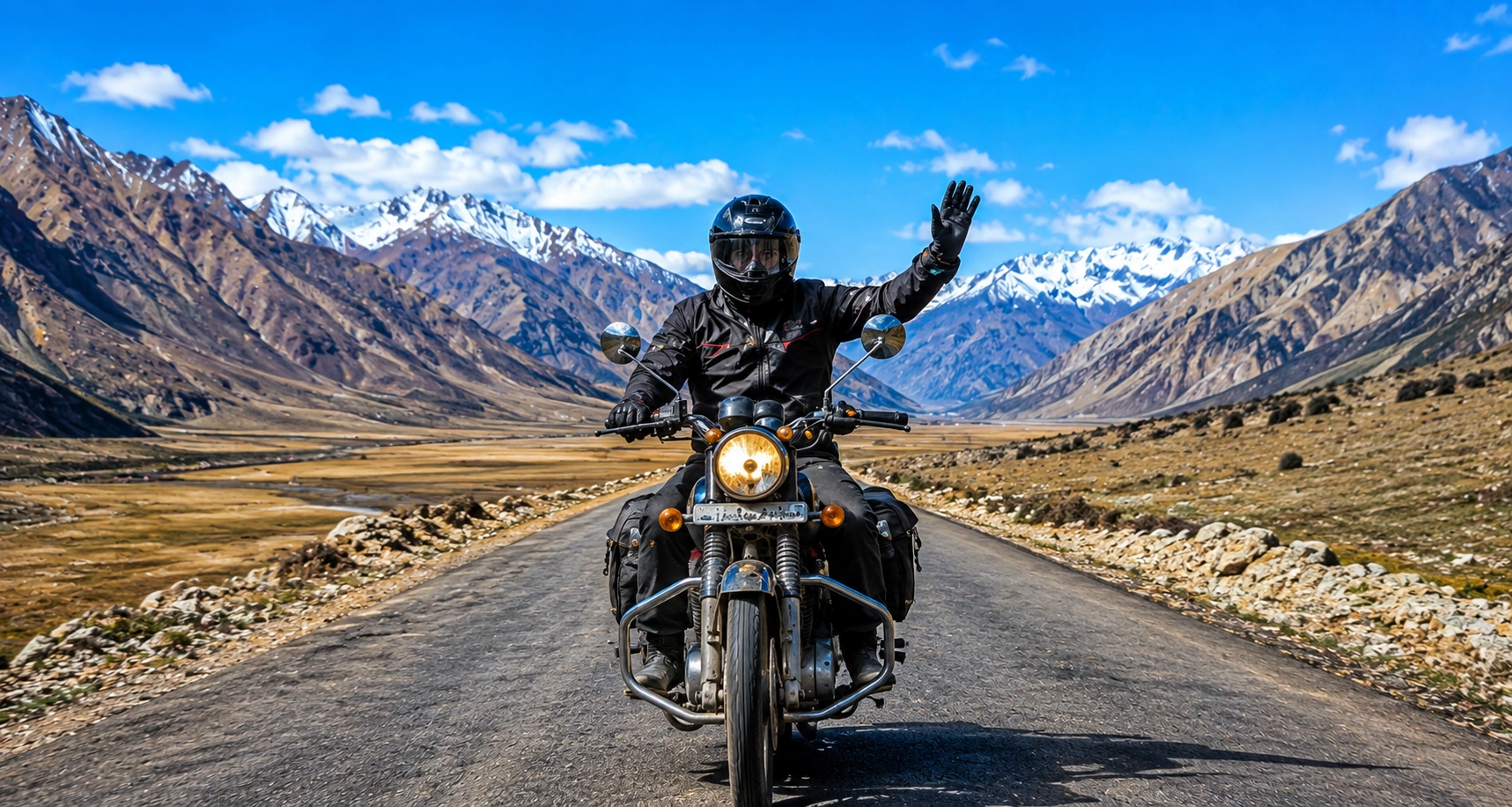
There is a specific kind of quiet that only shows up a hundred miles from the nearest gas station, when the pavement has run out, the dust has settled behind you, and the only sound is your own engine ticking as it cools. That feeling is why Motorcycle Adventure Tours have exploded in popularity over the last few years. Riders are trading crowded interstates for gravel passes, high desert two-track, and mountain roads that most cars will never see.
Part of the appeal is simple freedom. A loaded adventure bike can carry everything you need, take you almost anywhere, and change your plans on a whim. But the growth is also being driven by better bikes, better navigation, and a booming community of riders sharing routes and stories online. Whether you dream of a fully supported guided expedition or a solo run down a remote backcountry trail, there has never been a better time to plan a trip.
This guide is built to be the most complete resource you will find on the subject. You will get 10 of the best routes in the country, honest advice on choosing the Best Adventure Touring Motorcycle, a full breakdown of guided versus self-guided riding, a realistic budget, a packing checklist, safety guidance, and the seasons that actually work. By the end, you will know exactly how to plan your own trip and which route deserves to be first.
What Are Motorcycle Adventure Tours?
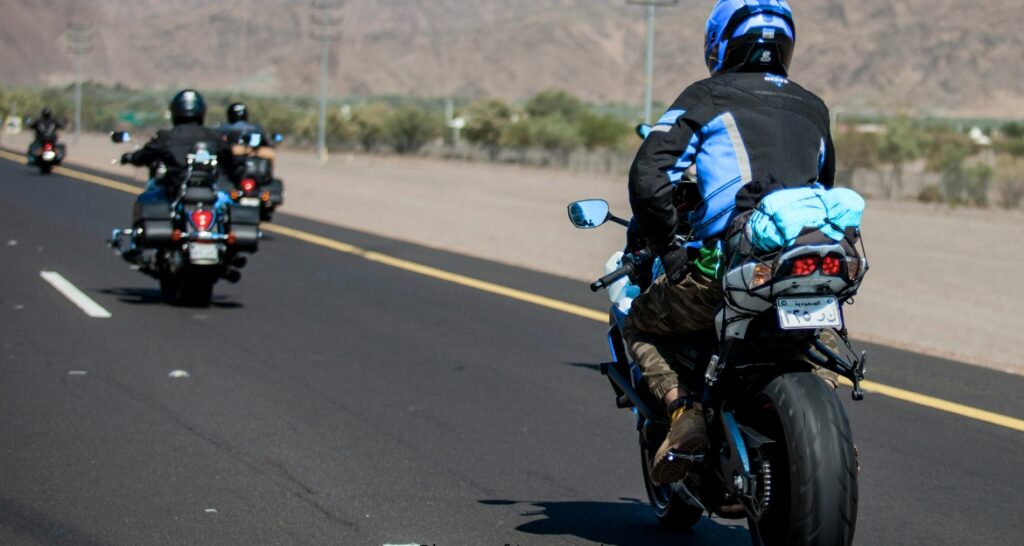
Motorcycle Adventure Tours are multi-day trips built around exploration rather than just getting from A to B. They mix scenic paved roads with gravel, dirt, and sometimes genuinely technical off-road sections, and they are ridden on adventure or dual-sport bikes designed to handle both. The point is the journey itself: remote camping, small towns, mountain passes, and terrain that rewards a bit of skill and self-reliance.
How They Differ From a Regular Road Trip
A classic road trip sticks to highways and hotels. An adventure tour deliberately seeks out the unpaved third of America’s road network, factors in fuel range, and expects you to camp, wrench, and navigate where cell signal disappears. The bike, the gear, and the mindset are all different.
Adventure Touring vs Off-Road Riding
Adventure touring leans toward long-distance comfort on mixed surfaces, while pure off-road riding is about technical trails on lighter machines. Most tours live somewhere in between. Dual Sport Motorcycle Adventures sit further toward the dirt end of that spectrum, using lighter, street-legal bikes that can tackle tighter, rougher trails.
Guided vs Independent Riding
Some riders want everything handled: bike, route, lodging, and a mechanic in a support truck. Others want a GPS file and the open road. Both are valid, and we compare them in detail below.
Why Motorcycle Adventure Tours Are So Popular
The surge in Motorcycle Adventure Tours is not a fad. It reflects a broader shift toward experiential travel, plus a wave of capable, affordable bikes and a genuinely welcoming community.
- Scenic freedom – you decide the pace, the stops, and the detours, with terrain no tour bus will ever reach.
- National Parks and public land – the USA has roughly 4.1 million miles of public road, and nearly a third of it is unpaved, opening up an enormous playground.
- Remote backcountry – hot springs, ghost towns, alpine lakes, and dark-sky camping are all part of the appeal.
- Adventure community – forums, local rides, and organised events make it easy to learn and find travel partners.
- Bucket-list experiences – crossing a 12,000-foot pass or completing a full Backcountry Discovery Route is the kind of memory that lasts.
| Trend | What’s Driving It | Why It Matters for Riders |
|---|---|---|
| Experiential travel | People value experiences over things | More demand for immersive, multi-day rides |
| Better middleweight bikes | Lighter, cheaper, capable ADV models | Lower barrier to entry for beginners |
| Curated GPS routes | Organisations like BDR mapping trails | Easier, safer self-guided planning |
| Growing rider community | Clubs, events, online groups | Support, knowledge, and companionship |
Types of Motorcycle Adventure Tours
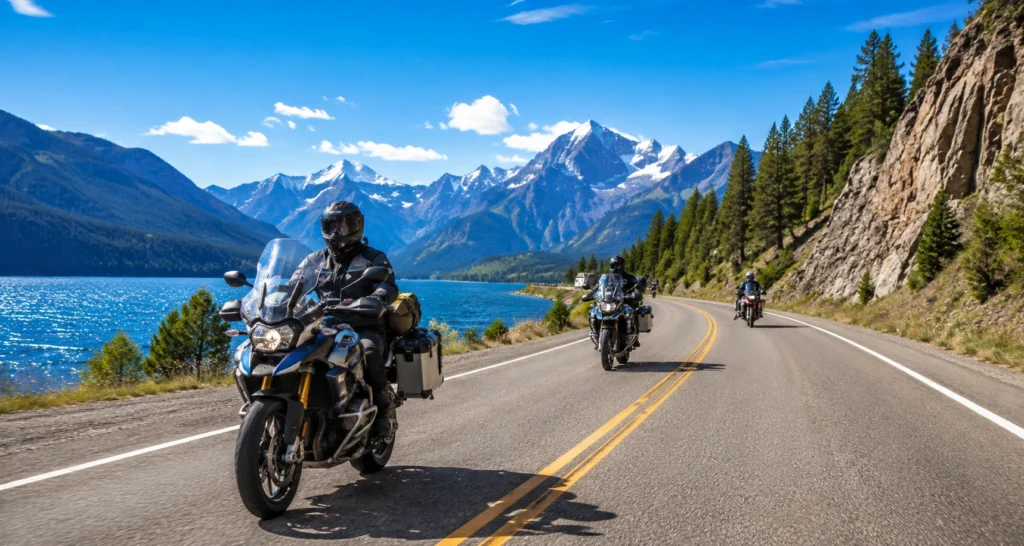
Not every trip looks the same. Understanding the main formats helps you match a tour to your skill, budget, and appetite for the unknown.
Guided Tours
A professional outfit handles routing, lodging, and often a support vehicle with tools and a spare bike. Ideal for first-timers, international trips, or anyone who wants to switch off and simply ride.
Self-Guided Tours
You get a route file and recommendations, then ride it on your own schedule. Cheaper and more flexible, but you own the logistics, repairs, and problem-solving.
Dual Sport Motorcycle Adventures
Built around lighter, street-legal dirt-oriented bikes, Dual Sport Motorcycle Adventures favour tighter trails, single-track detours, and riders who want a machine they can pick up easily when it tips over.
Luxury Adventure Travel Vacation Packages
At the premium end, Adventure Travel Vacation Packages bundle top-tier bikes, boutique lodging, gourmet meals, and full support. You still ride real terrain, but the comforts are dialled up.
Camping Adventure Tours
These lean into self-sufficiency: you carry a tent and sleep under the stars, keeping costs low and immersion high. Common on remote routes with limited lodging.
International Motorcycle Tours
From Baja to the Andes to the Alps, guided operators make riding abroad approachable by handling rentals, borders, and local knowledge.
Here are 10 of the best routes and regions in the country, spanning smooth coastal sweepers, high-alpine passes, and hardcore backcountry trails. Together they cover the full range of Adventure Motorcycle Tours USA has to offer, so there is something here whether you ride a big touring GS or a nimble dual-sport.
| Tour Type | Best For | Skill Level | Budget | Duration |
|---|---|---|---|---|
| Guided | Beginners, international trips | Any | $$$ | 3–14 days |
| Self-guided | Independent, experienced riders | Intermediate+ | $ | Flexible |
| Dual sport | Technical trail lovers | Intermediate+ | $$ | 2–10 days |
| Luxury package | Comfort-focused travellers | Any | $$$$ | 5–14 days |
| Camping | Budget & immersion seekers | Intermediate | $ | 3–14 days |
| International | Bucket-list explorers | Varies | $$$ | 7–21 days |
10 Best Motorcycle Adventure Tours in the USA
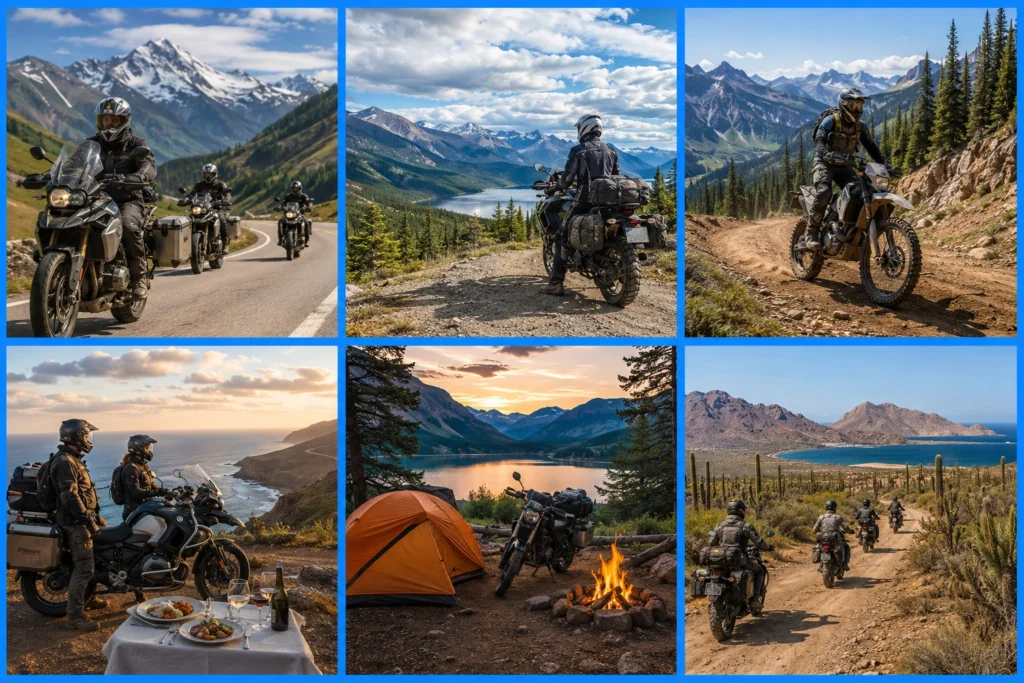
The list runs roughly from easiest to most demanding. The early paved routes are approachable on almost any bike and make excellent first trips, while the backcountry routes near the end assume off-road experience, proper tyres, and self-sufficiency. Mix and match freely — many riders link a paved icon with a nearby dirt route to get the best of both worlds in a single trip.
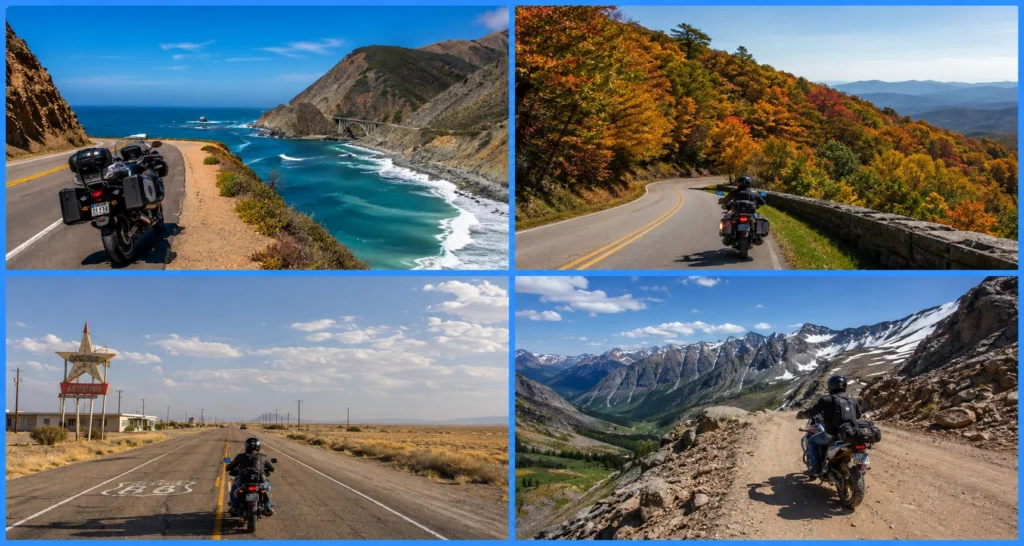
1. Pacific Coast Highway (California)
If you only ever ride one paved route in the USA, make it this one. California’s Highway 1 clings to the coast for hundreds of miles, stringing together sea cliffs, redwood groves, surf towns, and some of the most photographed corners in the country. It is the classic entry point to Motorcycle Adventure Tours: approachable on any bike, endlessly scenic, and forgiving enough for a first big trip.
Ride it north to south so you sit on the ocean side of the road, and go in spring or fall to dodge summer fog and RV traffic. Do not rush — the constant pull-offs at Bixby Bridge, Big Sur, and countless nameless coves mean you will cover far fewer miles per day than you expect, and that is the whole point.
2. Blue Ridge Parkway (Virginia–North Carolina)
The Blue Ridge Parkway is 469 miles of low-speed, no-commercial-traffic mountain road threading the spine of the Appalachians. Sweeping overlooks, stone tunnels, and flame-coloured autumn forests make it one of the most relaxing and beginner-friendly rides in the East.
The 45 mph limit is strictly enforced, so treat it as a savour-the-scenery cruise rather than a fast blast. There are no gas stations on the Parkway itself, so fuel up in the valley towns, and target October for peak fall colour — just expect company, because everyone else has the same idea.
3. Route 66 (Illinois to California)
The mother road runs roughly 2,400 miles from Chicago to Santa Monica and is less about technical riding than about Americana: neon motels, retro diners, ghost towns, and long desert straights. As a bucket-list cross-country pilgrimage, few rides carry the same mythology.
Grab a dedicated turn-by-turn guide or GPS file, because the historic alignment is chopped up by the interstate and easy to lose. Budget 10 to 14 days to do it justice, and ride the western desert sections in spring or fall to avoid brutal summer heat.
4. Colorado Rockies (San Juan Skyway)
For high-alpine drama, the Colorado Rockies are hard to beat. The San Juan Skyway and the infamous Million Dollar Highway deliver guardrail-free switchbacks above 11,000 feet, while nearby passes like Imogene and Engineer turn the trip into a genuine dual-sport adventure for confident riders.
Summer is the only realistic window, and afternoon thunderstorms are almost a daily event, so ride the high passes early and be back down by lunch. This is a route where a lighter, dirt-capable bike opens up far more of the map than a heavy tourer.
5. Tail of the Dragon & the Smokies (North Carolina–Tennessee)
US 129 — the Tail of the Dragon — famously packs 318 curves into 11 miles, and it has earned near-mythical status among riders. Pair it with the higher, quieter Cherohala Skyway and the Foothills Parkway for a full day of flowing corners through the most-visited national park in the country.
Ride the Dragon early on a weekday to dodge traffic and heavy enforcement, and remember the roadside photographers will capture every line you take. Ride smooth and within your limits rather than chasing heroics; the Cherohala is arguably the better road anyway.
6. Beartooth Highway (Montana–Wyoming)
Charles Kuralt once called it the most beautiful drive in America, and on two wheels it is even better. US 212 climbs to nearly 11,000 feet in a staircase of dramatic switchbacks right beside Yellowstone’s northeast gate, with alpine lakes and snowfields lingering well into summer.
It is only open from roughly late May to mid-October, so timing is everything. Even in July the summit can hover near freezing, so carry warm layers no matter how hot the valley is, and link it with Yellowstone or the Chief Joseph Scenic Byway for a multi-day loop.
7. Moab (Utah)
Moab is where paved touring gives way to serious off-road play. Slickrock, canyon rims, the White Rim Trail, and endless jeep tracks make it a Dual Sport Motorcycle Adventures mecca, all set against some of the most surreal red-rock scenery on the planet.
This is intermediate-and-up territory. Carry far more water and fuel than you think you need, because desert distances are deceptive and help is a long way off. Spring and fall are ideal; midsummer heat here is genuinely punishing.
8. Washington Backcountry Discovery Route (WABDR)
The original BDR is roughly 575 miles of forest roads and mountain passes running from the Columbia River north to the Canadian border. It remains one of the best introductions to true backcountry riding and a natural first step before the longer western routes.
Its mix of easy gravel and a handful of tougher optional sections lets you build confidence at your own pace. Ride it July through September once the high passes clear, and use it as a proving ground for your bike setup and camping kit.
9. Oregon Backcountry Discovery Route
Around 682 miles of high desert, lava fields, hot springs, and Cascade forest, the Oregon Backcountry Discovery Route is a demanding, scenery-rich classic — and one of the most varied landscapes of any BDR. Note it was recently re-scouted, so older 750-mile write-ups are out of date.
It rewards solid off-road skills and careful fuel planning, with some sections stretching well over 100 miles between reliable gas. It earns a full section-by-section guide further down this page.
10. Idaho Backcountry Discovery Route
At roughly 1,250 miles, the Idaho Backcountry Discovery Route is the longest of the western BDRs: endless twisty mountain roads, remote hot springs, historic corridors, and true off-grid solitude across the entire length of the state.
It is less about extreme technical difficulty and more about endurance and self-sufficiency, with long stretches and no cell reception. Most riders take 8 to 10 days; it too gets its own detailed guide below.
| Route | Distance | Days | Difficulty | Best Season |
|---|---|---|---|---|
| Pacific Coast Hwy | ~650 mi | 3–5 | Easy | Spring / Fall |
| Blue Ridge Parkway | 469 mi | 2–4 | Easy | Fall |
| Route 66 | ~2,400 mi | 10–14 | Easy | Spring / Fall |
| Colorado Rockies | Varies | 4–7 | Moderate–Hard | Summer |
| Tail of the Dragon | 11 mi (loop day) | 1 | Easy | Spring–Fall |
| Beartooth Hwy | 68 mi | 1 | Easy (seasonal) | Jun–Sep |
| Moab | Varies | 2–5 | Hard | Spring / Fall |
| WABDR | ~575 mi | 5–7 | Moderate | Jul–Sep |
| Oregon BDR | ~682 mi | 6–8 | Moderate–Hard | Jul–Sep |
| Idaho BDR | ~1,250 mi | 8–10 | Moderate (long) | Jul–Oct |
Oregon Backcountry Discovery Route: Complete Guide
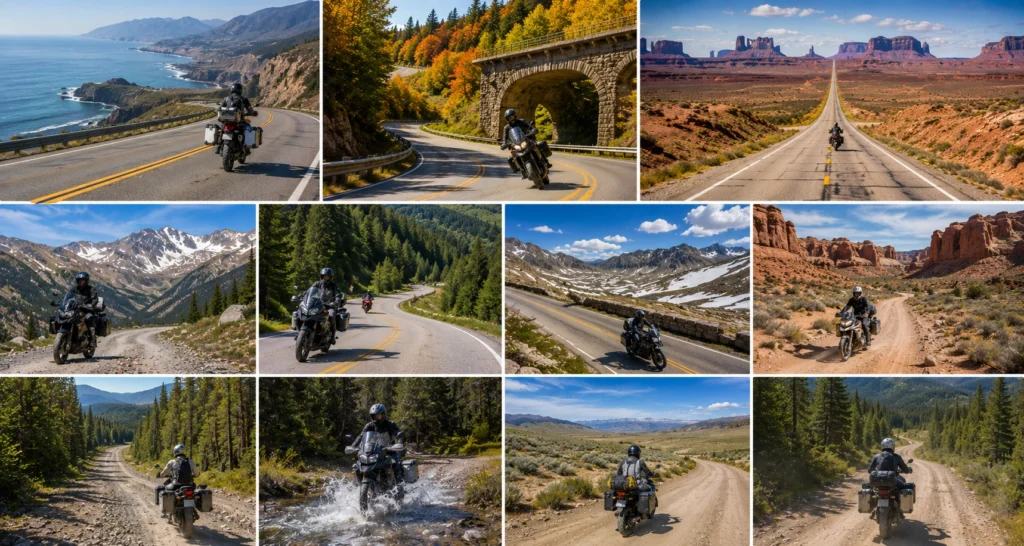
The Oregon Backcountry Discovery Route is one of the most rewarding off-pavement rides in the country. Note that the route was re-scouted and updated recently, so older 750-mile write-ups are out of date.
Overview
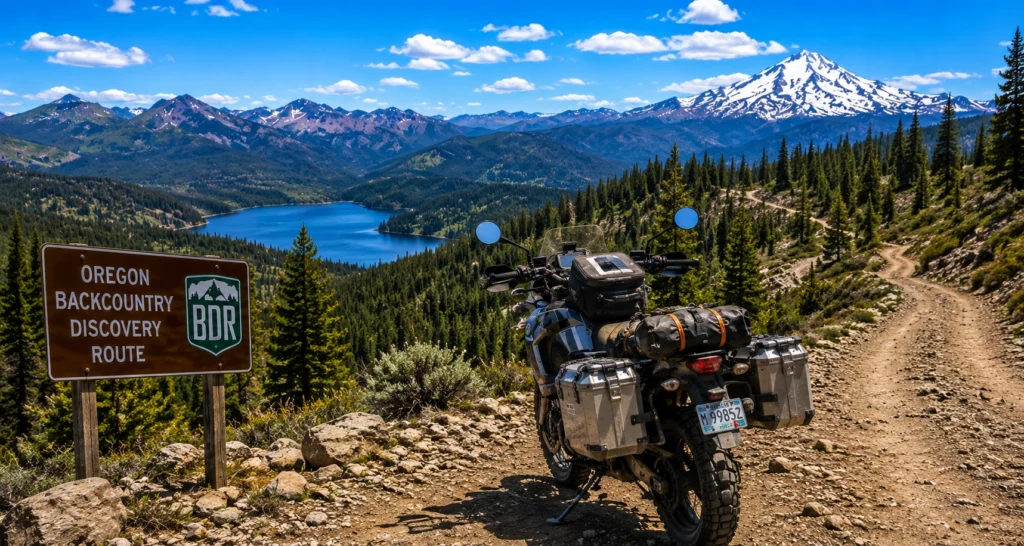
The current Oregon Backcountry Discovery Route runs roughly 682 miles from the California border north to Hood River on the Columbia River, climbing from high desert into the Cascade Range across around seven sections.
Difficulty
Rated moderate to hard. Long, loaded adventure bikes are fine for confident riders, but lava rock, silt, deep sand, and rough mountain roads will test your skills, especially late in a dry season.
Terrain
Expect sagebrush steppe, hot springs, lava tubes, glaciated volcanoes, and towering pine forest — one of the most varied landscapes of any BDR.
Best Time
Generally July through September, once high-country snow has cleared and before autumn storms arrive.
Camping
Plentiful dispersed and established camping, with rustic lodging in tiny towns. Remote sections mean booking any indoor beds well in advance.
Fuel Stops
Fuel is sparse; some sections stretch well over 100 miles between reliable gas. Follow the golden backcountry rule: never pass a gas station.
Navigation Tips
Carry the official Butler map and a GPS file on a device with offline maps. Cell coverage is unreliable, so download everything before you leave pavement.
Idaho Backcountry Discovery Route Guide
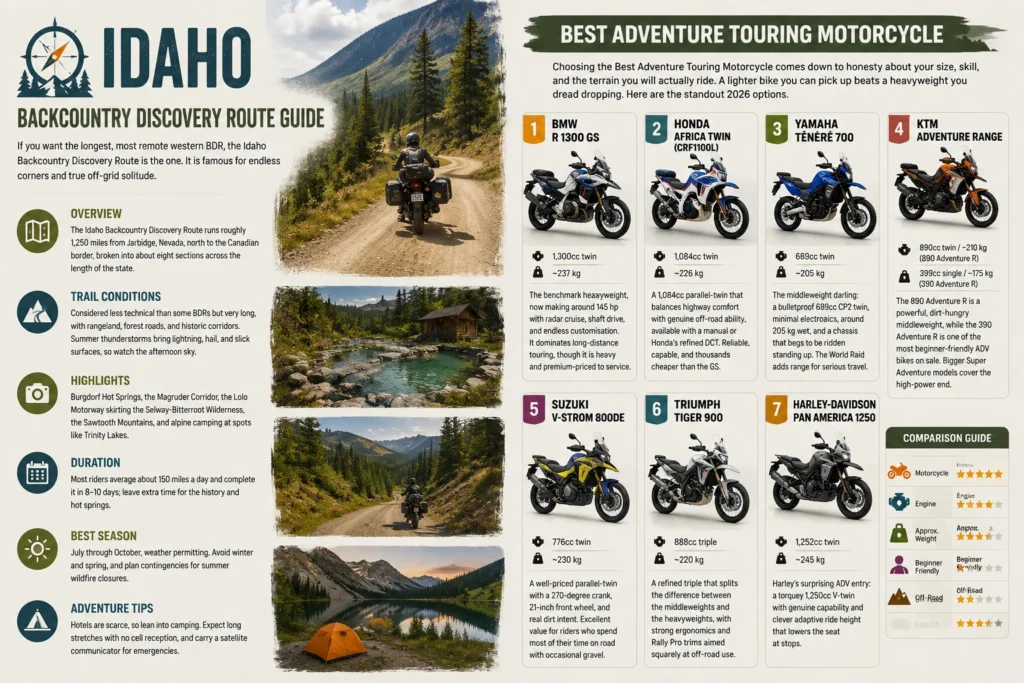
If you want the longest, most remote western BDR, the Idaho Backcountry Discovery Route is the one. It is famous for endless corners and true off-grid solitude.
Overview
The Idaho Backcountry Discovery Route runs roughly 1,250 miles from Jarbidge, Nevada, north to the Canadian border, broken into about eight sections across the length of the state.
Trail Conditions
Considered less technical than some BDRs but very long, with rangeland, forest roads, and historic corridors. Summer thunderstorms bring lightning, hail, and slick surfaces, so watch the afternoon sky.
Highlights
Burgdorf Hot Springs, the Magruder Corridor, the Lolo Motorway skirting the Selway-Bitterroot Wilderness, the Sawtooth Mountains, and alpine camping at spots like Trinity Lakes.
Duration
Most riders average about 150 miles a day and complete it in 8–10 days; leave extra time for the history and hot springs.
Best Season
July through October, weather permitting. Avoid winter and spring, and plan contingencies for summer wildfire closures.
Adventure Tips
Hotels are scarce, so lean into camping. Expect long stretches with no cell reception, and carry a satellite communicator for emergencies.
Best Adventure Touring Motorcycle
Choosing the Best Adventure Touring Motorcycle comes down to honesty about your size, skill, and the terrain you will actually ride. A lighter bike you can pick up beats a heavyweight you dread dropping. Here are the standout 2026 options.
BMW R 1300 GS
The benchmark heavyweight, now making around 145 hp with radar cruise, shaft drive, and endless customisation. It dominates long-distance touring, though it is heavy and premium-priced to service.
Honda Africa Twin (CRF1100L)
A 1,084cc parallel-twin that balances highway comfort with genuine off-road ability, available with a manual or Honda’s refined DCT. Reliable, capable, and thousands cheaper than the GS.
Yamaha Ténéré 700
The middleweight darling: a bulletproof 689cc CP2 twin, minimal electronics, around 205 kg wet, and a chassis that begs to be ridden standing up. The World Raid adds range for serious travel.
KTM Adventure Range
The 890 Adventure R is a powerful, dirt-hungry middleweight, while the 390 Adventure R is one of the most beginner-friendly ADV bikes on sale. Bigger Super Adventure models cover the high-power end.
Suzuki V-Strom 800DE
A well-priced parallel-twin with a 270-degree crank, 21-inch front wheel, and real dirt intent. Excellent value for riders who spend most of their time on road with occasional gravel.
Triumph Tiger 900
A refined triple that splits the difference between the middleweights and the heavyweights, with strong ergonomics and Rally Pro trims aimed squarely at off-road use.
Harley-Davidson Pan America 1250
Harley’s surprising ADV entry: a torquey 1,250cc V-twin with genuine capability and clever adaptive ride height that lowers the seat at stops.
| Motorcycle | Engine | Approx. Weight | Beginner Friendly | Off-Road |
|---|---|---|---|---|
| BMW R 1300 GS | 1,300cc twin | ~237 kg | Moderate | Very good |
| Honda Africa Twin | 1,084cc twin | ~226 kg | Moderate | Excellent |
| Yamaha Ténéré 700 | 689cc twin | ~205 kg | Good | Excellent |
| KTM 890 Adventure R | 889cc twin | ~210 kg | Moderate | Excellent |
| KTM 390 Adventure R | 399cc single | ~175 kg | Excellent | Very good |
| Suzuki V-Strom 800DE | 776cc twin | ~230 kg | Good | Good |
| Triumph Tiger 900 | 888cc triple | ~220 kg | Moderate | Very good |
| Harley Pan America | 1,252cc twin | ~245 kg | Moderate | Good |
Guided vs Self-Guided Motorcycle Adventure Tours
One of the biggest decisions when planning Motorcycle Adventure Tours is whether to book a guided trip or go it alone. Neither is better; they simply suit different riders. A useful way to decide is to weigh three things honestly: your budget, your mechanical and off-road skills, and how much of the planning you actually enjoy. If the logistics excite you as much as the riding, self-guided is a joy; if they feel like a chore or the trip is somewhere unfamiliar, a guided operator earns its fee many times over.
| Feature | Guided | Self-Guided |
|---|---|---|
| Cost | Higher (all-in) | Lower (DIY) |
| Flexibility | Fixed schedule | Fully flexible |
| Safety | Support truck & guide | On your own |
| Logistics | Handled for you | Your responsibility |
| Skill needed | Lower | Higher |
| Best for | Beginners, abroad | Experienced, local |
Pros and Cons at a Glance
- Guided pros: zero planning stress, mechanical backup, local expertise, instant riding community.
- Guided cons: higher cost, fixed pace, less spontaneity.
- Self-guided pros: cheaper, total freedom, ride your own bike, change plans anytime.
- Self-guided cons: you own every problem, from a flat tyre to a wrong turn in no-signal country.
How to Plan Motorcycle Adventure Tours
Good planning is what separates a great trip from a miserable one. Work through these steps before you commit.
Choose Your Destination
Match the route to your skill and the season. A first-timer should not open with the full Idaho BDR in October.
Estimate Your Budget
Add up fuel, lodging or camping, food, maintenance, and any tour fees. See the detailed breakdown below.
Book Accommodation Early
Remote routes have very limited beds. Reserve rustic lodging weeks ahead or plan to camp.
Download Offline Maps
Load GPS tracks and offline map tiles before you leave signal. Do not rely on live data in the backcountry.
Check Your Motorcycle
Fresh tyres, chain, brakes, and fluids. Fit knobbier rubber for dirt-heavy routes and confirm your fuel range.
Sort Travel Insurance
Get coverage that includes motorcycling and, ideally, remote evacuation. Standard policies often exclude both.
Pack an Emergency Kit
Tools, tube/plug kit, first aid, and a satellite messenger are non-negotiable off the grid.
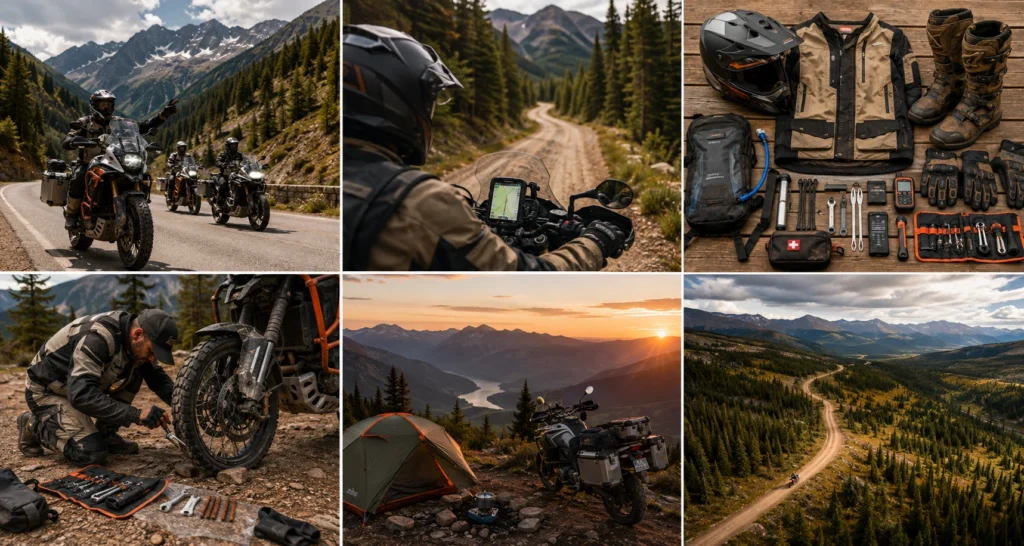
Essential Gear Checklist
The right kit keeps you safe, comfortable, and self-reliant. Prioritise protection and reliability over gadgets.
Helmet
An adventure or dual-sport helmet with a peak and good ventilation, ideally with a drop-down or pinlock visor.
Adventure Jacket & Pants
Vented, armoured textile gear with a waterproof layer handles the wide temperature swings you will meet in a single day.
Boots
Tall, protective ADV boots that support your ankles off-road but still let you walk and shift comfortably.
Navigation
A GPS unit or phone in a vibration-damped mount, plus a paper map as backup.
Repair Kit
Tyre plugs, or tubes, a pump, basic tools, zip ties, and duct tape cover most trailside fixes.
Camping Gear
A compact tent, sleeping bag, pad, and small stove open up remote routes with no lodging.
Hydration
A hydration pack plus extra water in the desert; dehydration wrecks judgement faster than fatigue.
| Gear Item | Priority | Notes |
|---|---|---|
| ADV helmet | Essential | Peak + good ventilation |
| Armoured jacket & pants | Essential | Vented, waterproof layer |
| ADV boots | Essential | Ankle support off-road |
| Gloves (2 pairs) | Essential | Summer + waterproof |
| Navigation + backup | Essential | GPS/phone + paper map |
| Tyre repair + pump | Essential | Plugs/tubes, mini pump |
| Satellite messenger | High | For no-signal areas |
| Camping kit | Situational | Remote routes only |
Motorcycle Adventure Tour Budget
Costs vary hugely between a self-guided camping run and a luxury guided package. Use the table below as a per-day planning guide, then multiply by your trip length.
| Expense | Budget (Self-Guided) | Mid-Range | Premium (Guided) |
|---|---|---|---|
| Fuel | $15–25 / day | $20–35 / day | Often included |
| Lodging | Camping $0–20 | Motels $80–150 | Hotels included |
| Food | $20–35 / day | $40–70 / day | Mostly included |
| Maintenance | $10–20 / day | $15–30 / day | Support included |
| Tour fees | None | None | $300–600 / day |
| Insurance | $5–15 / day | $10–20 / day | Often included |
| Rough daily total | $50–115 | $165–305 | $350–700+ |
As a rule of thumb, a week of self-guided riding on your own bike can cost a few hundred dollars, while a fully supported guided week often runs into the thousands. Adventure Travel Vacation Packages sit at the top of that range but remove nearly all the hassle.
Best Time for Motorcycle Adventure Tours
Season makes or breaks a trip, especially at altitude where high passes and BDRs may be snowed in for half the year.
Spring
Great for deserts and low elevations; high mountain passes are often still closed.
Summer
Peak season for the BDRs and mountain routes, but deserts become dangerously hot. Watch afternoon thunderstorms.
Fall
Arguably the best all-round window: cooler temperatures, fall colour, thinner crowds. Watch for early snow up high.
Winter
Mostly limited to southern deserts and coastal routes; northern backcountry is off the table.
| Region | Spring | Summer | Fall | Winter |
|---|---|---|---|---|
| Deserts (SW) | Excellent | Too hot | Excellent | Good |
| Rocky Mtn passes | Closed | Excellent | Good | Closed |
| Western BDRs | Partly closed | Excellent | Good | Closed |
| Coastal (CA/OR) | Good | Foggy | Excellent | Fair |
Safety Tips for Motorcycle Adventure Tours
Remote riding raises the stakes. A little preparation dramatically lowers your risk. The single biggest factor in staying safe on Motorcycle Adventure Tours is not raw skill but good judgement: knowing when to turn back, when to walk a difficult section first, and when the weather or your energy says it is time to stop for the day. Fatigue and ego cause far more backcountry incidents than genuinely difficult terrain does.
Wildlife
Deer, elk, and cattle wander onto backcountry roads. Slow down at dawn and dusk and scan the verges.
Weather
Mountain weather turns fast. Pack layers and rain gear, and get off high, exposed ground before afternoon storms.
Off-Road Riding
Ride within your limits, stand on the pegs in the rough, and never let ego push you into terrain beyond your skill.
Navigation
Carry redundant navigation and tell someone your route and expected check-in times.
Emergency Communication
A satellite messenger or personal locator beacon can save your life where phones have no signal.
First Aid
Carry a proper kit and know the basics. Help can be hours away in the backcountry.
Group Riding
Agree on spacing and regroup points, and keep the slowest rider in mind so no one gets left behind.
Mistakes Riders Should Avoid
- Overpacking – every extra kilo makes the bike harder to handle off-road.
- Poor tyres – worn or wrong-compound rubber is the fastest way to a bad day in the dirt.
- Ignoring the weather – underestimating heat, cold, or storms is genuinely dangerous.
- Skipping maintenance – a pre-trip service prevents most breakdowns.
- Running low on fuel – map your gas stops and top up early on remote routes.
- Overestimating your skill – choose routes honestly and build up over time.
Expert Tips for First-Time Adventure Riders
New to this? A few habits will flatten the learning curve fast.
Recommended Motorcycle Adventure Tour Companies
If you would rather have the logistics handled, several established operators run excellent guided trips. Always confirm current routes, pricing, and bike availability directly before booking.
- MotoQuest – Alaska-founded specialist known for small groups and off-the-beaten-path routes across North America and beyond.
- RawHyde Adventures – the official BMW off-road training academy, blending professional instruction with guided Western backcountry tours.
- EagleRider – the largest US rental and tour company, with a huge fleet and many self-drive and guided options.
- Ayres Adventures – premium, BMW-focused operator running polished tours across multiple continents.
- RIDE Adventures – rental and guided specialists known for local knowledge and full BDR support tours.
- Edelweiss Bike Travel – long-running premium operator, most famous for its Alpine tours but active worldwide.
| Company | Style | Known For |
|---|---|---|
| MotoQuest | Guided, small group | Alaska & remote routes |
| RawHyde | Training + guided | BMW off-road academy |
| EagleRider | Rental + guided | Largest US fleet |
| Ayres Adventures | Premium guided | BMW, global tours |
| RIDE Adventures | Rental + guided | BDR support |
| Edelweiss | Premium guided | Alpine & worldwide |
Conclusion
From the ocean sweepers of the Pacific Coast to the high-desert solitude of the western backcountry, Motorcycle Adventure Tours offer some of the most memorable travel you can experience anywhere. The USA’s mix of paved icons and unpaved wilderness means there is a route for every skill level and every kind of rider.
Start by choosing a trip that matches your ability and the season, not your ego. Off-road enthusiasts should put the Oregon Backcountry Discovery Route and the Idaho Backcountry Discovery Route high on the list, while newcomers might begin with a single BDR section or a guided tour. Whatever you pick, invest in the Best Adventure Touring Motorcycle you can comfortably handle, pack smart, and plan your fuel, weather, and safety.
Then stop planning and go. Book a guided trip or one of the many Adventure Travel Vacation Packages if you want it all handled, or load a GPS track and set off on your own. Either way, your next great Adventure Motorcycle Tours USA experience is waiting just past where the pavement ends.
FAQs
1. What are Motorcycle Adventure Tours?
Ans: They are multi-day trips on adventure or dual-sport bikes that combine paved and unpaved roads, focused on remote scenery, self-sufficiency, and exploration rather than just covering distance.
2. Which Motorcycle Adventure Tours are best for beginners?
Ans: Start with easier, well-supported options like the Blue Ridge Parkway, the Pacific Coast Highway, a single WABDR section, or any guided tour with a support vehicle.
3. What is the Oregon Backcountry Discovery Route?
Ans: The Oregon Backcountry Discovery Route is a recently updated off-pavement route of roughly 682 miles running from the California border to Hood River, crossing high desert, lava fields, and the Cascade Range.
4. How difficult is the Idaho Backcountry Discovery Route?
Ans: The Idaho Backcountry Discovery Route is rated moderate but is very long at around 1,250 miles and extremely remote, so the main challenge is endurance, navigation, and days spent off-grid.
5. Which is the Best Adventure Touring Motorcycle?
Ans: There is no single answer, but the Yamaha Ténéré 700, Honda Africa Twin, and BMW R 1300 GS are top all-rounders. The Best Adventure Touring Motorcycle is the one that matches your size, skill, and terrain.
6. How much do Adventure Motorcycle Tours USA cost?
Ans: A self-guided camping trip can cost as little as $50–115 a day, while premium guided Adventure Motorcycle Tours USA packages often run $350–700+ per day with everything included.
7. Can beginners join guided motorcycle tours?
Ans: Yes. Guided tours are ideal for beginners because the operator handles routing, lodging, and mechanical support, and many run skills training before or during the trip.