

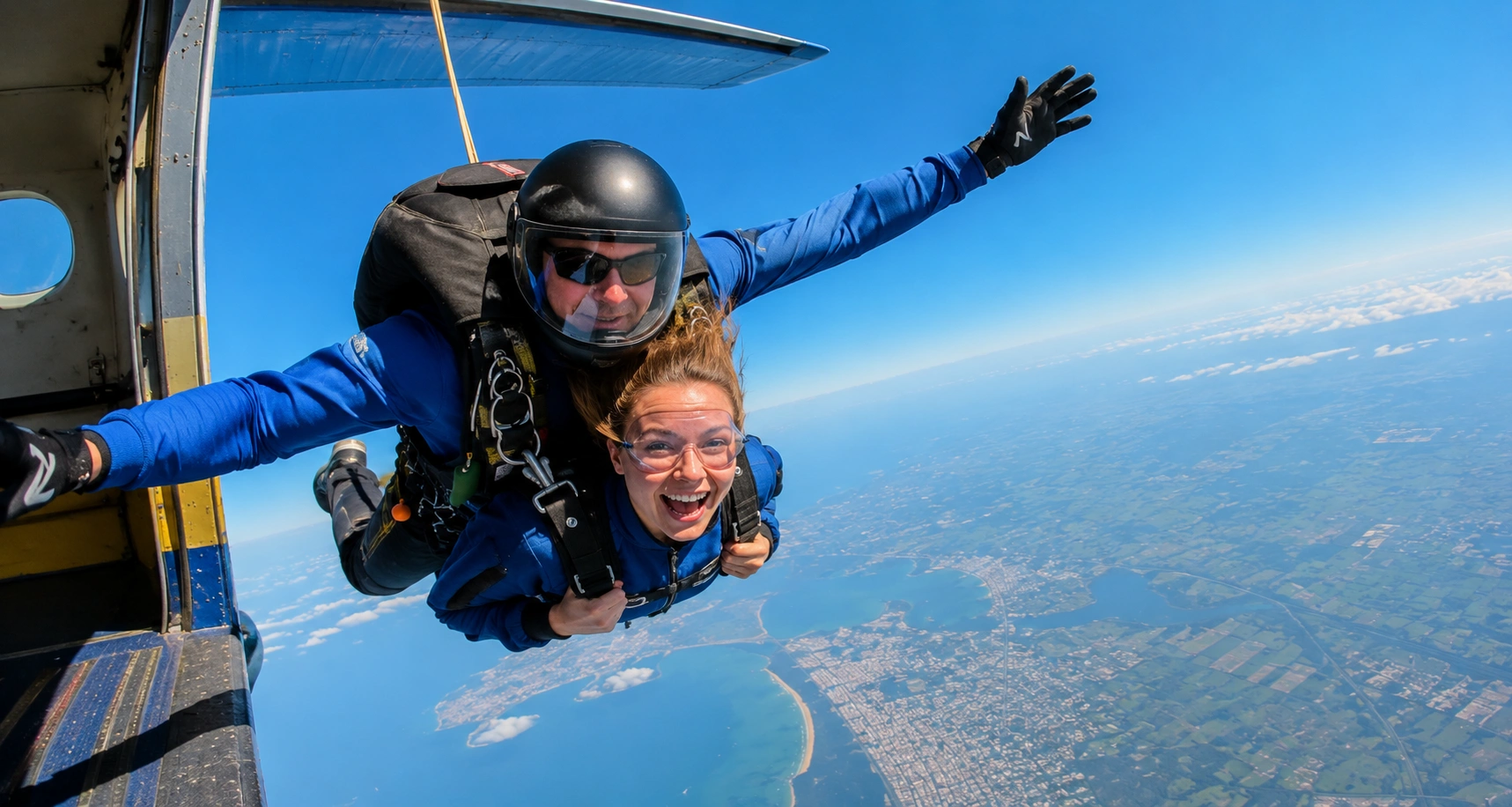
I told everyone I wasn’t scared. I signed the skydiving waiver with a steady hand, cracked jokes in my jumpsuit, and posed for photos like a war hero heading to the front.
Then the plane door opened at 13,000 feet, and every confident thing I’d ever said evaporated somewhere over the Costa Brava.
This is the honest version of the day, as it actually happened: from the ground to altitude, out of the door to back down again. If you’ve been googling “skydive Spain” at 1 a.m., wondering if you could actually go through with it, ride along. By the end you’ll know what it feels like, what it costs, how indoor skydiving rivals it if you’re not ready for an aircraft, and why I now think that a small canal town in Catalonia is the best place for skydiving in Europe.
The 30-Second Version (For the Scanners)
| Question | My Honest Answer |
| Worth it? | Completely. Best 20 minutes of all my travels. |
| Scariest moment? | The plane ride up. Not the jump. |
| Price Paid | €388 (Tandem Gold, photos + HD video included) |
| Where? | Skydive Empuriabrava, Costa Brava, Spain |
| Would I Repeat? | Already saving for jump two. |
Altitude: 0 Metres (The Decision)
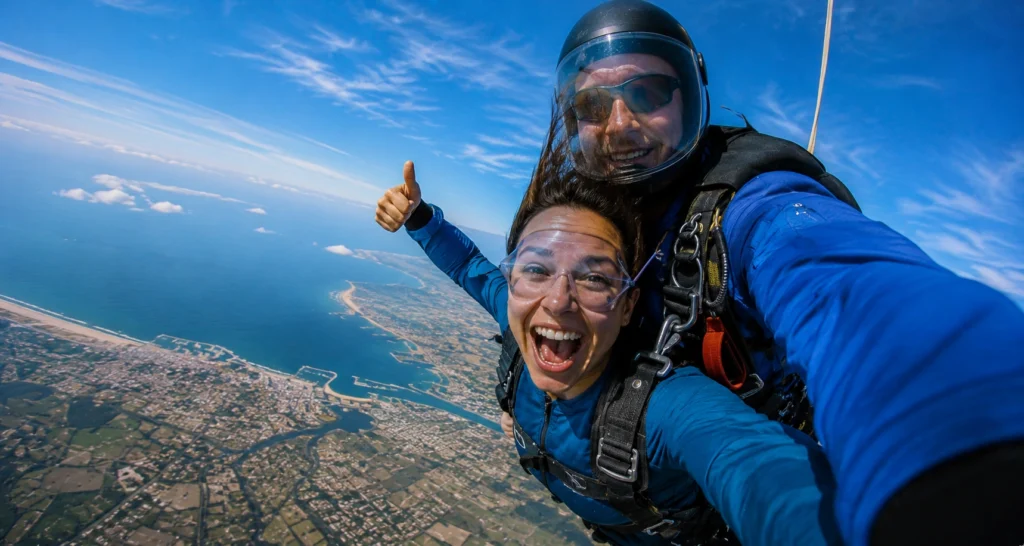
I wanted to fly since I was a kid. Not travel. Not see the world. Fly. So when skydiving finally moved from my someday list to my actual calendar, I refused to book the first drop zone that came up in search results. You’re only allowed one jump at first, so I spent weeks reading skydiving reviews, forum threads, and safety reports before I began jumping.
Nobody looking at skydive Spain options looks up the same few names; Skydive Empuriabrava is still in the top five. It’s on the Costa Brava, about 150 km north of Barcelona, and one of the world’s top dropzones. The setting is pretty unfair: The Pyrenees on one side, the Mediterranean on the other, and below you, the world’s biggest residential marina, threaded with 24 km of canals.
What did sell me was the safety record. Decades of operations, zero tandem accidents. When you’re about to trust a stranger with your life at 4,500 meters, that statistic outranks any view.
Before we climb, I can confess that my partner had vertigo and was quietly wishing the plane would die on its own. So I bought him a gift voucher for his birthday, so now I was wasting my money. Ruthless? Yes. Effective? Also yes.
Altitude: 0 Metres, T-minus one hour
The check-in was quick. Passports, payment, and then the waiver. Reading a Skydiving waiver that says you might die and that’s on you is a bizarre preflight ritual. I expected my hands to shake. They didn’t. My brain hadn’t yet caught up with what my body had agreed to.
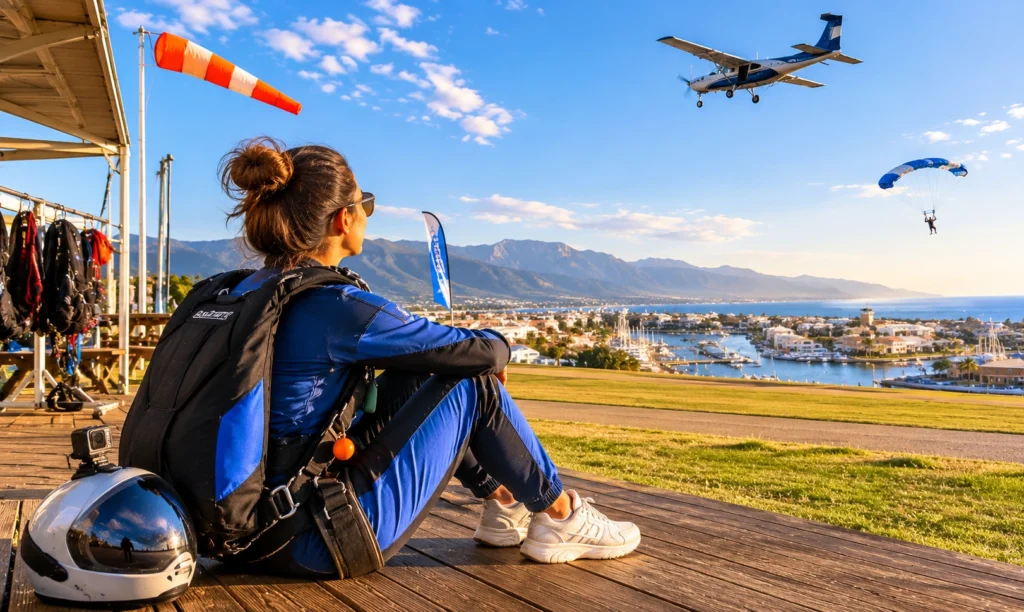
Then came the wait, which in skydiving is its own psychological event. You sit by the drop zone watching experienced jumpers spiral down, some throwing flips, all of them grinning. Every safe landing loosened something in my chest.
Nervous first-timer tip: watch the landings. Count them. It works better than any breathing exercise.
The Five-Minute Lesson (Yes, Five Minutes)
There are some things nobody tells you about tandem Skydiving: the training is tiny.
My instructor handed me a jumpsuit, clipped my harness, and gave me the whole curriculum in the time it takes to make coffee:
- Cross your arms at the exit.
- Knees bent, head back.
- Watch for my hand signal, then spread your arms.
- Smile at the camera.
Five minutes. For jumping out of an aircraft.
It works because in a tandem your instructor does everything that matters. Mine had roughly 11,000 jumps behind him. Eleven thousand. But when he said that number later, my shoulders dropped two inches. It’s also part of the whole argument for choosing a world-class dropzone over a cheap one: the best place for skydiving is where the instructors are most experienced, not where the ticket is cheapest.
Altitude: Climbing (Where the Fear Actually Lives)
Nobody warned me about this part, so I’m warning you: the scariest part of skydiving is not the jump itself. It’s the fifteen-minute climb. And every skydiving veteran I’ve met since agrees.
I’d felt invincible on the ground. In the plane, packed shoulder to shoulder with first-timers and a few solo jumpers, fear crept in like cold water rising. The videographer asked how I was feeling, and I produced a smile that, in the footage, looks frankly deranged.
Then the door opened.
People vanish out of an aircraft, one by one, and it is a sight your brain cannot file as normal. My partner went before me. One second he was sitting on the edge with his instructor. The next one is gone.
And here’s the first genuinely unexpected thing: watching him disappear deleted my fear. No anxiety, no tension, nothing left but readiness. I chicken-walked to the door on my instructor’s lap and asked, “Are we ready?”
He didn’t answer. He smiled and pushed.
Altitude: 4,500 Metres and Falling (The Sixty Seconds)
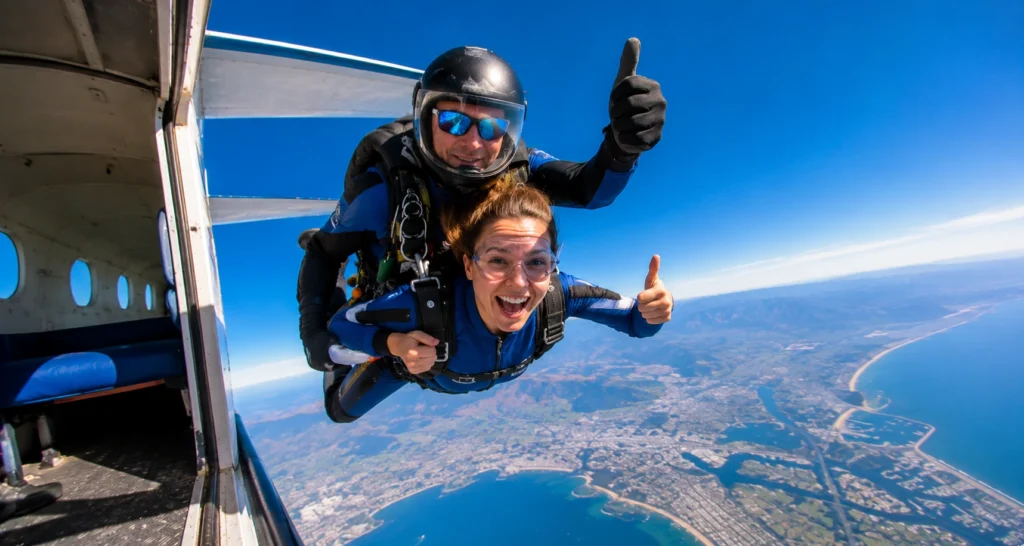
The first few seconds are pure static. Wind roaring at 200 km/h. Horizon spinning. My voice was snatched away before it left my mouth. I forgot every single instruction from the briefing: arms wrong, head wrong, everything wrong, and my instructor calmly folded me into position mid-air. And it seems that most first-timers do. He was ready for it.
Then we hit the terminal velocity, and the chaos was the sort of thing every skydiving story tries and fails to describe.
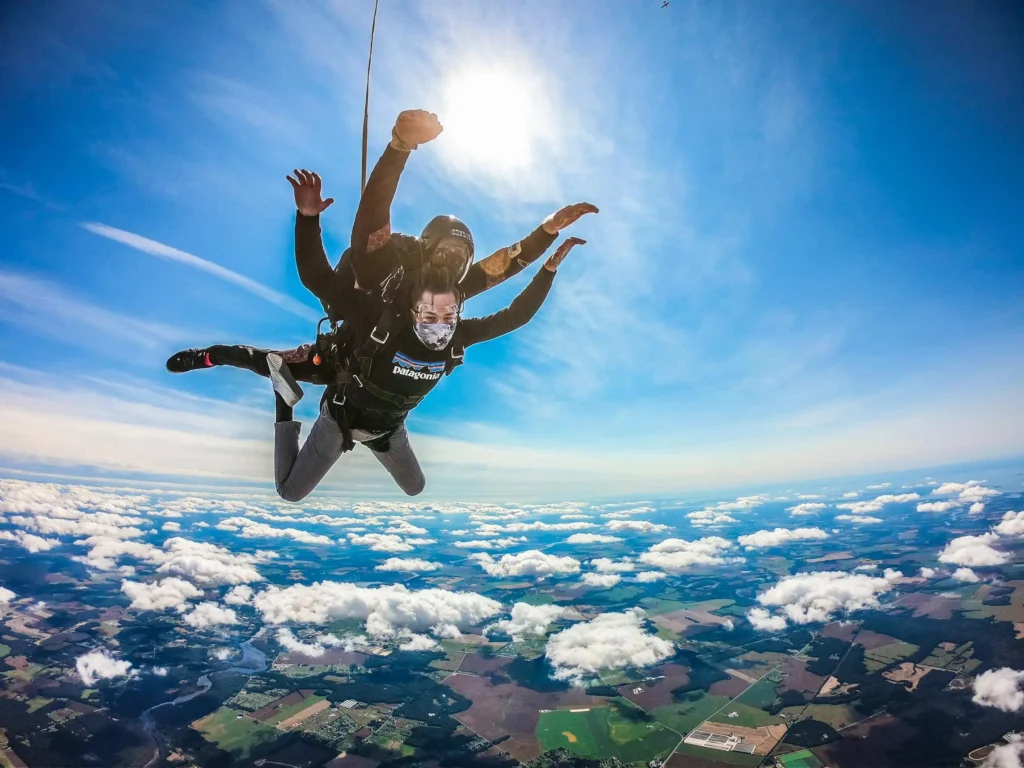
The falling sensation vanishes. You’re not dropping. You’re floating on a cushion of air with the Pyrenees rising like purple shark fins on one side and the Mediterranean glittering on the other. Breathing is hard at first, with thin air plus raw speed, so keep breathing anyway. Never hold your breath in freefall.
Sixty seconds sounds short. Up there it’s an entire lifetime, and it’s over too soon, both at once.
The Quiet Part: Under the Canopy
At the one-minute mark, my instructor deployed the parachute, and the world went silent.
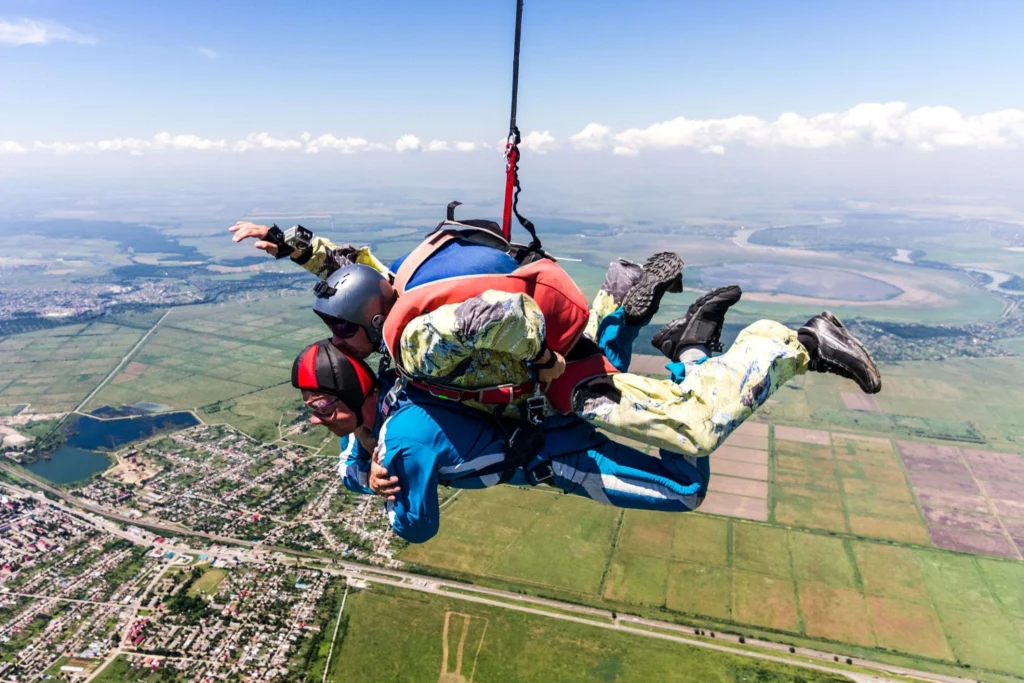
This six-to-seven-minute glide turned out to be my favorite surprise of the whole experience. He loosened my goggles and played tour guide to the airport, the canal town, the yachts, and even the French border hanging on the horizon. Then he asked if I wanted spins. We corkscrewed left and right through the sky, and I laughed the whole way down.
Here’s what nobody’s GoPro footage captures about the canopy ride: the smell. Clean, cold, faintly salted air from the Mediterranean, the kind you only get above the haze line. And the scale. From up there, Empuriabrava’s canals look like someone dropped a silver net over the town, and the yachts inside them shrink to grains of rice. I remember thinking that people pay for helicopter tours to see a fraction of this, and I was getting it as the encore to the main event.
The landing was so soft I barely registered it. My feet swept the grass, and my partner grabbed me in a hug, and just like that, my first skydiving experience was over. Less than twenty minutes from takeoff. A memory that will outlast most of my others.
The Verdict: The Good, the Scary & the Unexpected
The Good. Everything I hoped skydiving would be. The views, the professionalism, the freefall, the parachute spins, the certificate, the strange lasting confidence. But weeks later, regular problems seemed less daunting. I jumped out of a plane; I can survive a Monday.
The Scary. The climb. The open door. Watching the first jumpers disappear. Also, the waiver, if you actually read it.
The Unexpected. How little fear I felt at the actual edge. How hard those first breaths were. How emotional the landing was. And how fast I started planning jump number two.
So, Is Empuriabrava the Best Place for Skydiving?
The honest answer: it’s the best place for skydiving I could have chosen for a first jump and among the best on Earth, by most rankings. “Best” often gets thrown around loosely in travel writing, so here’s exactly why this dropzone earns the best place for skydiving title:
- Safety record: zero tandem accidents over decades of operation.
- Instructor quality: thousands of jumps per instructor is the norm, not the exception.
- The scenery: mountains, sea, and a canal town below. Most dropzones offer flat farmland.
- Infrastructure: fast aircraft, on-site photographers, and a professional wind tunnel next door.
Zoom out, and the wider skydive Spain scene is truly spoiled for choice. Seville is a huge Andalusian drop zone that training camps adore to use for its 300+ sunny days. Madrid has Lillo; the Costa Blanca has coastal operations. Find Skydive Spain on any forum, and you will find loyal fans of each. But for the first tandem with maximum wow factor, Empuriabrava would be the one I would book again without hesitation. Most experienced jumpers think this is the best place for skydiving in Europe, and many fly in every summer for it.
When to go: Late spring through early autumn gives you the most reliable jump weather on the Costa Brava, with May, June, and September hitting the sweet spot of clear skies without peak-summer crowds or the Tramuntana wind that occasionally grounds flights. July and August work too, but book several days ahead, because slots fill fast and the afternoon heat can make the wait sweatier than the jump.
One final note for anyone sketching a skydive Spain itinerary: Empuriabrava pairs beautifully with Barcelona. It’s a 90-minute drive up the coast, with Cadaqués, Figueres (Dalí’s hometown), and the Cap de Creus cliffs on the same route. Finding the best place for skydiving is only half the plan; the other half is to keep a buffer day for weather.
The Tunnel Detour: Not Ready to Jump? Try Indoor Skydiving
If the aircraft is your dealbreaker, indoor skydiving is a legitimate first step, not a consolation prize. You float on a column of air inside a vertical wind tunnel, feeling the physics of freefall a meter off the ground with an instructor beside you.
Empuriabrava actually keeps one of Europe’s best-known tunnels right next to the dropzone, which shows you how seriously the sport treats indoor skydiving as training. Professionals use it to sharpen body position. First-timers use it to see if they like the sensation before committing to the sky.
I’d probably like you to know here before booking indoor skydiving:
- It mimics freefall body position very well, but not the views, the altitude, or the canopy ride.
- Kids can usually fly from around age 4 or 5, so it’s a family option real skydiving can never be.
- Tunnels run rain or shine all year round, and not a single person worries about the weather.
- Two minutes in the tunnel is roughly two full jumps’ worth of freefall.
Is indoor skydiving a substitute for the real thing? No. Nothing replicates the door moment. But as a confidence-builder or a taster, it’s excellent, and honestly, it’s a blast in its own right.
The Money Part: Tandem Jump vs Indoor Skydiving Cost
The second question everyone asks me. Here are the real numbers.
My tandem jump: €388 for the Tandem Gold package, covering the 4,500 m jump, a full photo report, HD video, a T-shirt, and a small charity donation. Basic tandems without media start around €250 to €300. Pay for the video anyway. You will watch it more times than you’ll admit.
The cost of indoor skydiving is much kinder to a budget:
| Option | Typical Price |
| Intro Package (2 Flights in Spain) | €50–€70 |
| Longer Sessions / Family Bundles | €100–€200 |
| US/UK Intro Indoor Skydiving Cost | $70–$110 |
| Extra Tunnel Minutes (The Hidden Cost Indoor Skydiving Ads Skip) | €25–€45 per minute |
So the cost indoor skydiving carries is roughly one-fifth of a tandem. Compare the cost of indoor skydiving per minute of freefall sensation and tunnels win very easily; compare memories per euro and the aircraft wins by a landslide. When people talk about cost indoor skydiving versus the real jump, my answer fits in one line: the tunnel is a purchase, the jump an investment.
There are two budgeting details that people miss. First, the cost indoor skydiving operators advertise usually only covers 2–4 minutes of flight; extra minutes are where tunnels make their margin, so read the fine print. Second, the real skydiving prices rise with the altitude, but that extra meter buys nearly double the freefall, and that’s what you’re looking for. If you’re reading an indoor skydiving cost sheet or a tandem price list, always ask what you get per minute in the air.
Money-saving tip from experience: many dropzones, Empuriabrava included, hand you a discount voucher for your next jump after landing, with a short validity window. If you suspect you’ll want a second skydiving session, and most people do, plan for it before the voucher expires.
Can You Actually Jump? The Quick Checklist
Before you book anything on the skydive Spain circuit, run through this:
- Age 16+ with parental consent, or 18+ (varies by dropzone).
- Under roughly 90–100 kg.
- No recent surgeries, serious heart or back conditions (be honest on the form).
- Zero experience required; tandem skydiving is built for total beginners.
Your instructor takes care of the exit, the stability, the parachute, and the landing. You only want to show up, listen for five minutes, and enjoy it. If a dropzone does not ask any health questions, it should be seen as a red flag, not just a convenience.
Skydiving is weather-dependent. Wind or low clouds can push your slot back by hours or a day, one more reason to jump early in your trip rather than on your last morning. It’s also the one honest advantage indoor skydiving holds over the sky because a tunnel never checks the forecast.
Six Tips I’d Give My Pre-Jump Self
If I could pass one envelope back through time to the version of me pacing around the drop zone, these six lines would be inside it.
- Book a morning or midday slot. Calmer weather and shorter delays across every Skydive Spain dropzone, coastal or inland.
- Eat a light, normal breakfast. Jumping hungry is worse than jumping full.
- Wear trainers and comfy clothes. The jumpsuit goes on top.
- Don’t overthink the briefing. You’ll forget it anyway; your instructor is prepared for that.
- Breathe through the first five seconds. The static passes, and what follows is the best minute of your skydiving life.
- Buy the video. Non-negotiable. Your first skydiving footage is the souvenir you’ll actually keep.
Final Descent: Would I Do It Again?
I’m already saving for jump number two.
Skydiving gave me the single most vivid twenty minutes of all my travels: the dread on the climb, the strange calm at the door, the roar of freefall, and the silent, spinning glide over the canals. Expensive, brief, and worth every euro.
If you’re hesitating, start small. Book an indoor skydiving session, feel the wind hold you up, and see how your body responds. Then open a map, type “skydive Spain,” and pick your drop zone. Because somewhere over the Costa Brava there’s a green light and an open door with your name on it, and the best place for skydiving into a braver version of yourself is 13,000 feet above the Mediterranean.
One last thought. Fear didn’t disappear that day; it just got renegotiated. I still feel it on ladders, on cliff paths, and at the edge of high balconies. But now there’s a counterweight, a memory my body can point to that says we’ve been higher than this, and we flew. That, more than the video or the certificate, is what you’re actually buying.
Jump. You’ll spend the rest of your life glad you did.
FAQs
1. Is skydiving safe for complete beginners?
Ans: Tandem skydiving at a reputable dropzone is statistically very safe. You’re harnessed to a professional with thousands of jumps, using dual parachute systems with automatic activation devices. Choose established centers with strong safety records rather than shopping purely on price.
2. How much does skydiving in Spain cost?
Ans: Tandem jumps across the Skydive Spain circuit generally run €230 to €420 depending on altitude, location, and media packages. My Tandem Gold in Empuriabrava was €388 with full photos and video. Booking directly with the dropzone usually beats reseller prices, a rule that holds across the whole skydive Spain market.
3. What’s the difference between indoor skydiving and a real jump?
Ans: Indoor skydiving recreates the freefall sensation in a wind tunnel a meter above a net. It’s brilliant training and a great taster, but it can’t replicate the aircraft exit, the altitude, the views, or the canopy ride. Many first-timers fly the tunnel first, then graduate to the sky.
4. Is indoor skydiving expensive?
Ans: Not compared to a jump. The typical cost of indoor skydiving sessions is €50 to €70 for a two-flight intro package in Spain. Watch the per-minute math, though, since the advertised indoor skydiving cost often covers only two short flights. Even so, it’s one of the cheapest adrenaline experiences you can buy.
5. Where is the best place for skydiving in Europe?
Ans: Empuriabrava on Spain’s Costa Brava is widely cited as the best place for skydiving in Europe thanks to its safety record, elite instructors, and Pyrenees-meets-Mediterranean scenery. Interlaken and the Algarve are strong runners-up, but ask ten jumpers to name the best place for skydiving, and eight will say Empuriabrava.
6. Can I skydive if I’m afraid of heights?
Ans: Very likely yes. My partner has vertigo, spent the whole drive to the dropzone inventing reasons to turn around, and jumped anyway. He landed grinning and asked about jump two before I did. Oddly, skydiving doesn’t trigger height fear the way a balcony does, because there’s no visual reference connecting you to the ground. If you want to test yourself first, an indoor skydiving session is the perfect warm-up.