

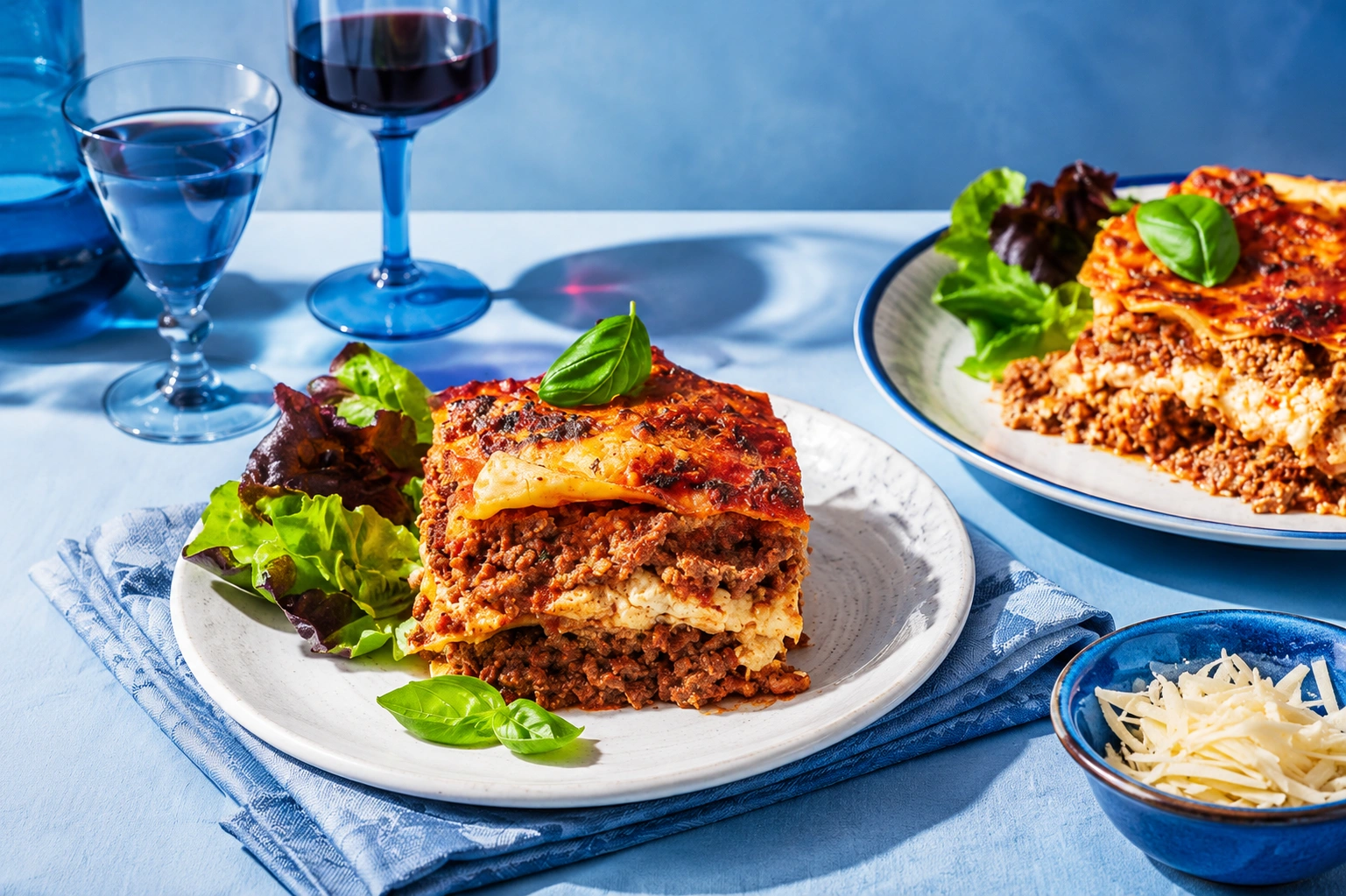
The best Italian food in Rome isn’t subtle. The city eats loudly, seasonally, and with an intensity that borders on religion. Ask a Roman where to find the best Italian food carbonara, and you’ll get an argument, a neighborhood suggestion, and possibly a lecture on why guanciale is not pancetta and never will be.
That fierce specificity is why the best Italian food isn’t found in Florence’s Instagram cafes or a Michelin room in Milan. It’s here, in a Testaccio trattoria where the cacio e pepe gets thrown inside a hollowed wheel of pecorino, or in a Jewish Ghetto kitchen frying artichokes the same way it has since the 1500s.
I’ve eaten my way through this city enough times to have opinions, favorite tables, and a short list of places worth crossing town for. Below are 15 of the best Italian foods that define Roman cooking, plus the addresses where locals actually order them. Skip the spots with a view of the Trevi Fountain and a laminated menu in six languages. The real stuff is a few streets back.
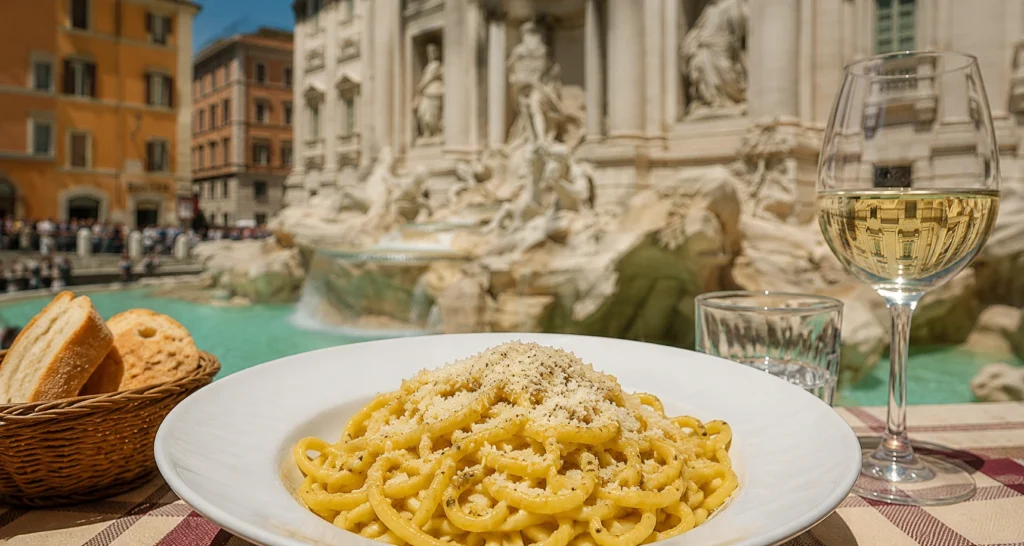
The Four Roman Pastas You Came For
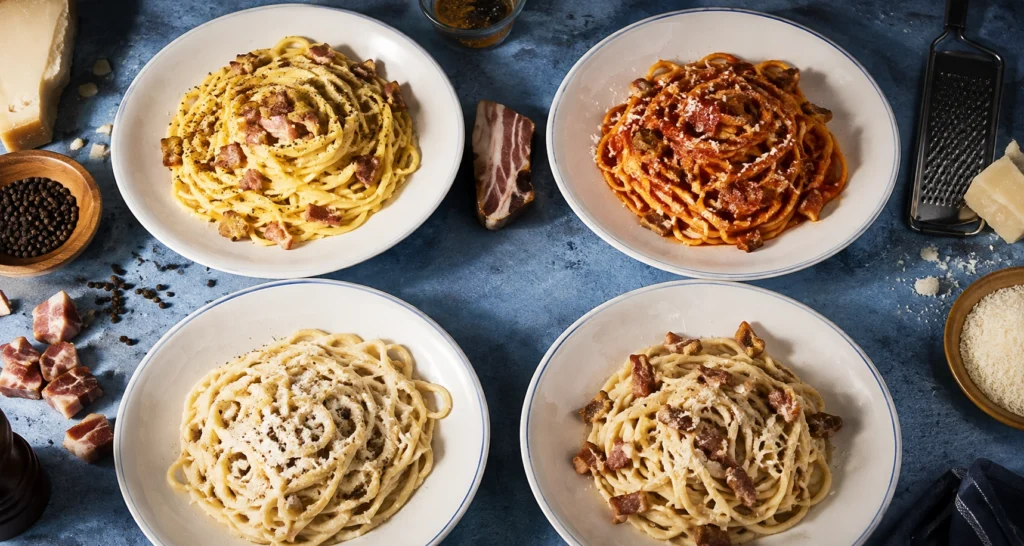
The best Italian food in Rome’s pasta canon is built on four sauces, and they share DNA. Guanciale (cured pork cheek), pecorino romano, black pepper, and egg are recombined into a quartet that has hardly changed in a century. You learn these four, and you learn the spine of Roman cooking.
1. Cacio e Pepe
Three ingredients: pecorino, black pepper, and pasta water. No cream, no butter, no shortcuts. It’s all about how the cheese is emulsified and how it’s still able to cling to the tonnarelli and not get rubbery. It’s the most elegant thing anyone has ever made from nothing.
Where to try it: Felice a Testaccio (Via Mastro Giorgio 29) has been open since 1936 and mixes the best Italian food tableside, folding the tonnarelli into the cheese in front of you. Book ahead, because everyone knows. Over in Trastevere, Da Enzo al 29 (Via dei Vascellari 29) makes a version many locals will defend as the city’s best Italian food. Roscioli uses aged pecorino and expects you to reserve it.
2. Carbonara
The one people get most wrong at home. Real carbonara has no cream, no onion, and no garlic. It’s guanciale, egg yolk, pecorino, and pepper, all cooked off the heat so the eggs turn silky instead of scrambled. The guanciale turns into crisp, fatty gold that permeates the whole bowl and best Italian food.
Where to try it: Roscioli (Via dei Giubbonari 21) is the carbonara pilgrimage that most of the best Italian food writers make, and the queues at 1pm prove it. For a warmer, less polished room, Da Cesare al Casaletto in Monteverde is a hearty and honest version worth the tram ride. Da Enzo also serves a classic if you are already in Trastevere.
3. Amatriciana
Guanciale, tomato, pecorino, and a bit of chili are traditionally over bucatini, so the sauce splashes everywhere. It came down the mountains from Amatrice and became Roman by adoption. The tomato brings sweetness, the guanciale salt and fat, and the pecorino ties it together.
Where to try it: Perilli in Testaccio (Via Marmorata 39) has served old-school Roman cooking for over a century and treats amatriciana with proper respect. Osteria Grappolo d’Oro near Campo de’ Fiori (Piazza della Cancelleria 80) is a reliable central option when you don’t want to trek across the river.
4. Gricia
Best Italian food:- Let us think of gricia as the mother of the other three: guanciale, pecorino, pepper, no egg, and no tomato. It’s the oldest and the plainest, sometimes called “white amatriciana” by purists because there’s nowhere to hide. If the guanciale is good and the cheese is aged right, gricia sings.
Where to try it: Flavio al Velavevodetto (Via di Monte Testaccio 97), built into a hill of ancient broken amphorae, does gricia and the rest of the Roman quartet with generous confidence. Perilli is again a safe bet for the traditional version.
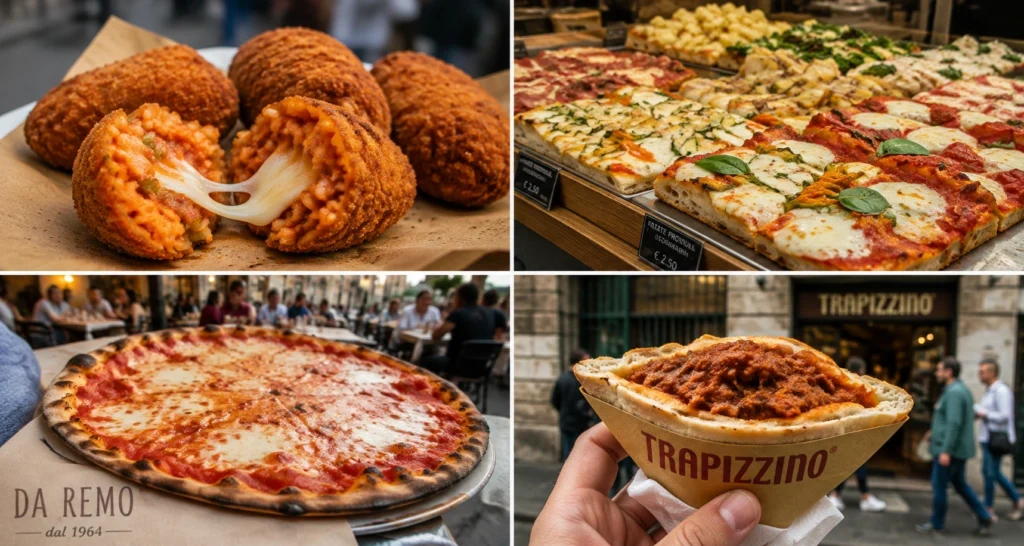
Rome’s Street Best Italian Food: Eating on Your Feet
Before sit-down trattorias, Romans ate standing up. The city built an entire cheap-eats culture centered around fried things and pizza by weight, and it’s still one of the greatest pleasures of visiting on any budget.
5. Supplì
A supplì is a fried rice croquette, usually risotto with tomato and a molten core of mozzarella that stretches into a “telephone wire” when you bite it. The good ones are crisp outside and gooey inside. The bad ones are gym-sock dense. Get to know the difference very soon.
Where can I try it? Supplizio, near Campo de’ Fiori, serves a curated, gourmet version from a proper chef. For something rougher and more everyday, the original Trapizzino counters do a good job, along with their signature. Supplì Roma in Trastevere keeps it cheap and direct.
6. Pizza al Taglio
Pizza by the slice, sold by weight, cut with scissors. You point at what you want, they weigh it, they warm it, and you eat it while walking. Best Italian foods. This is lunch for half of working Rome, and the toppings run seasonal and wild.
Where can I try it: Pizzarium, Gabriele Bonci’s shrine near the Vatican, transformed pizza al taglio into an art form with sourdough bases and creative toppings. Forno Campo de’ Fiori is the classic city-center counter, and the plain pizza bianca there, warm and salty, is a religious experience for a euro or two.
7. Pizza Romana (Tonda)
Not to be confused with Neapolitan pizza. The Roman round pizza is thin, crisp, and almost cracker-like at the edges; cooked fast in a blazing oven and eaten as a full evening out. It’s a different animal from the fluffy Neapolitan version, and Romans will die on this hill.
Where to try it: Da Remo in Testaccio is the loud, no-frills, cash-friendly benchmark, so expect a wait and a paper tablecloth. In Trastevere, the pizzeria on Viale Trastevere, dubbed “the morgue” by locals for its bright lights and marble tables, slings some of the crispest bases in the city.
8. Trapizzino
The one modern invention in this list. Stefano Callegari took a triangular pocket of pizza dough and stuffed it with slow-cooked Roman classics: chicken cacciatore, meatballs in sauce, and oxtail. It’s Roman comfort food in a handheld format, and it works far better than a gimmick has any right to.
Where to try it: The original Trapizzino on Via Giovanni Branca in Testaccio is still the best Italian food, but the brand has since spread across the city and beyond.
The Fried Glory of the Jewish Ghetto
Rome’s Jewish community is one of the oldest continuing communities in Europe, and its cooking, cucina ebraica romana, gave the city some of its most distinctive and best Italian food. The ghetto around Via del Portico d’Ottavia is small, walkable, and worth the afternoon.
9. Carciofi alla Giudia
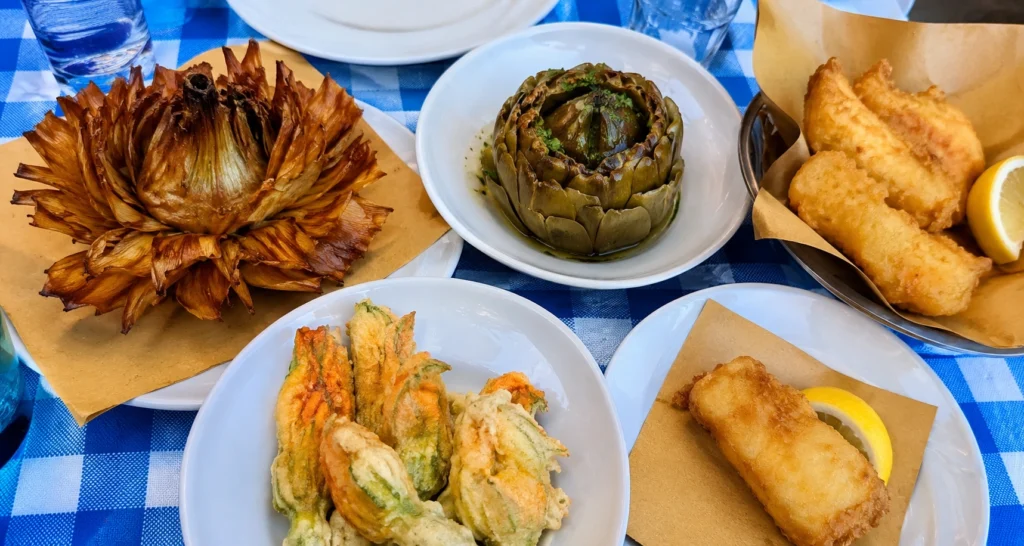
The famous “Jewish-style” artichoke is deep-fried whole twice until the leaves fan open like a bronze flower and shatter like a chip. The best ones are Roman mammole artichokes grown up the coast. The season runs roughly March through May, and in early spring the whole city throws itself an artichoke party: pyramids of them in grocery windows, piles at the Testaccio Market in an ombré of green and purple, and every trattoria board leading with them. If you can, time your trip.
Where to try it: Piperno, which has been open since 1860, calls itself the kingdom of Jewish artichokes and earns the title. Giggetto and Nonna Betta are the other two names locals reel off, and Anthony Bourdain filmed at Nonna Betta for good reason. Check ahead in spring, since the whole city wants a table.
10. Carciofi alla Romana
The other Roman artichoke is often confused with the fried version. This one is braised whole in olive oil, garlic, and mint until meltingly soft, served upright, and eaten leaf by tender leaf. Where alla giudia is crunch, alla romana is silk. Try both in the same meal and pick a side.
Where to try it: Any solid ghetto trattoria does both, so Piperno, Ba’Ghetto, or Nonna Betta will sort you out. Armando al Pantheon also does a lovely braised version in season.
11. Filetti di Baccalà
A fillet of salt cod, battered and fried into a crisp golden log, served hot and best Italian food eaten standing on the street with a paper wrapper and a beer. Simple, cheap, and one of Rome’s great snacks.
Where to try it: Dar Filettaro (known as Filetti di Baccalà) around Campo de’ Fiori has done one thing very well for decades. Piperno does a good sit-down version of it if you want it as a starter.
12. Fiori di Zucca
Zucchini flowers stuffed with mozzarella and anchovy, battered and fried. They turn up on ghetto tables and pizzeria menus alike, and they are the definition of a summer treat: light, salty, and gone in three bites.
Where to try it: The Ghetto restaurants all fry them very well, and Da Remo puts them on the pizzeria menu as a starter before the pizza arrives. When they’re in season, order two portions.
The Roman Second Courses Worth Ordering
Tourists stop at pasta and miss the second course completely. That’s a mistake. Roman meat cooking, particularly the offal tradition established in the Testaccio slaughterhouse district, is where the city gets bolder.
13. Saltimbocca alla Romana
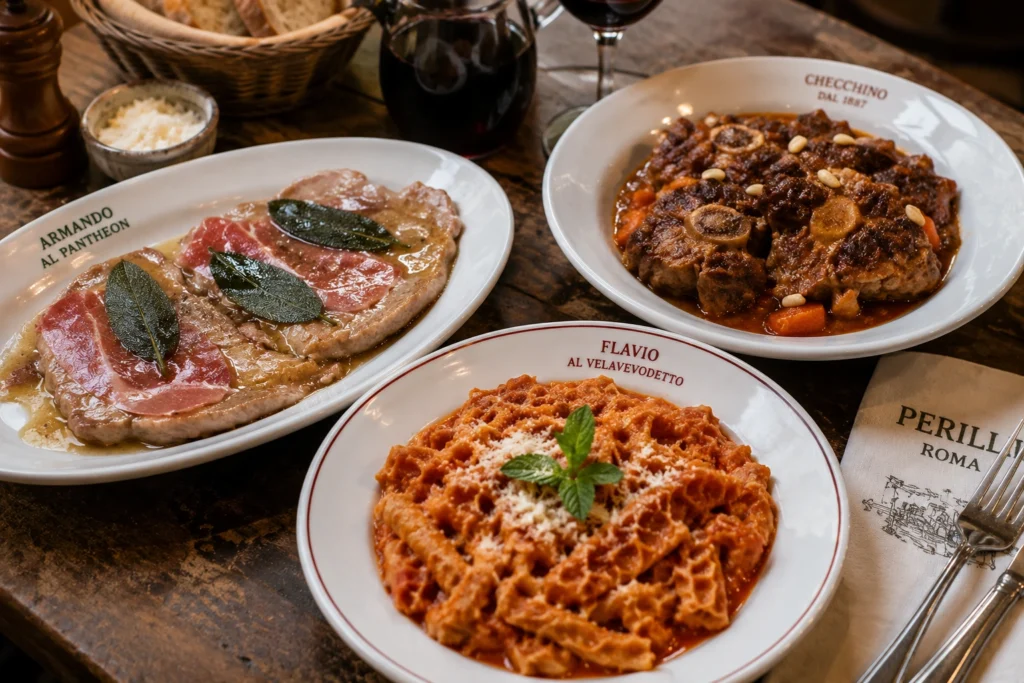
Thin veal, a piece of prosciutto, and a sage leaf pinned together and pan-fried in butter and white wine. The name means “jumps in the mouth,” which is a good warning. It’s fast, rich, and deceptively simple.
Where to try it: Armando al Pantheon, a family-run institution next to the Pantheon, serves a textbook saltimbocca and still feels authentic despite its tourist-heavy location. Grappolo d’Oro is another reliable central choice.
14. Coda alla Vaccinara
Oxtail braised for hours with tomato, celery, and a whisper of cocoa and pine nuts in the old style until the meat falls off the bone. This is Testaccio cooking at its heart, from the “fifth quarter,” the offcuts butchers took home when the prime cuts went to the wealthy.
Where to try it: Flavio al Velavevodetto makes an excellent and celebrated version. Checchino dal 1887, just across from the old slaughterhouse, has been cooking the fifth quarter for well over a century, and it is heritage.
15. Trippa alla Romana
Tripe stewed in tomato and finished with mint and a snow of pecorino. If you’ve only had rubbery, sad tripe elsewhere, the Roman version might convert you. It’s warming, tangy, and unapologetically old-school. Saturday was tripe day in Rome, and still some kitchens are doing tripe in their kitchens.
Where to try it: Perilli and Flavio both do proper trippa, and Da Enzo will serve it in Trastevere when it’s on. Order it, even if you think you do not like tripe. Especially then.
Italian Food and Drink: What to Order Alongside
Roman eating is not just about the plate. The drinks, the coffee ritual, and the sweet finish are half the story, and getting them right marks you out as more than a passing tourist.
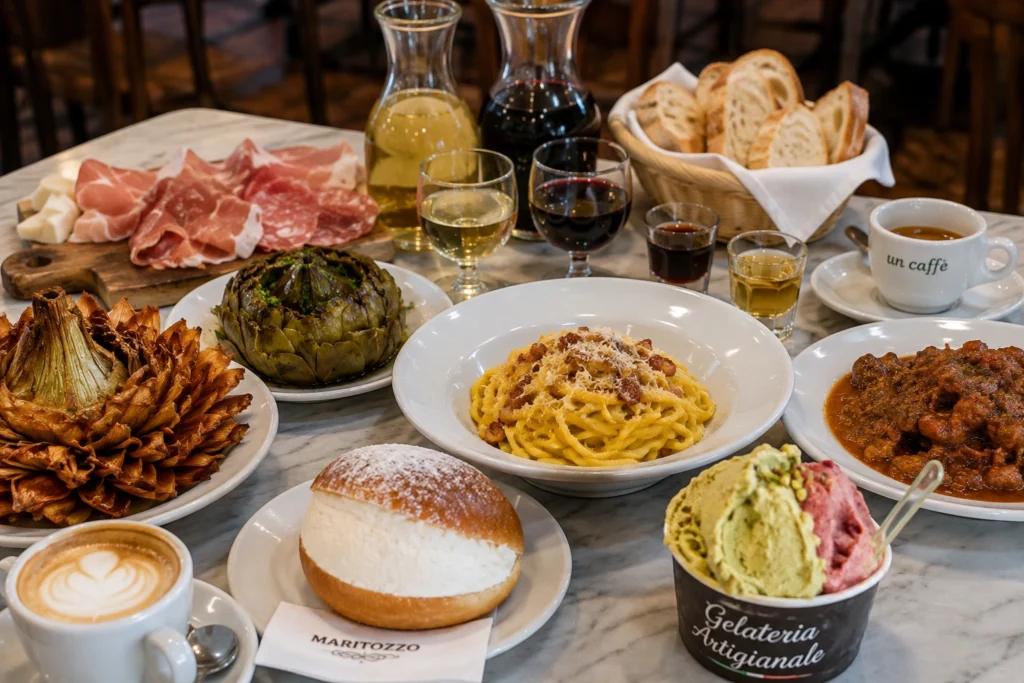
Wine. The house white in Rome is Frascati, a crisp local wine from the hills southeast of the city, and a quartino (a quarter-liter carafe) costs around four euros in a trattoria. It won’t change your life, but it’s exactly right with fried artichokes. For reds, ask for something from Lazio or nearby Abruzzo, like a Montepulciano.
Coffee. Order espresso at the bar, a euro or so at a time. Order a cappuccino after 11 a.m., and you will get a look, but nobody will actually stop you. An “un caffè” refers to an espresso. A “caffè latte” is milky and mostly for kids; don’t think it is a latte back home unless you want warm milk.
The bitter finish. After a big meal, Romans reach for an amaro (a bitter herbal digestive) or a shot of grappa. Both are said to help you digest, which is a convenient theory that lets you keep drinking and eating the best Italian food.
Something sweet. Two options define the Roman sweet tooth. The maritozzo is a soft brioche bun, split and overstuffed with whipped cream, served for breakfast without a hint of guilt. Regoli near Termini has made them for generations, and Roscioli’s bakery does a great job too. Then there’s gelato, and Rome takes it seriously. Gelateria dei Gracchi near the Vatican makes some of the best Italian food, with all-natural ingredients and seasonal fruit. Fatamorgana gets wild with basil, honey, and walnut flavors. Giolitti near the Pantheon is an old-guard classic.
The trick locals use to judge a place: order the pistachio. Every flavor is expensive, but pistachio is the most expensive to make properly with real nuts, so a shop that does it right (muted green instead of fluorescent) is a shop that cares. The other stalls are a sign reading “artigianale” (artisanal), colors that happen naturally, and gelato in covered steel tubs rather than tossed into neon mountains built to lure children.
How a Roman Meal Actually Works
Order like a local, and the meal unfolds in courses, but no one except for the wedding eats all of them. Mix and match as you desire.
- Antipasti, the starters, where the fried ghetto classics and cured meats reside. Ideal for sharing.
- Primi, the first course of pasta, risotto, or soup. This is where the four Roman popes reside.
- Secondi, the mains: saltimbocca, oxtail, roast lamb, and tripe. The priciest line on the menu.
- Contorni, the side vegetables, are ordered separately (Roman artichokes often show up here).
- Dolce, dessert, then caffè (an espresso, never a cappuccino at this time) and a digestivo like amaro or grappa to finish.
It helps to know what kind of room you’ve walked into, and the sign on the door tells you what to expect:
- A trattoria is the Roman workhorse: family-run, with a simple menu, the natural home of carbonara and gricia.
- An osteria started out as a wine-first place and remains informal with a short seasonal menu.
- A ristorante is the dressier, more expensive one with a longer menu and table service, offering the best Italian food.
- A bar is not a pub. It’s a cafe for espresso, pastries, and a quick lunch, and it’s where you’ll get a maritozzo while standing up.
How to Order Food in Italian: A Quick Survival Guide
You don’t need to be fluent, but a few phrases will lead to warmer service and better Italian food. Romans respond well to anyone who tries, even badly.
- “Un tavolo per due, per favore.” A table for two, please.
- “Vorrei…” I would like… (the polite way to start any order).
- “Il conto, per favore.” The bill, please. Waiters won’t hurry it to you, so you have to ask.
- “Cosa mi consiglia?” What do you suggest? A magic phrase that is so often just the best Italian food dish you get for the day.
- “Sono vegetariano/vegetariana.” I’m vegetarian. (First ending for men, second for women.)
- “L’acqua del rubinetto” vs. “acqua naturale/frizzante.” Tap water is seldom offered, so expect still or sparkling bottled water on the bill.
- “Buonissimo!” Delicious. Say it and mean it, and the kitchen will love you.
A few table rules worth knowing: a coperto (cover charge) of a euro or two per person is normal and legal, not a scam. Tipping is not expected the way it is in the US, but rounding up or leaving a euro or two for excellent service is a kind gesture. And lunch generally runs from around 1 pm; dinner rarely before 8 pm, so an empty restaurant at 7 pm is a sign of tourist timing, not a bad kitchen.
How to Eat Well and Avoid the Traps
A few honest rules from too many meals, good and bad:
Walk away from anywhere with a host waving a menu at you on the street, pictures of the best Italian food, or a clear shot of a major monument. You’re paying for the location, not the cooking. Head instead for Testaccio, the old slaughterhouse quarter that the locals still regard as the city’s best Italian food heart, or the quieter back streets of Trastevere and Monti. Book the famous places, because Da Enzo, Felice, Roscioli, and the Ghetto institutions fill up days in advance. Eat what’s in season, especially artichokes in spring and puntarelle in winter. And order the thing that the neighborhood is known for rather than trying to find sushi three streets from the Colosseum.
Rome rewards curiosity and punishes laziness. Do a little homework, walk a few blocks past the crowds, and you’ll eat some of the best Italian food in a city that has been getting it right for two thousand years.
FAQs
1. What is Rome’s best Italian food known for?
Ans: Rome is known for its four signature pastas: cacio e pepe, carbonara, amatriciana, and gricia. Besides pasta, the city has Jewish-Roman fried artichokes (carciofi alla giudia), street best Italian food supplì and pizza al taglio, and hearty offal best Italian food like coda alla vaccinara from the Testaccio District. For many travelers, this quartet of pastas plus a fried artichoke is the core of the best Italian food in Rome.
2. Where do the locals eat in Rome?
Ans: Locals gravitate to Testaccio, the historic slaughterhouse neighborhood with old-school trattorias like Flavio al Velavevodetto and Perilli, and to the back streets of Trastevere and Monti. As a rule, if a restaurant has a laminated multilingual menu and a view of a famous monument, it’s built for tourists. The best Italian food tends to hide a few streets away from the sights.
3. How much does a meal cost in Rome?
Ans: A plate of pasta in a neighborhood trattoria costs 10 to 15 euros and 20 to 25 at destination places like Roscioli. A full dinner with a starter and house wine is usually around 28 to 50 euros per person. Street best Italian food is much cheaper: a supplì or a slice of pizza al taglio costs only a few euros, and an espresso at the bar is around one euro. Prices are approximate for 2026 and worth checking locally.
4. When is the best time to eat carciofi alla giudia in Rome?
Ans: Roman artichoke season runs from roughly March through May, with the coveted mammole variety at its peak in early spring. If fried Jewish-style artichokes are a priority, plan your trip for spring and book a ghetto restaurant like Piperno or Nonna Betta in advance.
5. Do I really need to speak Italian to eat well in Rome?
Ans: No, but a little goes a long way. Most restaurants in tourist areas have English-speaking staff, but learning how to order food in the best Italian food, even a few phrases like “vorrei” (I would like) and “cosa mi consiglia?” (What do you recommend?) gets warmer service and often the best Italian food. The effort is more important than the accuracy in Romans, we think.