

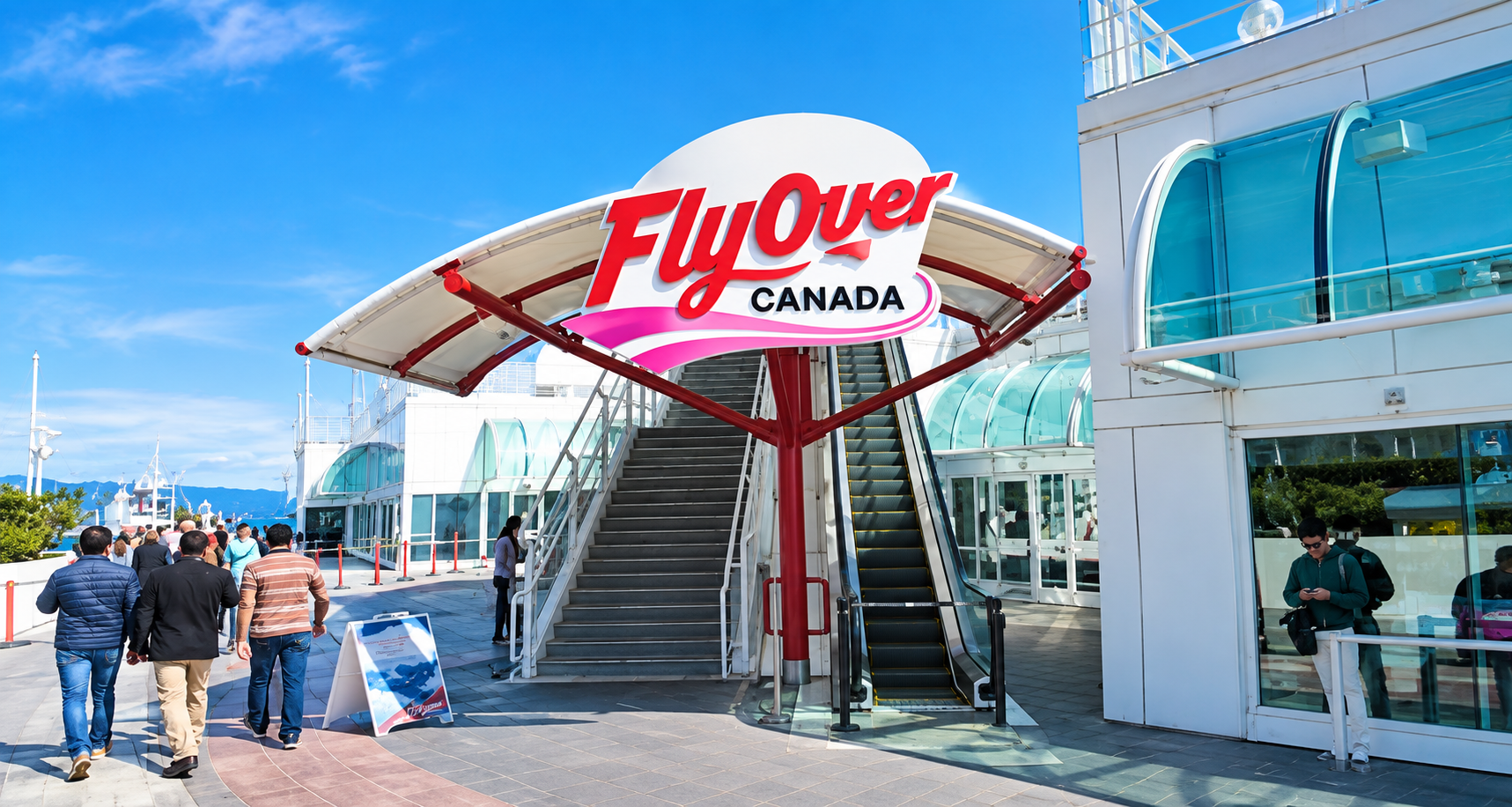
The floor disappears beneath you first. One second you are strapped into a suspended seat with your legs dangling like a kid on a swing set, and the next, the whole theater tilts backward, and the room falls away. Somebody two seats down gasps. A kid up front shrieks with delight. Then the wind hits your face, the smell of pine and salt water rolls in from somewhere unseen, and you’re airborne over a coastline that seems suspiciously like it belongs on a postcard, because it does.
That’s the opening thirty seconds of Flyover Canada, the flying-theater attraction tucked inside Vancouver’s Canada Place, and it’s the reason people walk out of the exit already asking how soon they can go back in. But here’s the question every visitor eventually types into Google before booking: is a ride that lasts less time than your average sitcom episode actually worth the ticket price? I sat through it twice, watched the line of skeptics turn into believers in real time, and dug into everything from the ride mechanics to the fine print on refunds to answer that properly.
This isn’t a press-release rehash. It’s a real, detailed Flyover Canada review: what you’re paying for, what surprised me, who should skip it, and how to get the best seat in the house.
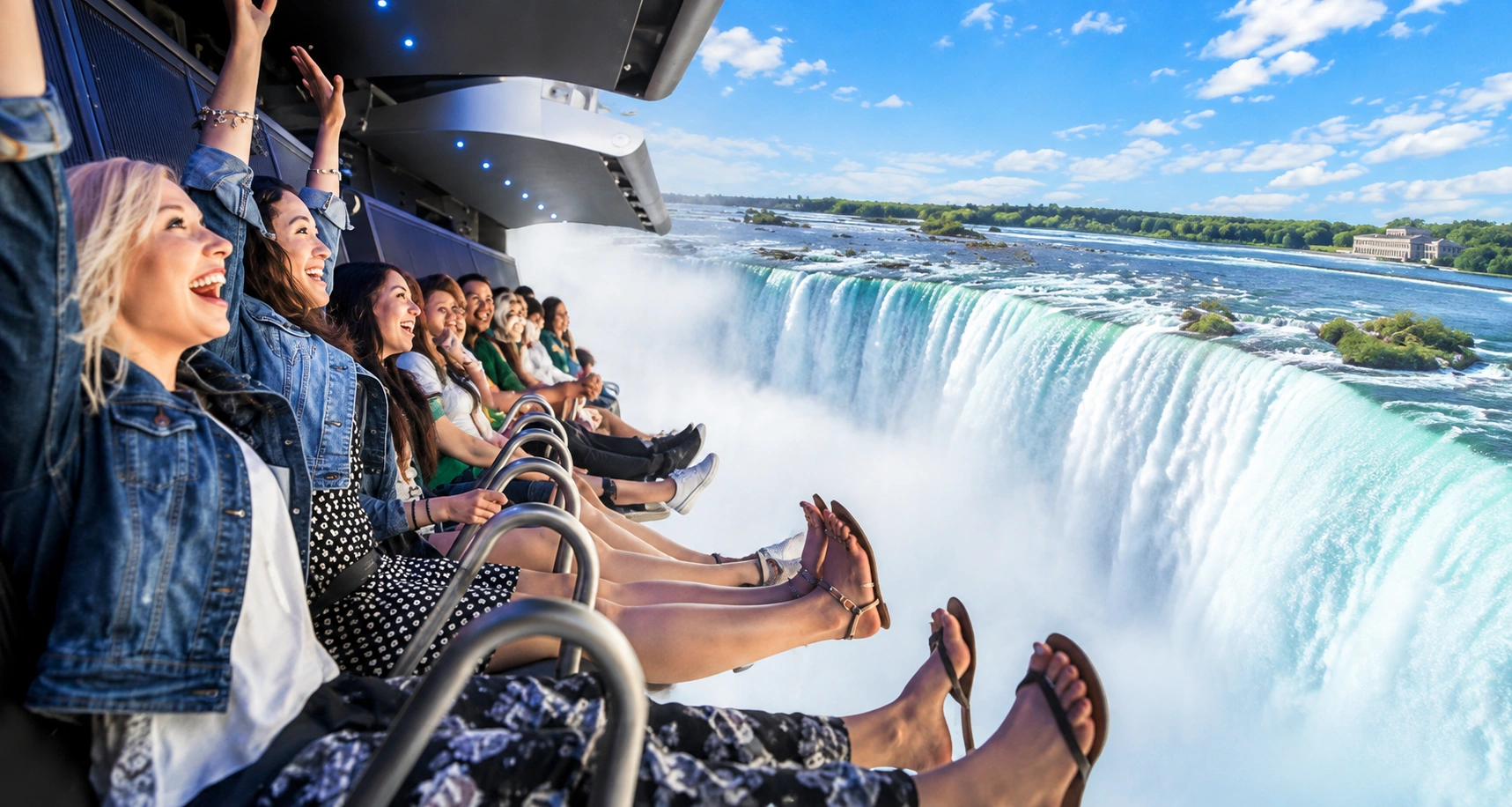
Flyover Canada at a glance
| Detail | Information |
|---|---|
| Location | Canada Place (east end), Vancouver, BC, next to the cruise terminal |
| Ride length | ~8 to 10 minutes |
| Total visit time | 30 to 40 minutes (pre-show, boarding, and flight) |
| Adult ticket | ~28 to 40 CAD |
| Child ticket (under 13) | ~10 to 15 CAD less than an adult |
| Height requirement | 102 cm (40 in) minimum, any age |
| Accessibility | Wheelchair users must transfer into seating |
| Visitor rating | 4.3 to 4.7 out of 5 across major booking platforms |
| Technology | Flying-theater dome, same category as Disney’s Soarin’ |
What exactly is Flyover Canada?
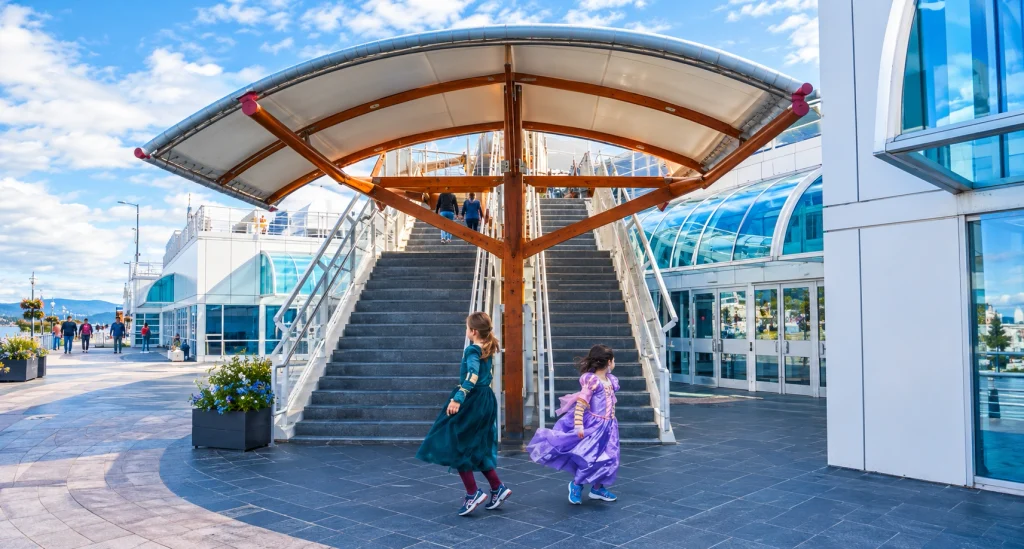
Flyover Canada is what’s known in theme park circles as a “flying theater,” the same underlying technology that brought Disney’s beloved Soarin’ attraction to life, except this version is built entirely around Canadian geography. You and about sixty more guests are strapped into a horseshoe-shaped bank of suspended seats, your feet hanging free below a massive domed screen. When the film begins, the whole seating rig lifts, tilts and swoops in sync with the action, so your body genuinely believes it’s banking over a mountain range or dropping into a waterfall.
It’s not a screen you watch. It’s a screen you’re inside of.
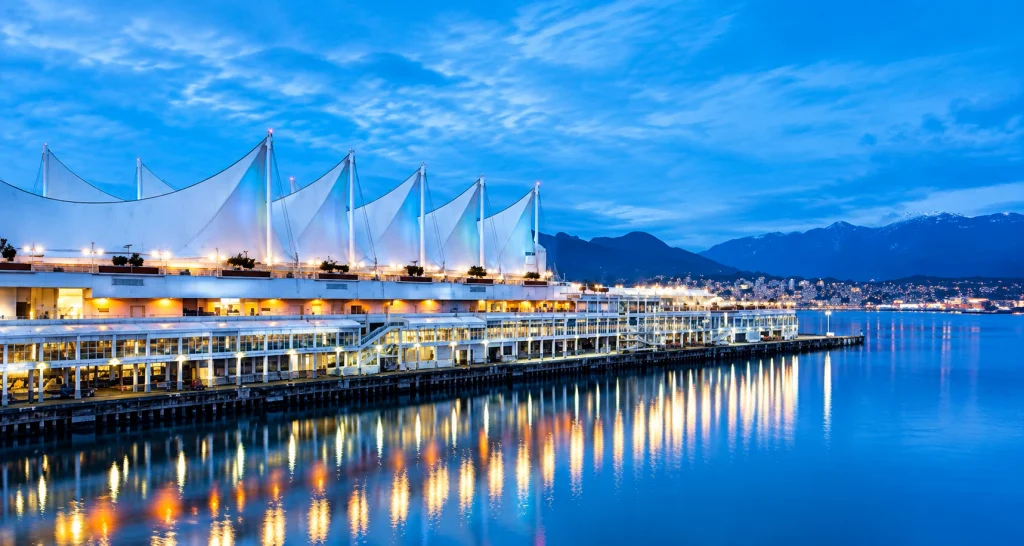
The attraction sits in the east end of Canada Place, next to Vancouver’s cruise ship terminal, which is why many Alaska-bound cruisers slot it in at the front or back end of their trip. It opened in 2013 as a roughly $16 million CAD investment, and one of its leading creative minds, Rick Rothschild, had already led Soarin’ Over California for Disney Imagineering, so the DNA feels familiar if you’ve ridden the Disney version.
Since the original Vancouver location, the concept has moved to sister attractions in Iceland, Las Vegas, Chicago, and the Mall of America, but the Vancouver original is still considered the flagship, and the one most travelers mean when they search Flyover Canada Vancouver.
The 10-minute ride: what actually happens inside
Here’s where a lot of Flyover Canada reviews gloss over the details, so let’s break down the whole sequence, because the “ride” itself is only one piece of a longer, more theatrical experience.
The pre-show warm-up
You don’t just walk into the theater. First, there’s a set-up space, a cool and quiet area with soft visuals and audio that set a tone of Canadian identity: landscapes, people, culture, all of it. It’s mood-setting rather than must-see, and, honestly, it’s the one part of the whole visit where the energy dips a little. Think of it as the opening act before the headliner.
From there, you move to the boarding area, where a “flight crew” runs through safety with a dry, self-aware bit of humour rather than a flat PA announcement. It works. People laugh.
Boarding and liftoff
Getting into your seat feels like a cross between a ski lift and a dentist’s chair: a shoulder harness locks you in, your legs swing free, and there’s a real flicker of “wait, is this safe?” right before the lights dim. That flicker is the point.
Then the floor drops away, the screen curves around your entire field of vision, and the ride begins. Total flight time runs around 8 to 10 minutes, depending on which film version is playing, which is the number that makes people pause before booking. More on whether that’s actually a problem in a second.
The sensory extras
What separates Flyover Canada from “just a movie” is the physical effects layered on top: wind machines that build in high-speed scenes, fine mist as you cruise near waterfalls or ocean spray, and even subtle scent cues (pine forest, salt air) pumped in at the right moments. The seats themselves tilt and vibrate with the footage, so a swoop over a canyon actually registers in your stomach.
It sounds gimmicky on paper. In practice, it’s the difference between watching a nature documentary and feeling like you’re in one.
The film: Where does Flyover Canada actually take you?
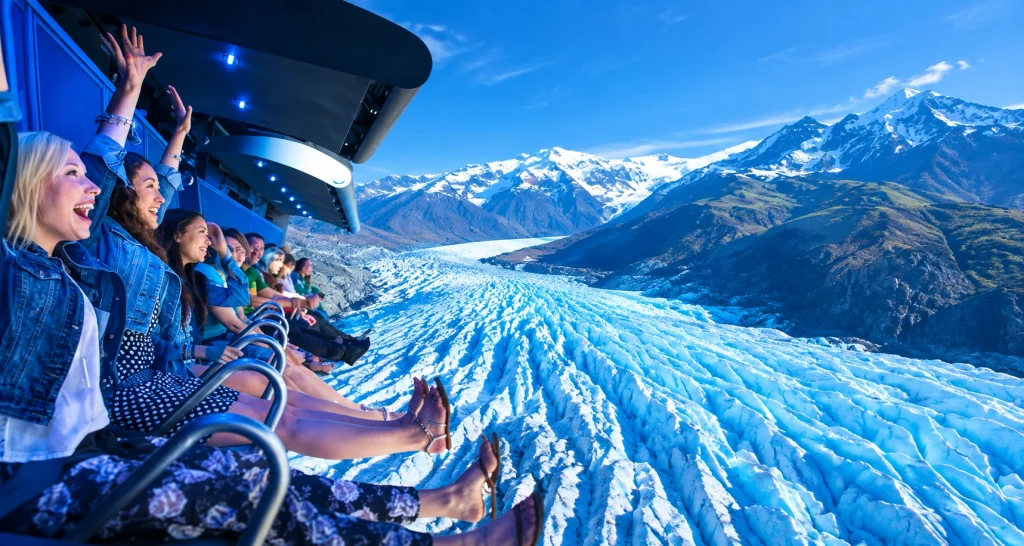
The signature film runs coast to coast, and the route reads like a highlight reel of the country’s most photogenic geography: icebergs drifting off Newfoundland, the fortified charm of Old Quebec, golden prairie stretching across Manitoba, the jagged peaks of the Canadian Rockies, and glimpses of Toronto’s and Vancouver’s skylines woven in for contrast. There are sweeping detours over Niagara Falls, Banff National Park, and the aurora-lit skies of the north, plus vineyard country and rugged fjords to round things out.
It is not a documentary. It’s a highlight reel built for maximum “oh wow” moments, and it mostly delivers. The transitions between locations aren’t always seamless (a couple of scenes are a dissolve rather than a continuous flight), but the visual quality holds up well on the massive dome screen, and the pacing rarely lets the energy drain.
Where you’ll fly during the film
| Region | What you’ll see |
|---|---|
| Newfoundland | Drifting icebergs along Iceberg Alley |
| Quebec | The fortified old city, from above |
| Manitoba | Golden, wind-swept prairie |
| Alberta / BC | The jagged peaks of the Canadian Rockies, Banff National Park |
| Ontario | Niagara Falls up close, mist and all |
| Toronto and Vancouver | Skyline flyovers for urban contrast |
| The North | Aurora-lit skies and dramatic fjords |
| Wine country | Rolling vineyard landscapes |
One thing worth knowing before booking Flyover Canada shows: the film rotates seasonally. Alongside the main feature, the theater occasionally runs alternate or limited-run editions, so if you’ve already flown once, it’s worth checking the current lineup before you go back for round two.

How much does Flyover Canada cost in 2026?
We will do numbers because that is usually the deciding factor.
Flyover Canada tickets for 2026 sit roughly in the following range:
| Ticket type | Online price (CAD) | At-the-door price (CAD) | Notes |
|---|---|---|---|
| Adult (13+) | ~28 to 35 | ~35 to 40 | Dynamic pricing, depending on date, season and time slot. |
| Child (0 to 13) | ~18 to 25 | ~25 to 30 | Must meet the 102 cm (40 in) minimum height requirement. |
| BC resident | Discounted rate | Discounted rate | Valid British Columbia ID required at check-in. |
| Combo / double feature | Bundle pricing | Bundle pricing | Includes a second flight (e.g., Call of the Canadian Rockies) at ~50% off. |
Booking online almost always beats going to the box office: you’ll save a few dollars per ticket, skip the ticket-counter line entirely, and get right into the boarding queue. British Columbia residents can often find discounted rates on certain days (Tuesdays have historically been a value day), and hotel packages around downtown Vancouver sometimes bundle in a Flyover Canada voucher as part of a “welcome to the city” deal, so it’s worth checking your accommodation’s perks before buying separately.
Combo tickets are also worth a look if you’re going to ride more than once or pair the experience with other Canada Place attractions. They tend to bring the per-visit cost down meaningfully compared with buying single tickets each time.
Is it worth the price (at least to you)?
Cost-per-minute math will always make this attraction look rough on paper; nobody’s happy paying $35 for an 8-to-10-minute experience. But that framing misses how the value actually lands. You’re not just paying for flight time; you’re paying for the pre-show build-up, the sensory design, the seat technology, and, for a lot of visitors, a genuine goosebumps moment mid-flight that a regular sightseeing tour or observation deck simply can’t replicate the same way.
Compare it with other big-ticket Vancouver experiences: a helicopter tour over the same terrain will cost hundreds of dollars and needs clear weather. The Capilano Suspension Bridge charges a similar price for a longer but far less intense experience. Against that backdrop, Flyover Canada looks less like a rip-off and more like an efficient, weatherproof way to experience Vancouver and the country’s greatest hits in one sitting, provided you come in with the right expectations.
Pros and cons at a glance
| Pros | Cons |
|---|---|
|
|
Who should (and shouldn’t) book Flyover Canada
It is not a universal must-do, and pretending otherwise would not be an honest review.
| Book it if you… | Skip it if you… |
|---|---|
|
|
Tips for a better Flyover Canada experience
A few things worth knowing before your visit:
- Book a time slot online. Entry is timed, and pre-booking helps guarantee your window, especially during cruise season and busy summer weekends.
- Arrive with a buffer, not a rush. Budget for more than just the advertised flight time for the full visit. Aim to arrive about ten to fifteen minutes before your slot so the safety briefing and boarding don’t eat into your window.
- Sit as close to the centre as possible. The middle seats of the horseshoe get the best view of the dome. Edge seats look slightly flatter, though the motion effects are the same throughout.
- Skip it if you’re already queasy. The motion is convincing, and if you’re prone to simulator sickness, this isn’t the ride to test your limits on.
- Check for seasonal film swaps. If you’ve done the flagship film before, a quick look at the current schedule tells you whether a different feature is running during your visit.
- Pair it with the neighbourhood. Canada Place sits along a scenic waterfront promenade, so budget time before or after for a walk toward Coal Harbour or a bite at one of the nearby restaurants. It turns a single attraction into a proper afternoon, and if you’re building out a wider Canada itinerary, an attraction like the Glacier Skywalk makes a natural pairing further down the road.
How Flyover Canada compares to Soarin’ at Disney
For anyone who has ridden Disney’s Soarin’ (California or Epcot version), the comparison is unavoidable, and the similarities go well beyond coincidence given the shared creative lineage. Flyover Canada uses the same basic seat-and-dome model, but it has a slightly broader range of physical motion and a seating arrangement that keeps other guests’ dangling feet out of your sightline, a small but meaningful difference in the immersion department.
Where it falls a little short is the variety of scenery. Soarin’s global version spans multiple continents, while Flyover Canada is, by design, entirely focused on one country. That isn’t a flaw so much as a different mission: this attraction isn’t trying to be a world tour; it’s trying to be the best possible love letter to Canadian landscapes, and on that narrower goal, it largely works.
If you’re a traveler who collects these flying-theater experiences the way others collect passport stamps, Flyover Canada earns its place on the list. If you’re expecting it to match Disney’s global version scene-for-scene, temper your expectations accordingly.
Flyover Canada vs. other Vancouver experiences
| Experience | Duration | Approx. price (CAD) | Weather-dependent? | Best for |
|---|---|---|---|---|
| Flyover Canada | 8 to 10 min flight / 30 to 40 min total | 28 to 40 | No | Quick, intense, indoor motion thrill |
| Helicopter scenic tour | 20 to 30 min | 200 to 350+ | Yes | Authentic aerial views, special occasions |
| Capilano Suspension Bridge | 2 to 3 hours | 75 to 77 | Partially | Slower-paced nature walk through coastal rainforest |
| Vancouver Lookout | 30 to 45 min | 23 to 25 | No | Static 360-degree city and mountain skyline views |
| Soarin’ (Disney park) | 5 min flight | Included with park admission | No | Theme park guests looking for a global flying theater |
FAQs
1. How long is the actual Flyover Canada ride?
Ans: The flight sequence itself runs 8 to 10 minutes, but the whole visit (pre-show, safety briefing and boarding) typically takes 30 to 40 minutes from start to finish.
2. Where is Flyover Canada located?
Ans: It’s located in Canada Place at the east end, right next to Vancouver’s cruise ship terminal, making it one of the easiest attractions to reach on foot from downtown hotels or before a cruise departure.
3. Is Flyover Canada scary, or does it actually involve real drops?
Ans: There’s no actual free fall, but the seats tilt, swing, and simulate flight motion convincingly enough to feel intense for first-time visitors. It’s more thrilling than terrifying, though guests with motion sickness should be cautious.
4. What is the height requirement for Flyover Canada?
Ans: Riders must be at least 102 cm (about 40 inches) tall. There’s no minimum age beyond that height rule, but very young children may find the motion overwhelming even if they meet the requirement.
5. Are Flyover Canada tickets cheaper if I book online?
Ans: Yes. Booking in advance online is typically a few dollars cheaper than paying at the door, and it guarantees you a specific entry time instead of relying on walk-up availability.
6. Is Flyover Canada wheelchair accessible?
Ans: Yes, with a caveat: guests using wheelchairs need to be able to transfer into the ride seating independently or with the help of a companion, since the seating system itself isn’t wheelchair-adapted.
Final verdict: if you can book it, book it, but book it smart
Flyover Canada isn’t going to replace a real trip across the country, and it was never trying to. What it delivers instead is something rarer: ten compressed, sensory-heavy minutes that make grown adults gasp and kids point at the screen shouting “look,” without needing a passport, a flight, or even one day off work. The pre-show is a little slow, the ticket price stings slightly if you’re doing strict cost-per-minute math, and it’s not a once-in-a-lifetime experience so much as a genuinely great one-and-done (or one-and-done-twice-because-it-was-fun) afternoon activity.
If you’re in Vancouver with an hour to spare, especially before or after a cruise departure, book your slot online, arrive with a little buffer, and grab a seat near the centre. Ten minutes is short. But it’s ten minutes that most travelers walk away from talking about for the rest of their trip, which is exactly what a good attraction does.