

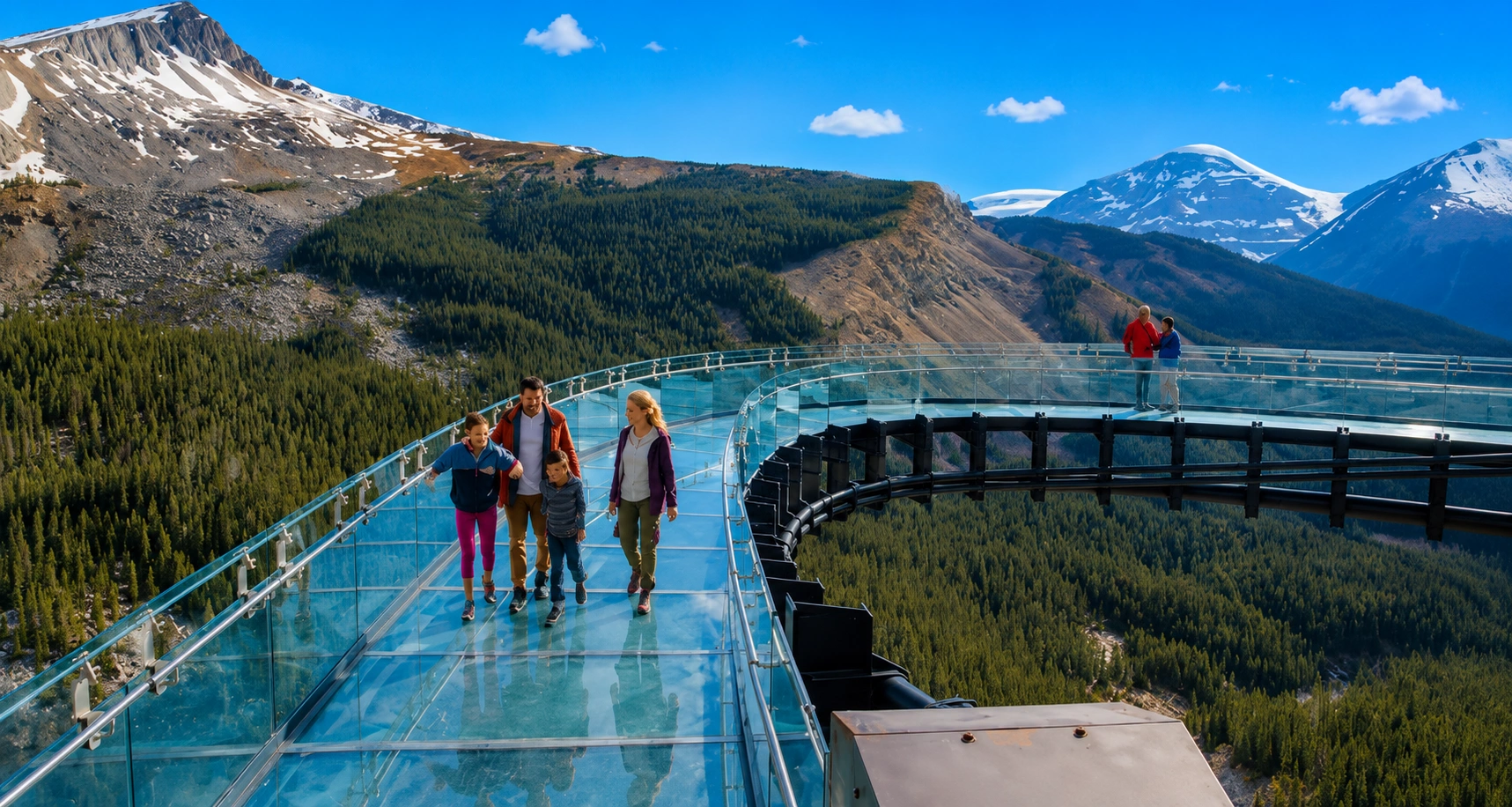
You step onto a floor of glass, and for a half-second your brain files a complaint. Below your shoes is a 918-foot drop into the Sunwapta Valley, and there is nothing between you and the treetops but a pane of engineered glass and your own nerve. That first step is the whole point of the Glacier Skywalk, a curved cliff-edge platform in the Canadian Rockies that has drawn well over 375,000 people a year since it opened.
I have been to a lot of viewpoints that promise something and hand you a fence and a parking lot. This one is different, though not for the reasons the marketing photos suggest. This guide covers what to expect, what it costs, when to go, and whether it earns a slot on your Icefields Parkway drive.
What is the Glacier Skywalk?
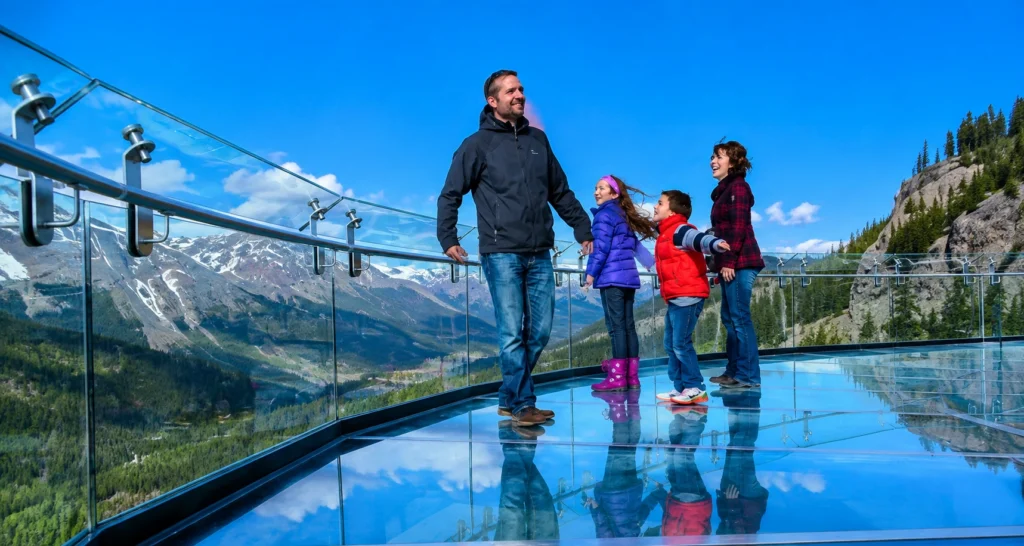
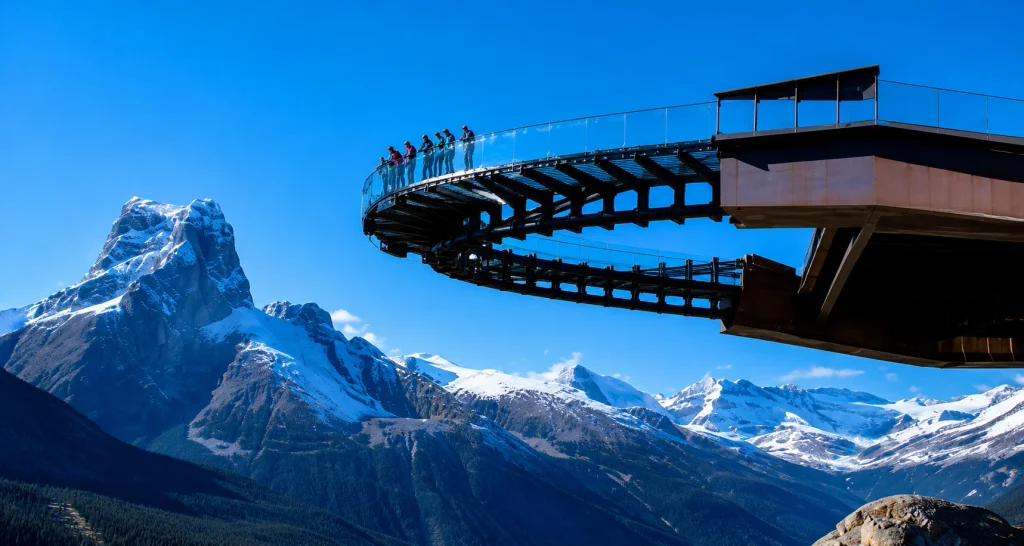
The Glacier Skywalk is a glass-floored observation platform that cantilevers about 35 meters out from a cliff face, roughly 280 meters (918 feet) above the valley floor. It is located on the Icefields Parkway between Banff and Jasper, a short hike north of the Athabasca Glacier and the Columbia Icefield Glacier Skywalk Discovery Centre.
You will see the same attraction listed under several names, which trips up a lot of first-time visitors. The Athabasca Glacier Skywalk, Jasper Glacier Skywalk, Glacier Skywalk Banff, and Columbia Icefield Skywalk all point to the same glass bridge. The multiple names come down to geography. The platform looks out over the Athabasca Glacier, it belongs to Jasper National Park, and it’s close enough to the Banff boundary so that people driving up from Banff will assume it is theirs.
The walk itself runs about 400 meters from end to end along a cliff-edge boardwalk lined with interpretive displays about geology, Glacier Skywalk, and wildlife of the region. An audio guide in nine languages runs as you go. The glass semicircle at the far end is waiting for us, offering approximately 270 degrees of view of the Sunwapta Valley and Mount Athabasca and Mount Andromeda from the horizon.
A Feat of Engineering Most People Walk Right Past
Most visitors view the glass floor as the main event and do not care about the story of how it got there. That story deserves a minute.
Brewster Travel Canada commissioned Calgary firm Sturgess Architecture and engineers Read Jones Christoffersen to design something that would thrill people without scarring the landscape. The proposal was presented in 2011, and it won a Future Projects award at the World Architecture Festival before a single beam went up. PCL Construction built it, and the platform opened to the public in May 2014 with a budget of around $16 million.
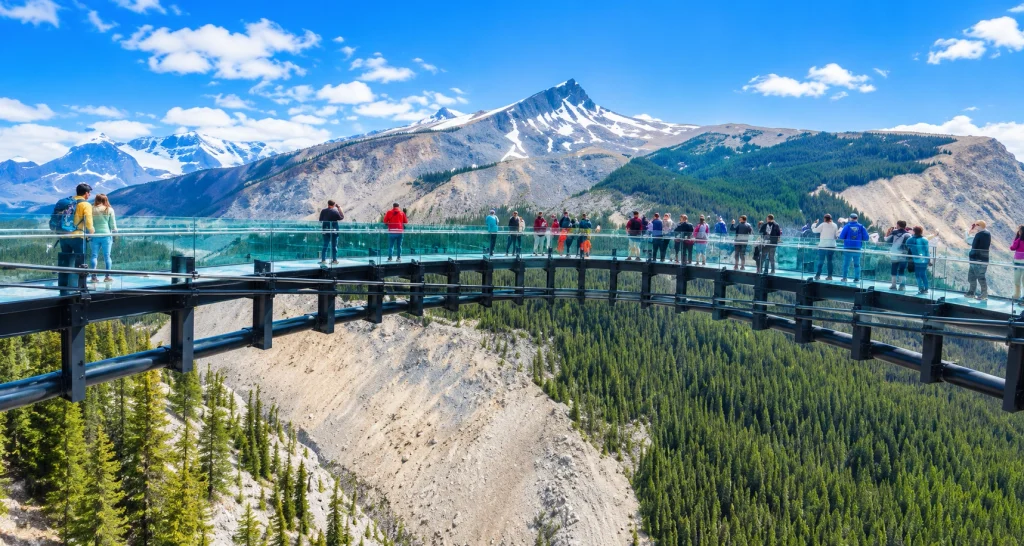
The materials do quiet work. The structure is made of weathered Cor-ten steel, which oxidizes to a rusty brown, and it’s like iron-rich rock from the cliffs, so it’s as much an outcropping as it is a machine bolted onto a mountain. Architect Jeremy Sturgess had one blunt design brief for the glass section: it had to be scary. He got his wish.
Under the outer edge are four tuned mass dampers, visible in the glass if you look, that absorb the sway of footsteps and wind. Wind-tunnel testing in the shape of the walkway prevented it from vibrating in Rocky Mountain gusts. The glass panels are layered and thick enough to stand on with a crowd, though your legs will not believe that for the first thirty seconds. The design was later awarded the Governor General’s Medal in Architecture, one of Canada’s top design honors.
None of this is on a plaque you can read while queuing. Knowing it beforehand shifts the walk from a novelty photo into something that is more akin to something like standing inside a good idea.
What the Walk Feels Like
The experience does not open with the glass. It opens with a shuttle and a boardwalk, and that slow build is part of the design.
You board the bus at the Discovery Centre, roll six kilometres north, and get off at the end of the interpretive trail. The first stretch is a cliff-edge boardwalk hugging the mountainside. Interpretive panels line the route, and the audio guide explains how thrust faults pulled this landscape down, how Glacier Skywalk carved the valley, and which animals are living here. Kids tend to pace themselves through it. The panels give the glass floor its meaning, so by the time you reach the platform, you know you are hanging over a valley that ice spent tens of thousands of years grinding open.
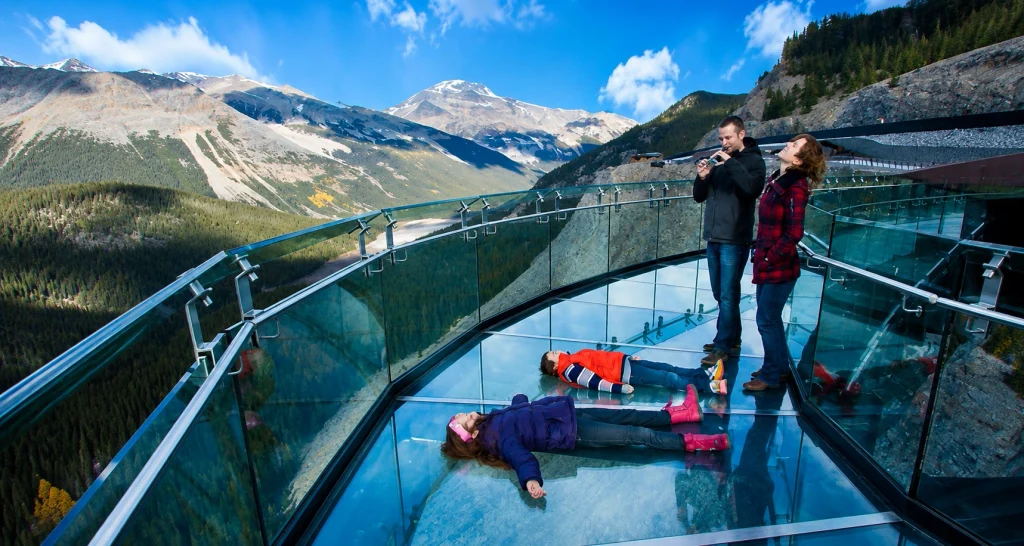
Then the boardwalk curves, the mountainside falls away, and you are on the semicircle. The floor below you turns to glass. Down through it, past your own shoes, the Sunwapta Valley falls away for the better part of a kilometer, the river threading silver at the bottom. Your rational brain knows the panels are bulletproof-grade laminate rated for a crowd. Your knees file a formal objection anyway. To the extent that most people take that first step with one hand on the rail and a nervous laugh, they make sure to take a few steps before they get comfortable, and then take photos in a minute and then get taken.
The platform is a semicircle of view around 270 degrees of the Sunwapta Valley, with Mount Athabasca and Mount Andromeda framing the skyline and the Columbia Icefield glowing high above Mount Kitchener in the distance. Waterfalls hang down the far cliffs. On a clear morning the light is clean and the air is sharp, and for a few minutes crowds and the ticket price fade, and it is just you, suspended in open mountain air.
Glacier Skywalk Price and Tickets
Cost is where people get surprised, so let me be direct about it. The Glacier Skywalk price depends on whether you buy the platform alone or bundle it with the glacier tour. All prices below are Canadian dollars and reflect the 2026 season. Expect them to drift by a few dollars with demand and season.
| Ticket Type | Adult Price | Child Price |
| Skywalk Only | ~$48 | ~$31 |
| Columbia Icefield Adventure (Ice Explorer + Skywalk) | ~$124 | ~$81 |
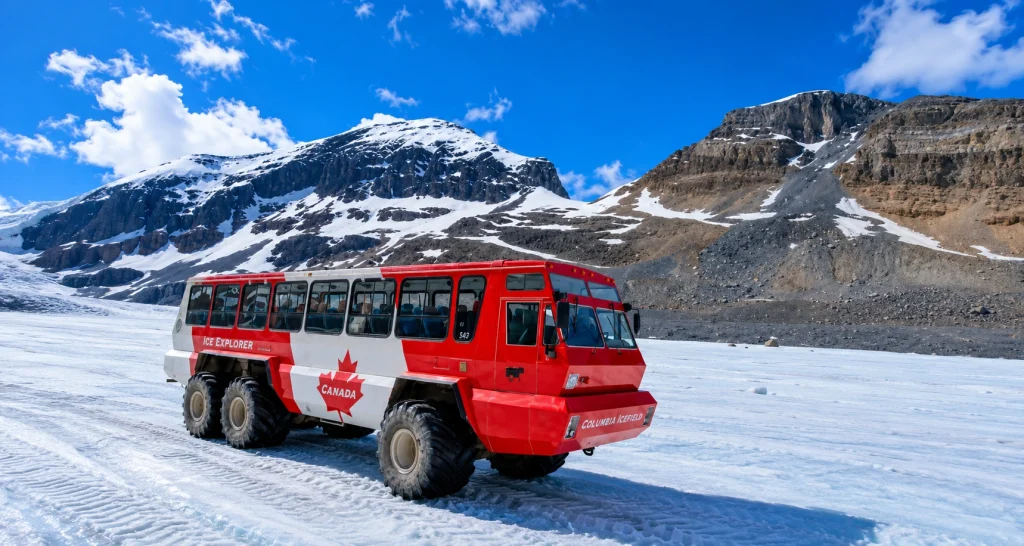
The Columbia Icefield Adventure combines the Athabasca Glacier Skywalk with a ride aboard the Ice Explorer, a six-wheeled vehicle that crawls out onto the glacier itself and lets you stand on 10,000-year-old ice. One catch worth knowing is you can’t book the Ice Explorer without the Skywalk, so the combo is your only way to get on the glacier.
A few ways to trim the bill:
- Go off-peak. Pursuit, the operator, discounts tickets for early-morning and late-afternoon time slots. A departure after 3:30 PM can shave about 20 percent off, and the low light on the glacier is better anyway.
- Alberta residents save. Locals get a discount through Pursuit Rewards with proof of residency, often around 20 percent.
- Bundle passes. Pursuit’s multi-attraction passes bring the Glacier Skywalk trip in with the Banff Gondola, a Lake Minnewanka cruise, the Golden Skybridge, and more, with savings that can reach 25 to 40 percent versus buying each ticket on its own.
Directly book around the Banff Jasper Collection site at the base rate or through Viator and GetYourGuide if you want a full-day tour with transport from Banff or Jasper folded in. The most popular time slots sell out in July and August, so we recommend reserving ahead instead of walking up.
One more line item people forget: the park pass. All visitors must have a Parks Canada pass to even be on the Icefields Parkway. A day pass is $12.25 for adults and free for youth under 18. On a trip of several days through Banff and Jasper Glacier Skywalk, the annual Discovery Pass at $83.50 per adult (or $167.50 for a family of up to seven) pays for itself.
Best Time to Visit the Glacier Skywalk
Visiting time is easy to come by, but the best time to visit is when you are visiting, and what month and at what hour?
Which Season?
The Skywalk runs seasonally, roughly from May 1 to October 12 in 2026, and closes through winter because of snow and ice hazards on the Parkway. It can close at a moment’s notice even in summer, so check conditions the morning you plan to go. July and August bring the warmest weather and the fullest parking lots. June and September thin the crowds while keeping the road open and the light gorgeous. Early September is my favorite window: larches are not turning yet, but the summer rush has eased, and the air already has that first bite of fall. Wildlife sightings also pick up in the shoulder months along the Parkway.
Which Hour?
Book the first tour of the day or one of the last. Midday, from 11 AM until 3 PM, is when tour buses meet and the glass platform gets shoulder-to-shoulder in the middle of the day. Early in the day you’ll get quieter displays and cleaner photos, and late in the day you’ll get golden light and thinner crowds.
In the season, opening hours shift across the season:
| Dates (2026) | Hours |
| May 1 – May 31 | 11:00 AM – 5:00 PM |
| June 1 – September 2 | 10:00 AM – 6:00 PM |
| September 3 – September 28 | 10:30 AM – 5:00 PM |
| September 29 – October 12 | 11:00 AM – 5:00 PM |
Getting There and Parking
The most common mistake: Driving to the Skywalk looking for a place to park. You cannot. There is no parking on the platform, and stopping on the road is not allowed.
Instead, everyone parks at the Columbia Icefield Glacier Discovery Centre and rides an included shuttle around six kilometers to the Skywalk. The shuttle runs every 15 to 30 minutes and takes less than ten minutes. Your ticket also has a time slot, so you can aim to be at the center at that time.
The Discovery Centre is on the Icefields Parkway (Highway 93), about an hour south of Jasper and two and a half hours north of Banff. Coming from Banff, you drive 55 km to Lake Louise and then 125 km north on the Parkway, passing Bow Lake and Peyto Lake on the way, both of which you should stop at. Coming from Jasper, it is 108 km straight down the Parkway.
For anyone who calls it the Glacier Skywalk Banff, the drive from Banff is long, and the attraction is technically in Jasper National Park, not Banff. Plan the day around the distance rather than assuming it is a quick trip from town.
How Long Does It Take?
As a complete day trip, give yourself an hour or so for the Skywalk on its own, shuttle rides included. The walk takes about 400 metres each way, and most people spend 30 to 45 minutes out on the boardwalk taking in views and reading displays.
If you add the full Columbia Icefield Adventure with the Ice Explorer ride onto the Athabasca Glacier, block off three to four hours. That is the version worth doing if you have the time and the budget, because standing on the Glacier Skywalk is the memory people carry home, more than the glass floor.
Is the Glacier Skywalk Worth It? An Honest Take
Now, for the part the operator’s website will never tell you.
The engineering is excellent, the platform is beautifully made, and the accessibility is excellent. The whole route is flat and wheelchair-friendly, which is rare for a Rockies viewpoint and means grandparents and strollers get the same thrill as everyone else. If you are going with someone who cannot manage a hike, this is one of the few places they can stand suspended over a glacial valley.
But the views, though wonderful, are not the most jaw-dropping in the region. Plenty of free hikes nearby, Parker Ridge being the first of those, offer bigger, wilder panoramas for some effort and a good pair of boots. The glass section is also short. Some visitors finish it feeling the ticket only made them more like parking lot and shuttle logistics than wonder.
So who should go? People who love clever design and want the vertigo hit. Families with a range of ages and abilities. Anyone doing the whole glacier adventure, since the Skywalk comes attached anyway. Who might skip it? Budget travelers are happy to earn their views on foot, and anyone expecting the single best vista of their Rockies trip. It is a good experience, not a transcendent one, and knowing that you’re going in tends to make people enjoy it more.
What to Bring and Wear
The Discovery Centre area is at altitude and can be 15 degrees colder than town even in July. Dress in layers, bring a windbreaker, and wear closed-toe shoes with grip if you are also doing the glacier. Sunglasses and sunscreen matter more than you would think at this elevation, because the glare off ice and snow is fierce.
Neither the Skywalk nor the Ice Explorer is pet-friendly, so leave the dog at home or with someone at the center. And charge your phone or camera, because the Sunwapta Valley from a glass floor is a photo you will want.
Pair It With the Athabasca Glacier
If you drive all the way to the Columbia Icefield, do not stop at the glass. The Athabasca Glacier is the reason the Discovery Centre exists, and it is the most accessible Glacier Skywalk in the Canadian Rockies.
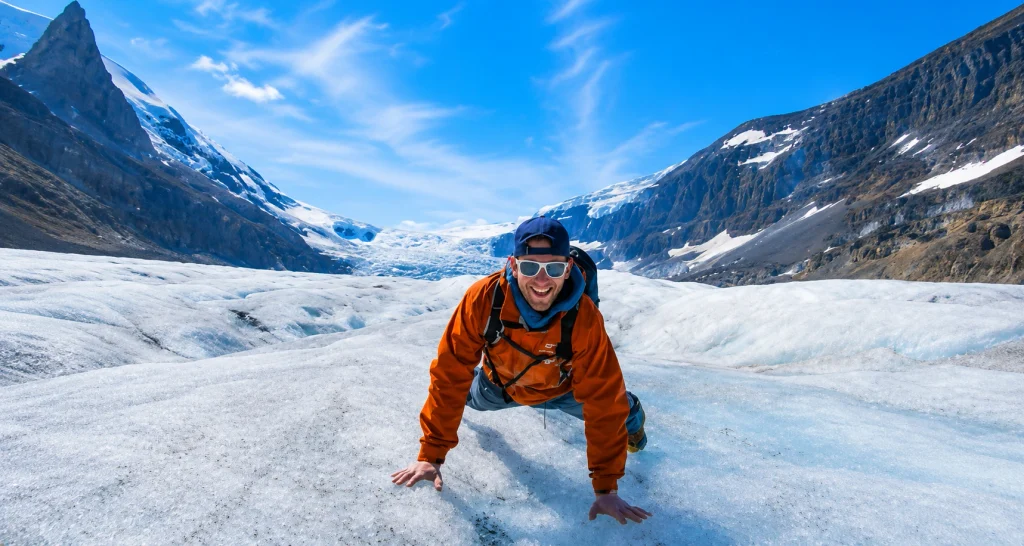
The Columbia Icefield Adventure takes you on the Ice Explorer, a six-wheeled vehicle that descends one of the steepest grades a passenger vehicle attempts anywhere, and then rolls onto the ice. You climb down and stand on a sheet of frozen water about 10,000 years old, thick enough in places to swallow a skyscraper. You can touch it, and if you had a bottle, fill it from a meltwater rivulet. The glacier is far colder than the parking lot, and so those layers you put on earn their place here.
For a lower cost and a bigger workout, guided ice walks with independent operators take you onto the Glacier Skywalk on foot with crampons and a guide, revealing the crevasses and blue ice that the Ice Explorer route skips. The free option is the toe of the Glacier trail from the Discovery Centre, a short walk to the glacier’s edge that costs nothing but a little effort and a park pass.
Other Stops Along the Icefields Parkway
The drive to the Skywalk is not filler between destinations. The Icefields Parkway is one of the most scenic roads in the world, and the stretch around the Columbia Icefield is packed with places worth the pull-over.
Bow Lake and Peyto Lake are both short detours off of the road from the Banff side, and Peyto Lake’s wolf-head shape with glacial blue is one of the most photographed views in Canada. Parker Ridge, south of the Discovery Centre, is a tough but short hike that rewards you with a glimpse at the Saskatchewan Glacier Skywalk, which is better than anything the glass platform can offer to see, and it is free. Sunwapta Falls and Athabasca Falls are both on the Jasper Glacier Skywalk side of the road and take minutes to reach and are very close to the road.
When we integrate these into the day, it is hard to see the Skywalk as such a pricey standalone attraction, and it starts to look like this one bead on a good string.
Where to Stay Nearby
It’s a remote part of the Rockies, and there is little to no hotel there. The only hotel right at the icefield is Glacier View Lodge, a hotel with an excellent view of the Athabasca Glacier and priced close to its rarity. Down the Parkway, you can find Sunwapta Falls Rocky Mountain Lodge and HI Rampart Creek Hostel near Saskatchewan River Crossing with more modest budgets. Campers have several Parks Canada campgrounds in reach. Most visitors live in Jasper Glacier Skywalk or Banff and view the Skywalk as a day trip that can be done on their own and the drive distances are so long enough that it’s quite manageable.
The Bottom Line
The Glacier Skywalk is an elegant, beautiful design that will let anyone hang over a glacial valley on a sheet of glass and feel their stomach drop. It’s not the most dramatic view of your Canadian Rockies trip (the hikes nearby win on raw scenery), but few of them let you stand suspended in open air the way this platform does, wheelchair or hiking boots or not.
Treat it as one stop on a bigger Icefields Parkway day, pair it with the glacier tour if the budget allows, go early or late to avoid the crowds, and check the weather before you commit. Do that, and the first step onto the glass earns its ticket.
FAQs
1. How high is the Glacier Skywalk?
Ans: The glass-floored platform hangs about 280 meters, or 918 feet, above the Sunwapta Valley floor. The Discovery Vista, a smaller glass platform earlier on the walk, juts about 35 meters out from the cliff.
2. Is the Glacier Skywalk in Banff or Jasper?
Ans: Jasper. Despite the nickname of Glacier Skywalk Banff, the platform is in Jasper Glacier Skywalk National Park just north of Banff. Driving up from Banff takes about two and a half hours, which is why the confusion exists.
3. Is the glass floor safe?
Ans: Yes. The layered glass panels are designed to hold a crowd, and four tuned mass dampers under the platform keep it steady against footsteps and wind. Your instincts will protest on the first step regardless, which is exactly what architect Jeremy Sturgess wanted.
4. Can I visit the Skywalk without the glacier tour?
Ans: Yes. You can get a Skywalk-only ticket for around $48 per adult. The reverse is not true, however: you cannot book the Ice Explorer glacier ride without also getting the Skywalk.
5. Do I need a Parks Canada pass?
Ans: Yes. Everyone on the Icefields Parkway needs one. A day pass is $12.25 per adult; youth under 18 go free, and an annual Discovery Pass is $83.50 per adult if you are staying several days.
6. When is the best time to visit the Glacier Skywalk?
Ans: Aim for June or September and take the first or last tour of the day. Midday in July and August is the busiest time, and the platform can feel packed then.