

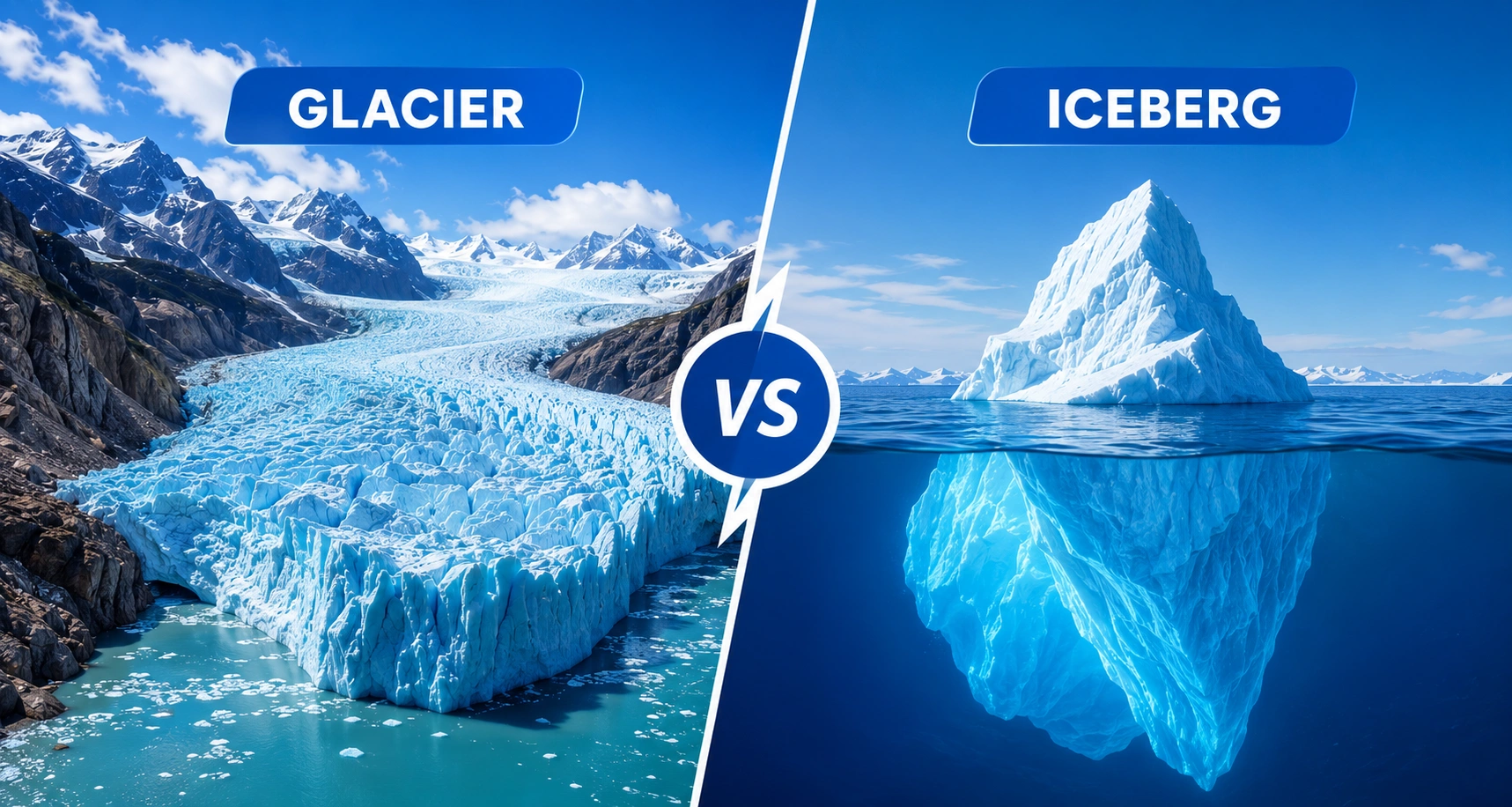
Stand on a cold shoreline in Alaska or Iceland and you will often hear the words Glacier vs Iceberg and iceberg used as if they mean the same thing. They don’t. The two are closely related — one is literally born from the other — but they live in different places, behave in different ways, and matter for different reasons.
Here is the simplest way to hold the two apart. A glacier is a huge mass of ice that forms and moves slowly across land. An iceberg is a chunk of ice that has broken away from a glacier or an ice shelf and now floats freely in water. In other words, every iceberg was once part of a glacier or shelf, but not every Glacier vs Iceberg ever produces an iceberg.
That distinction is more than trivia. It changes how you read a landscape, how scientists track climate signals, and how you plan a trip to see frozen scenery up close. Across this guide we’ll work through the full Glacier vs Iceberg comparison — formation, location, movement, size, colour, lifespan, melting, and climate significance — and finish with real destinations, from Glacier National Park in Montana to the iceberg lagoons of Iceland.
Quick answer: A glacier is land-based ice that flows downhill under its own weight. An iceberg is a floating piece of glacial or shelf ice adrift in the sea or a lake. The core of the Glacier vs Iceberg difference is simple: glaciers sit on land, icebergs float on water — and icebergs are pieces that have calved off glaciers.
What Is a Glacier?
A simple definition of a glacier
A glacier is a thick, long-lasting body of ice that forms on land where more snow falls each year than melts away. Over decades and centuries that snow piles up, gets squeezed into dense ice, and — crucially — begins to move. That slow, gravity-driven flow is what separates a true Glacier vs Iceberg from an ordinary snowfield that simply sits still and melts.
How glaciers differ from ordinary snow and ice
The journey from a fresh snowflake to glacial ice is a story of pressure and time:
- Snow accumulates season after season without fully melting.
- The weight of new snow compresses the layers beneath it.
- Trapped air is squeezed out and crystals fuse into dense, hard glacial ice.
- The ice persists for long periods — often centuries or far longer.
- Once thick enough, the whole mass creeps downhill under gravity.
That last point is the key. A backyard snowbank is not a glacier. A body of ice large and old enough to flow is.
Where glaciers are usually found
Glaciers need cold and, usually, height or high latitude. You’ll find them in:
- High mountain ranges such as the Alps, Rockies, Andes and Himalaya.
- Polar regions, above all Antarctica and Greenland, which hold the planet’s two great ice sheets.
- Alaska, Iceland, Norway, Switzerland and Patagonia, where alpine and coastal glaciers reach low elevations.
- Other high-altitude zones where snow survives the summer.
Types of glaciers
“Glacier” covers a whole family of ice bodies:
- Valley glaciers — rivers of ice confined between mountain walls.
- Mountain (alpine) glaciers — ice clinging to high peaks and cirques.
- Continental ice sheets — vast domes covering Antarctica and Greenland.
- Ice caps — smaller dome-shaped ice masses over highland terrain.
- Outlet glaciers — tongues that drain ice sheets and ice caps.
- Tidewater glaciers — glaciers that flow all the way to the sea and calve directly into it.
In short: A glacier is a moving mass of land-based ice built from compressed snow — the source from which most icebergs are born.
What Is an Iceberg?
A simple definition of an iceberg
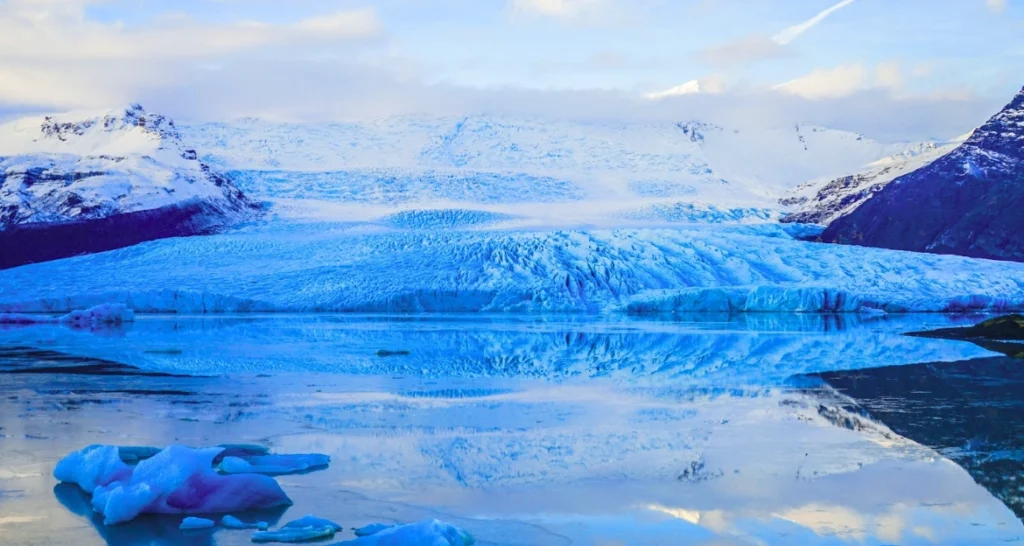
An iceberg is a large piece of freshwater ice floating in open water after breaking away from a glacier or ice shelf. If a glacier is the parent, an iceberg is the offspring set adrift. It is no longer attached to land; it drifts, tips, melts and eventually disappears.
How icebergs form through calving
Icebergs are created by calving — the dramatic moment when a slab of ice fractures off the leading edge of a glacier or shelf and crashes into the water. Calving happens where flowing ice meets the sea or a deep lake, and the front becomes too undercut, too stretched, or too buoyant to hold together.
Where icebergs are found
Icebergs cluster in the waters fed by calving glaciers and ice shelves: around Antarctica, off Greenland and eastern Canada, in Alaskan fjords, and in glacier-fed lakes and lagoons such as those in Iceland. Some drift surprisingly far south into shipping lanes of the North Atlantic before they melt.
Different iceberg shapes
Sailors and scientists classify icebergs by form:
- Tabular — flat-topped and steep-sided, like a floating table, typical of shelf ice.
- Dome-shaped — smooth, rounded tops.
- Pinnacled — one or more spires and peaks.
- Blocky — steep sides and a level top, but chunkier than tabular bergs.
- Irregular (drydock) — weathered, eroded shapes with channels and arches.
Why icebergs drift
Once afloat, an iceberg has no engine and no anchor. Its wandering is driven by:
- Ocean currents pushing the huge submerged mass.
- Wind acting on the exposed sail of ice above water.
- Waves nudging and eroding the berg.
- Water temperature, which controls how fast it melts and breaks apart.
Glacier vs Iceberg: The Main Difference
This is the heart of the Glacier vs Iceberg question, so it’s worth slowing down. The two are made of similar ice, yet almost everything about where they live and how they behave is different.
Glacier vs Iceberg in one sentence
A glacier is ice that forms and flows on land; an iceberg is ice that floats after breaking off a glacier or shelf. That single line captures the essential Glacier vs Iceberg difference.
Where they exist
Glaciers are anchored to land — mountains, valleys and polar landmasses. Icebergs float in water, whether that’s the open ocean or a glacier-fed lake. If it’s attached to the ground and creeping downhill, it’s a glacier. If it’s bobbing and drifting, it’s an iceberg.
How they form
The two are linked by a single process. Glaciers form through accumulation — the long build-up and compression of snow. Icebergs form through calving — the breaking-away of ice from a glacier or shelf front. So the Glacier vs Iceberg relationship is really a life cycle: accumulation builds the glacier, and calving releases the iceberg.
How they move
A glacier moves by flowing across land, usually just centimetres to a few metres a day, driven by gravity. An iceberg moves by drifting through water, steered by currents and wind, and can travel far faster and far further than the glacier that produced it.
Size and shape
Glaciers tend to be broad, layered, flowing masses that dwarf almost any single iceberg. Icebergs come in endless shapes and are usually far smaller than their parent glacier — though the largest tabular bergs can still be enormous.
Lifespan
A glacier can persist for centuries or millennia. An iceberg, cut off from its cold source and exposed to warmer water, typically survives only weeks, months or a few years before it melts or shatters.
What happens when they melt?
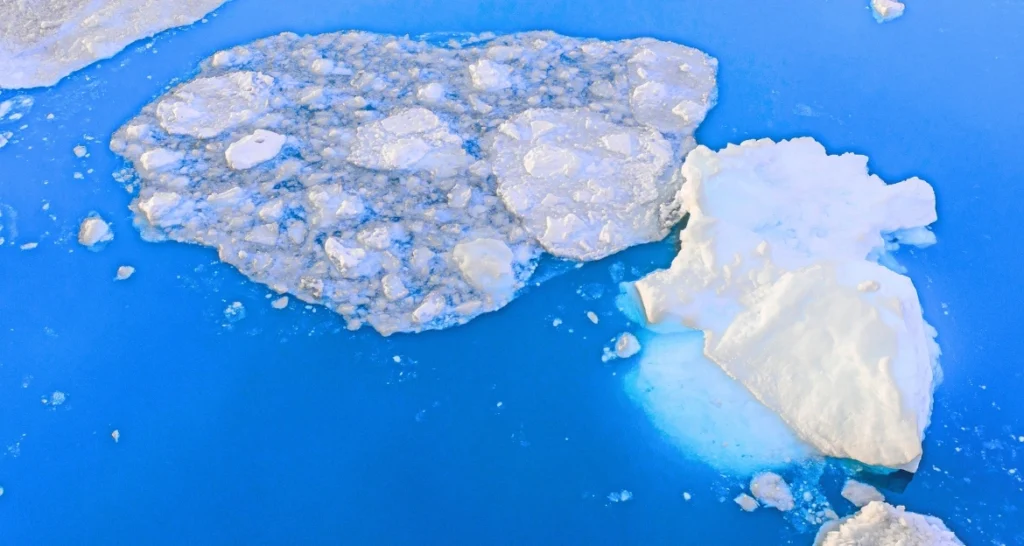
When an iceberg melts, it is completing its natural life cycle and, because it was already floating, its melt does not by itself raise sea level. When a glacier loses mass on land and that water reaches the ocean, it does add to sea-level rise. That contrast is one of the most important parts of the whole Glacier vs Iceberg story, and we’ll return to it in the climate section.
How Do Glaciers Form?
Snow accumulation
Everything starts with snow that survives the melt season. In cold, snowy environments, each winter leaves behind a layer that the following summer cannot completely erase. Year after year, those surviving layers stack up.
Compression and recrystallisation
As the pile deepens, the weight above squeezes the snow below. Fluffy flakes lose their delicate arms, air escapes, and the snow turns into a grainy, denser material called firn. With more pressure, firn recrystallises into solid glacial ice.
Formation of glacial ice
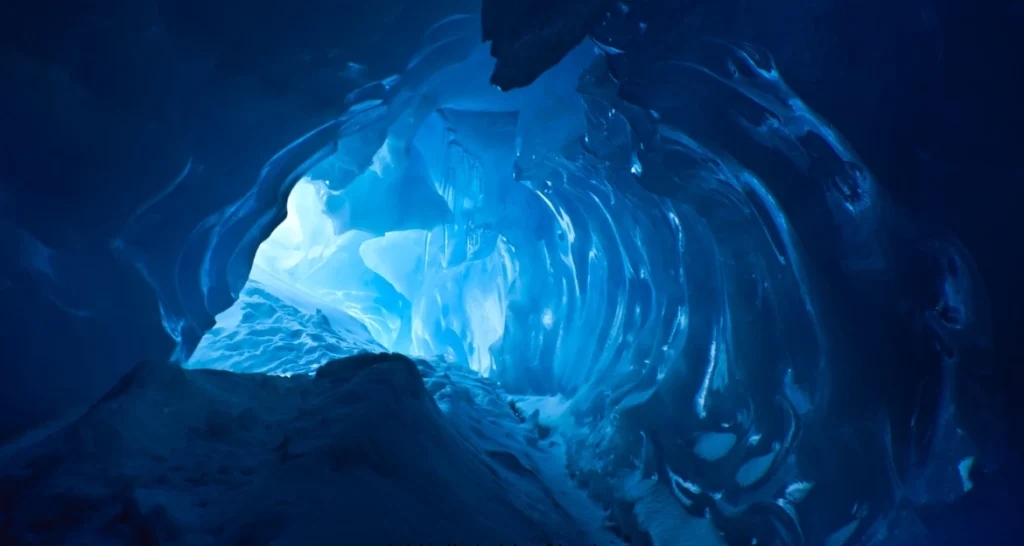
Dense glacial ice is what gives many glaciers their striking blue tint. Tightly packed, low-air ice absorbs red light and scatters blue — a visual signature of the long compression that formed it.
When does accumulated snow become a glacier?
The threshold is movement. Once the ice mass is thick and heavy enough to deform and slide under its own weight, it stops being a static snowfield and becomes a flowing glacier.
How gravity causes glaciers to move
Gravity pulls the ice downslope. The glacier flows partly by internal deformation — ice crystals sliding over one another — and partly by basal sliding, where meltwater lets the whole mass glide over the bedrock beneath.
The full pathway looks like this:
- Snow — fresh snowfall accumulates.
- Firn — compressed, granular old snow.
- Glacial ice — dense, recrystallised ice.
- Moving glacier — the mass flows under gravity.
How Do Icebergs Form?
What is glacier calving?
Calving is the breaking-off of ice from the front of a glacier or ice shelf into water. It is the single mechanism that turns part of a glacier into an iceberg, and it is the bridge that connects both halves of the Glacier vs Iceberg comparison.
Why pieces of glaciers break away
As a glacier flows into the sea or a deep lake, its floating or overhanging front is stressed by buoyancy, tides, waves and meltwater. Cracks widen until a slab finally fractures free — often with a thunderous crack and a large splash.
Glacier-to-iceberg formation process
The relationship can be traced in four steps:
- A glacier (or ice shelf) flows toward water.
- Its front becomes stressed and undercut.
- A slab calves off and drops into the water.
- The floating ice becomes an iceberg and drifts away.
Can icebergs form from ice shelves?
Yes. Ice shelves — vast floating platforms of glacial ice fringing Antarctica — shed some of the world’s biggest tabular icebergs when huge slabs break loose along fractures.
Can icebergs form in lakes?
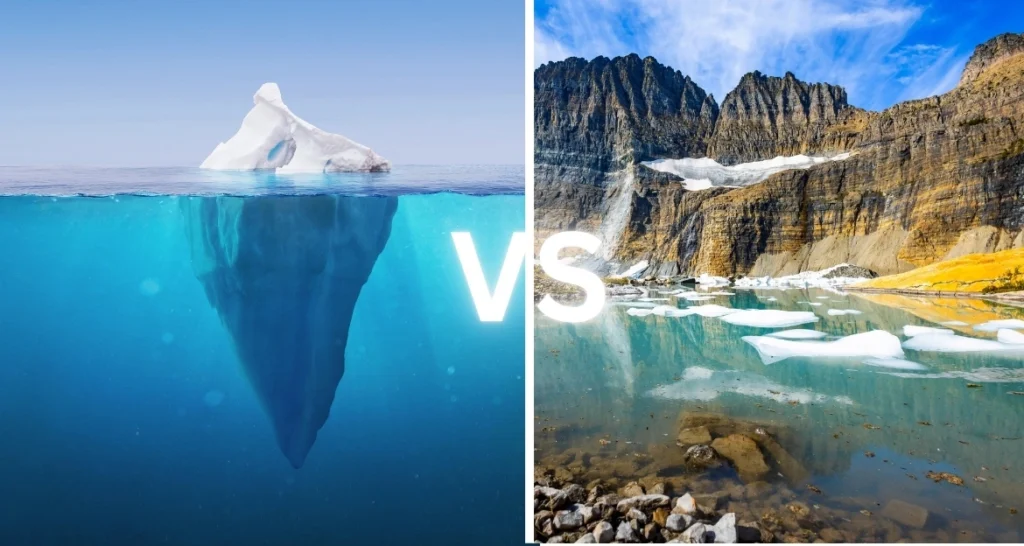
They can. Where a glacier ends in a deep lake or lagoon, it calves floating ice into freshwater. Iceland’s glacier lagoons are the classic example, and Montana’s own Upper Grinnell Lake below Grinnell Glacier fills with small floating bergs — a miniature version of the same process.
The chain in one line: glacier or ice shelf → calving → floating ice → iceberg.
Glacier vs Iceberg: Side-by-Side Comparison
If you only remember one thing, make it this table. It distils the entire Glacier vs Iceberg comparison into a single view.
| Feature | Glacier | Iceberg |
|---|---|---|
| Basic definition | Large mass of land-based ice | Floating piece of ice |
| Main location | Land (mountains, polar regions) | Ocean or lake |
| Formation | Snow accumulation and compression | Calving from a glacier or ice shelf |
| Movement | Flows slowly over land | Drifts with water and wind |
| Water environment | Usually land-based | Floats in water |
| Shape | Broad, layered, flowing mass | Many shapes and forms |
| Freshwater? | Yes | Yes |
| Main natural process | Accumulation, flow, melting | Calving, drifting, melting |
| Lifespan | Centuries or longer | Generally much shorter |
| Main danger | Crevasses, avalanches, unstable ice | Hidden submerged mass, calving |
How Big Are Glaciers Compared With Icebergs?
Typical glacier dimensions
Glaciers range from small alpine tongues a kilometre or two long to the continental ice sheets of Antarctica and Greenland, which span thousands of kilometres and can be over three kilometres thick. In sheer scale, a glacier almost always outsizes any single iceberg it produces.
How large can an iceberg become?
The biggest tabular icebergs that calve from Antarctic ice shelves can be genuinely vast — rivalling the area of small countries — but these giants are the exception. Most bergs you’ll ever see are a tiny fraction of that size.
Why iceberg size can be misleading
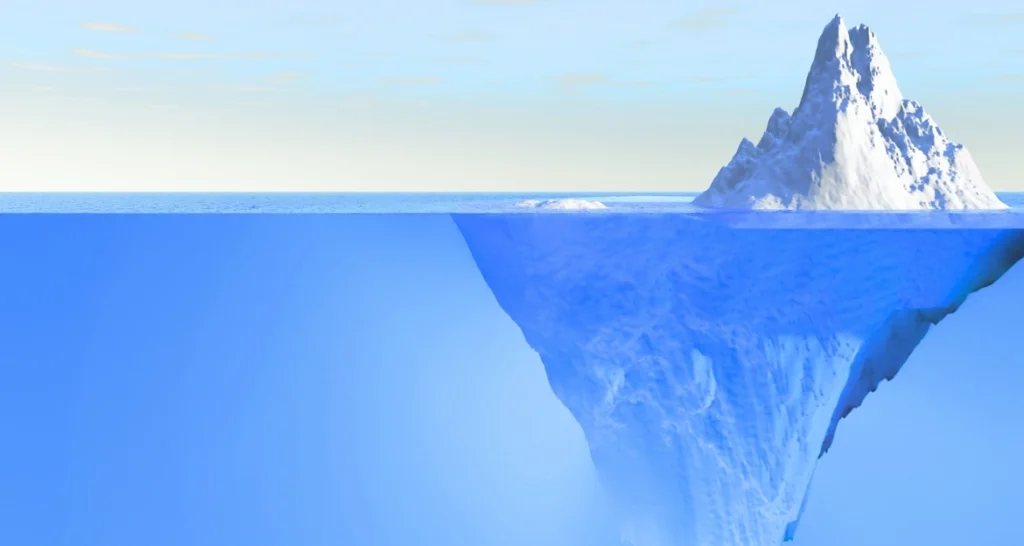
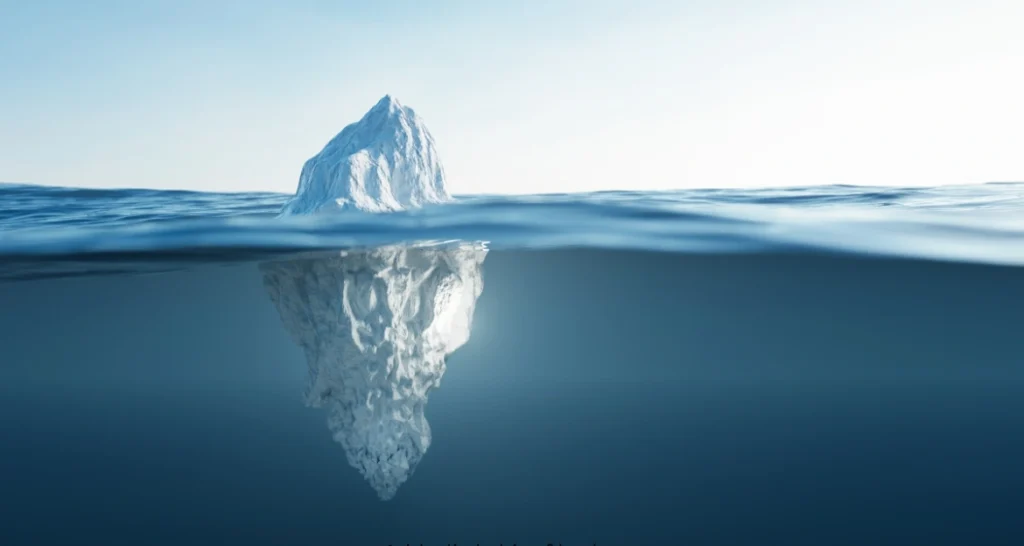
The part you see is only the beginning. Because ice floats low, the visible tip badly understates the true bulk. A berg that looks modest above the surface may hide a mass many times larger below.
Surface area vs total volume
Judging an iceberg by its exposed top is like judging a building by its roof. The submerged volume dominates — which is exactly why the next question matters so much.
Scale picture: mountain glacier → ice shelf → large iceberg → the small visible tip you actually see.
Why Does an Iceberg Float?
An iceberg floats for one elegant reason: ice is less dense than the water around it. When water freezes it expands, spacing its molecules farther apart, so a given volume of ice weighs less than the same volume of liquid water.
Key points:
- Freshwater ice is lighter than liquid water, so it floats.
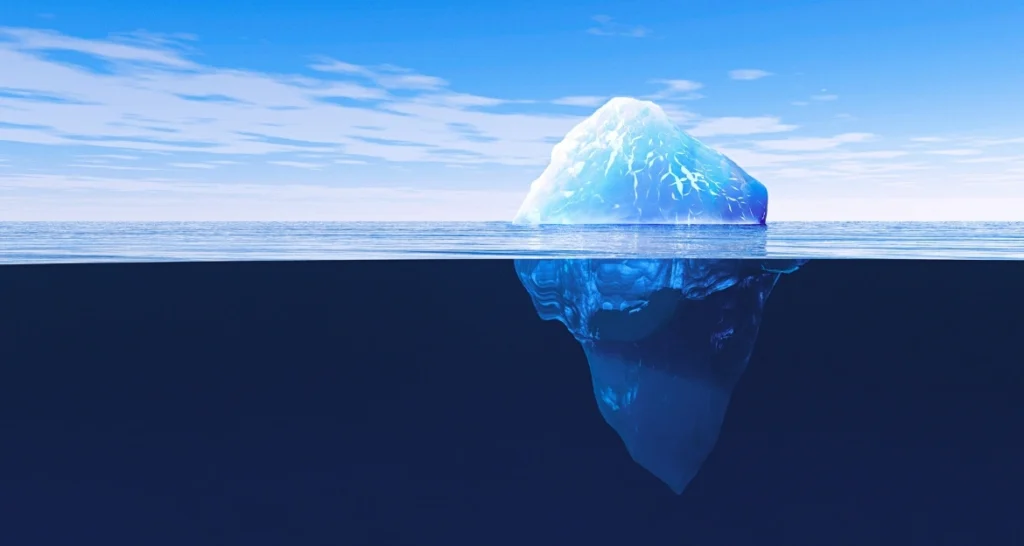
- Because ice and seawater densities are close, the berg floats low — most of it stays hidden below the surface.
- Salinity and water temperature shift the density of the surrounding water, so the exact float line varies.
That thin margin of buoyancy is why icebergs sit so deep in the water — and why they are so dangerous to ships.
How Much of an Iceberg Is Underwater?
The “tip of the iceberg” concept
The famous phrase is literally true. Because freshwater ice has roughly nine-tenths the density of seawater, only a small fraction of a berg — commonly cited as about a tenth — rises above the waterline, while the great bulk stays submerged.
Why the visible portion can be misleading
A berg that pokes only a few metres above the surface can extend many times deeper below it. Mariners cannot judge the hidden shape from the deck, which is what makes bergs so treacherous.
What determines how much ice is submerged?
The proportion is set by the density of the ice compared with the density of the surrounding water. Salinity, temperature and any trapped sediment or air all nudge the figure, so it is best treated as roughly nine-tenths submerged rather than a fixed number.
Why submerged ice matters for ships
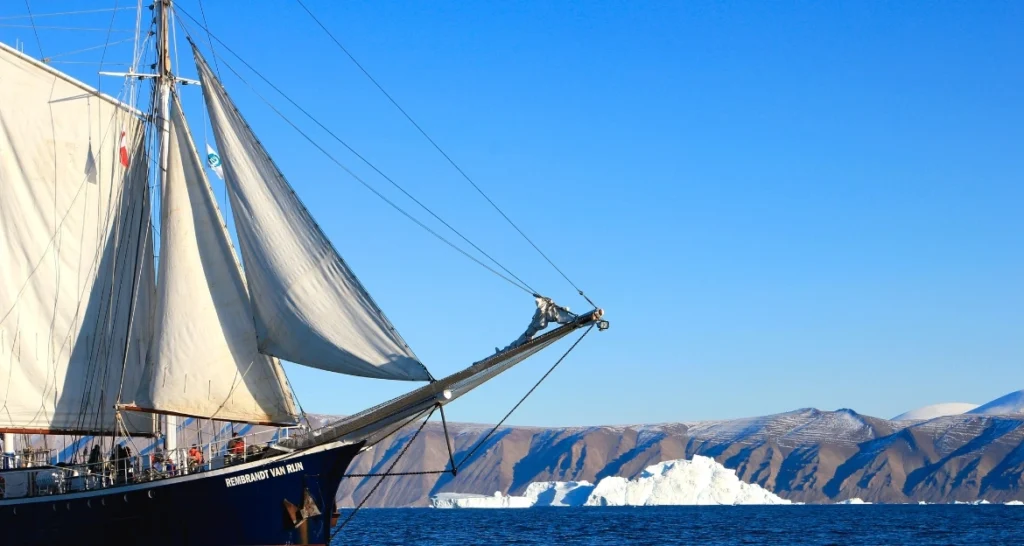
The underwater ram of a berg can reach out far beyond its visible edge, so a vessel can strike ice long before it appears to be near the berg at all — a hazard famous since the loss of the Titanic in 1912.
Diagram idea: visible ice above the waterline, the waterline itself, and the far larger submerged mass beneath — roughly a 1-to-9 split by volume, varying with density.
How Do Glaciers and Icebergs Move?
How glaciers move
Glacier motion is slow and steady, governed by:
- Gravity pulling ice downslope.
- Internal deformation as ice crystals shear past one another.
- Basal sliding, lubricated by meltwater at the bed.
- Slope steepness.
- Temperature, which affects how readily the ice deforms.
How icebergs move
Iceberg motion is comparatively quick and wandering, driven by:
- Ocean currents acting on the huge submerged mass.
- Wind pushing the exposed ice.
- Waves.
- Tides.
Why glaciers move much more slowly than icebergs
A glacier has to drag itself over rough bedrock; an iceberg floats free in fluid water. That difference in medium is the reason the two speeds are worlds apart, and it is one of the most intuitive parts of the Glacier vs Iceberg comparison: land grips, water lets go.
Where Are Glaciers and Icebergs Found?
Where are glaciers found?
Glaciers survive wherever it stays cold enough for ice to persist and flow, including:
- Antarctica and Greenland — the two great ice sheets.
- Alaska and Canada — extensive coastal and mountain glaciers.
- Iceland — ice caps such as Vatnajökull, the largest in Europe.
- Norway, Switzerland and the wider Alps.
- Patagonia in South America.
- Glacier National Park in Montana, USA.
Where are icebergs found?
Icebergs appear wherever glaciers and shelves calve into water: the seas around Antarctica, the coasts of Greenland and eastern Canada (including “Iceberg Alley” off Newfoundland and Labrador), Alaskan fjords, and glacier-fed lakes and lagoons worldwide.
Where is Glacier National Park?
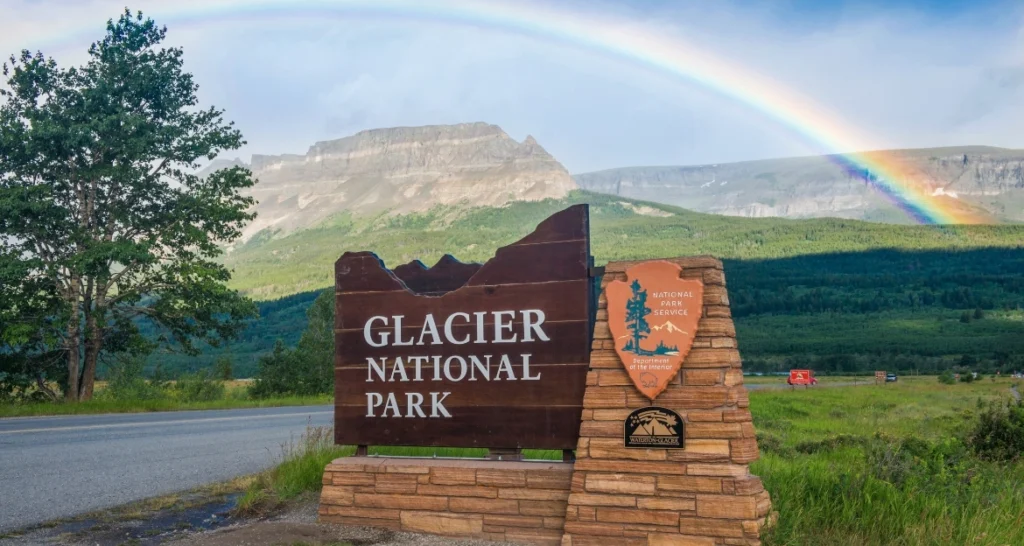
Glacier National Park sits in northwestern Montana, in the northern Rocky Mountains, straddling the Continental Divide right up against the Canadian border. It is famous for its alpine scenery, its remaining mountain glaciers such as Grinnell Glacier, and turquoise glacier-fed lakes.
One important clarification travellers often miss: Glacier National Park is a land destination of mountain glaciers, alpine lakes and hiking trails — it is not where you go to sail among giant ocean icebergs. For floating-berg boat trips you head to places like Iceland, Alaska or Newfoundland. This is a practical extension of the Glacier vs Iceberg difference: the park showcases glaciers on land, while ocean iceberg tours happen where those glaciers meet deep water.
Glacier vs Iceberg: Colour, Shape, and Appearance
Why glacier ice can look blue
Dense, compressed glacial ice absorbs the red end of sunlight and scatters the blue, so thick, air-poor ice can glow an intense blue.
Why some ice appears white
Ice packed with tiny air bubbles scatters all wavelengths of light more or less equally, and the result reads as white. Fresh, bubbly surface ice and snow look bright white for this reason.
Why icebergs can appear blue, white, turquoise, or dark
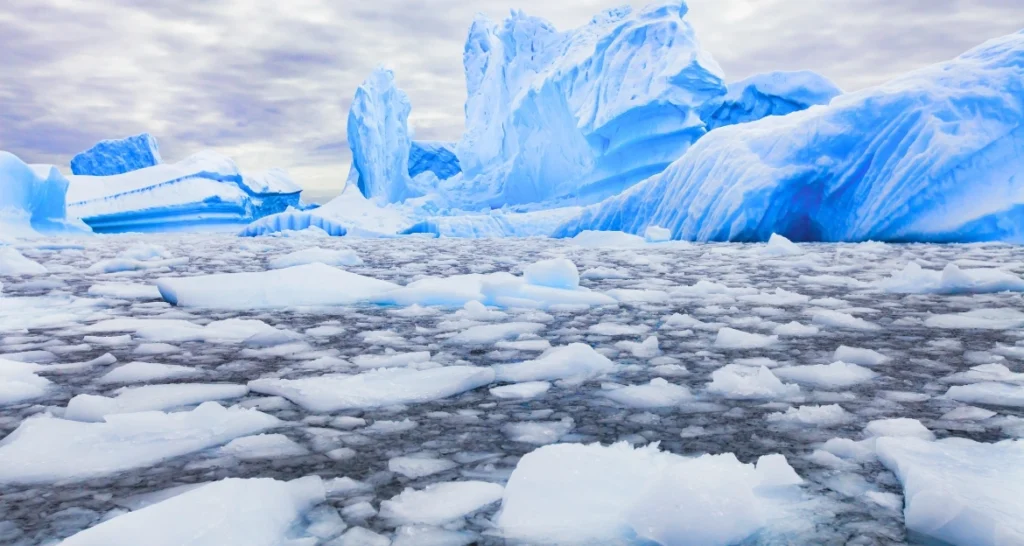
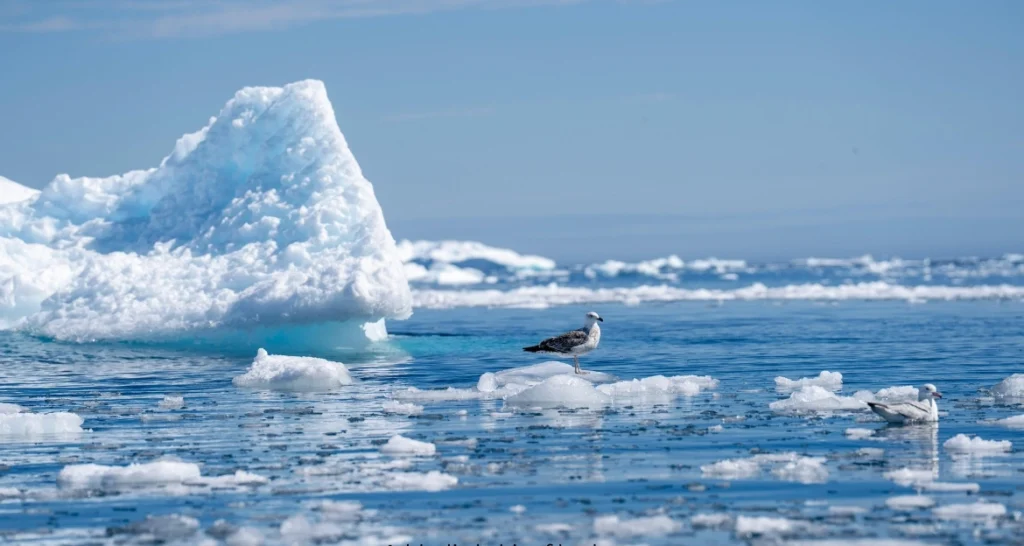
Icebergs show the whole palette. Old, dense ice glows blue; bubbly ice looks white; and bands of dark grey or brown appear where the ice carries volcanic ash or rock debris from its parent glacier — the striped bergs of Iceland are a striking example.
How sediment and trapped air affect appearance
Trapped air brightens ice toward white; embedded sediment darkens and streaks it. The same berg can show clean blue faces and dirty debris bands side by side.
Why iceberg shapes constantly change
An iceberg is never finished. Melting, wave erosion and shifts in balance make it tip, crack and re-form, so its outline changes from day to day — unlike a glacier’s broad, comparatively stable mass.
| Visual feature | Glacier | Iceberg |
|---|---|---|
| Blue ice | Common in dense glacial ice | Can occur in old, compressed ice |
| White ice | Common | Common |
| Sediment | Often visible in and on the ice | May be carried from the source ice |
| Shape | Broad and flowing | Irregular and constantly shifting |
How Long Do Glaciers and Icebergs Last?
Glacier lifespan
Glaciers are long-lived. Many have existed for thousands of years, and the polar ice sheets hold ice far older still. On human timescales a glacier is effectively a permanent feature — though not an unchanging one.
Iceberg lifespan
An iceberg is short-lived by comparison. Once adrift in warmer water it may last only weeks to a few years before melting away or breaking into growlers and bergy bits.
What causes icebergs to disappear?
Warmer water and air melt the berg from below and above; waves erode it; and shifting balance makes it fracture. Eventually it dissolves entirely back into the sea it came from.
Why glacier loss is different from iceberg melting
Here lies a subtle but vital point in the Glacier vs Iceberg comparison. An iceberg melting is simply the natural end of its life cycle. Long-term glacier mass loss, by contrast, means the land ice reservoir itself is shrinking — which has far broader consequences for freshwater supplies and sea level.
What Happens When a Glacier Calves?
What is calving?
Calving is the event in which ice breaks from a glacier or shelf front and enters the water — the birth of an iceberg.
Why glaciers calve
Glaciers calve where their front reaches deep water and becomes buoyant, undercut or over-stressed. Warmer water, tides and meltwater all encourage the front to fracture.
What happens after calving?
The freed slab may bob violently, roll, and send out a wave before settling into a drifting iceberg. The glacier front, meanwhile, retreats by the width of the piece it just lost.
Glacier → iceberg → drifting → melting
That is the whole arc in four beats: the glacier calves, an iceberg is born, it drifts on currents and wind, and it finally melts. It is the clearest possible illustration of how the two halves of the Glacier vs Iceberg story are joined.
Are Glaciers and Icebergs Freshwater?
Where the freshwater comes from
Both are built from snow, which falls as freshwater. That is why glacial ice — and the icebergs that calve from it — is fresh, not salty, even when it floats in the sea.
Why glacier ice is generally freshwater
Glaciers form on land from accumulated snowfall, with no seawater involved, so their ice is freshwater from the outset.
Is iceberg ice drinkable?
In principle iceberg ice is freshwater and some operators even harvest it, but a berg drifting at sea can carry salt spray, grit and other contamination on its surface, so it is not automatically safe to eat straight from the water without treatment.
Difference between freshwater ice and surrounding seawater
An iceberg is a raft of freshwater sitting in salt water. The berg itself is fresh; the sea around it is salty. This freshwater-on-saltwater contrast is an easy detail to overlook, yet it is central to how icebergs float and behave.
Why Are Glaciers and Icebergs Important?
Freshwater storage
Glaciers are among the planet’s largest freshwater reservoirs. Their seasonal melt feeds rivers that hundreds of millions of people rely on for drinking water, agriculture and hydropower.
Sea-level connection
Land ice locked in glaciers and ice sheets holds water out of the ocean. When that land ice is lost faster than it is replaced, the water it releases raises global sea level.
Ecosystems and wildlife
Cold glacial meltwater and iceberg-influenced waters shape distinctive habitats. Nutrients stirred up around calving fronts and drifting bergs can support plankton, fish, seals and seabirds.
Ocean circulation and climate systems
The input of cold, fresh water from melting ice affects ocean density and circulation, which in turn influences regional climate. It is a two-way link: climate shapes the ice, and the ice feeds back on climate.
Scientific research
Ice cores drilled from glaciers preserve trapped air bubbles that record ancient atmospheres, making glaciers priceless archives of past climate.
Tourism and local economies
Glacier and iceberg viewing supports guides, boat operators and whole communities in Alaska, Iceland, Norway, Canada and beyond — which is part of why understanding the Glacier vs Iceberg distinction matters to travellers, not just scientists.
Glacier vs Iceberg and Climate Change
Climate is where the Glacier vs Iceberg comparison gets most misunderstood, so it pays to separate a few ideas that often get blurred together.
How climate change affects glaciers
Warmer air and oceans tip many glaciers out of balance: they lose more ice to melting and calving than snowfall replaces, so they thin and retreat.
Glacier retreat and mass loss
Retreat means the glacier’s front pulls back up-valley. Mass loss means it is losing overall volume. A glacier can retreat while still being a large body of ice — the two are related but not identical.
Does climate change create more icebergs?
Faster flow and more calving at some glaciers can release more icebergs, but a burst of calving is not automatically a sign of collapse — calving is also a normal, healthy process for a glacier that reaches the sea.
Why calving does not automatically mean a glacier is disappearing
A tidewater glacier can calve icebergs continuously for centuries while remaining stable, as long as snowfall upstream keeps replacing the ice it sheds. Calving alone doesn’t tell you whether a glacier is shrinking; you have to weigh it against accumulation.
How scientists monitor glaciers and icebergs
Researchers track ice with satellites, aerial and repeat photography, GPS stations, radar and field surveys, measuring how fronts move, how surfaces thin, and how much mass is gained or lost over time.
Why long-term glacier measurements matter
A single dramatic calving makes headlines, but only long-term records reveal the real trend. That is why decades of consistent measurement — not one photograph — are what tell us how the world’s ice is truly changing.
Famous Places to See Glaciers and Icebergs
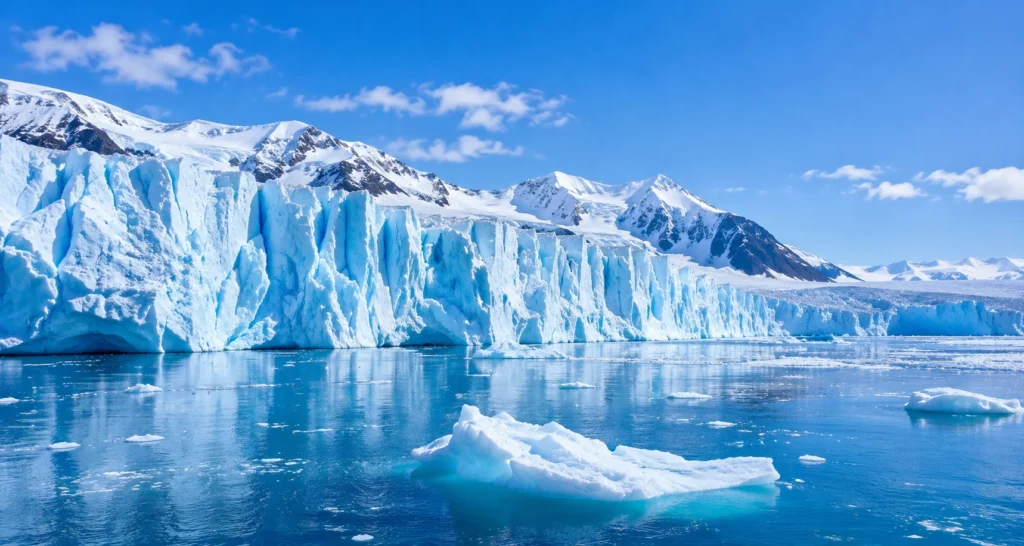
Now for the fun part. Here the Glacier vs Iceberg comparison turns practical: different destinations let you experience land glaciers and floating icebergs in very different ways.
Glacier National Park, Montana
Glacier National Park in northern Montana is the classic land-glacier destination in the United States. Its scenic Going-to-the-Sun Road, alpine trails and turquoise lakes draw visitors from around the world, and hikes lead to genuine mountain glaciers such as Grinnell Glacier. Because reservation and vehicle-access rules in Glacier National Park change from season to season, always confirm the current requirements on the official National Park Service site before you go.
Mendenhall Glacier, Alaska
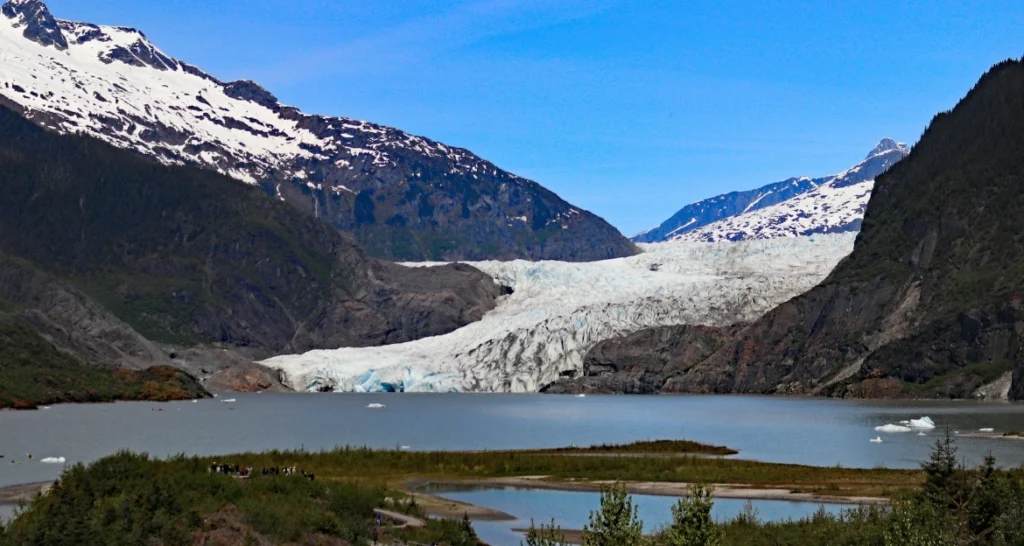
Mendenhall Glacier near Juneau is one of Alaska’s most accessible glaciers, flowing down from the vast Juneau Icefield toward Mendenhall Lake. A visitor centre, easy viewpoints and trails toward Nugget Falls make it a popular stop, and the surrounding lake and forest offer classic Alaskan scenery.
Typical ways travellers experience Mendenhall Glacier include:
- Viewing the glacier and Nugget Falls from the visitor-centre area and short trails.
- Longer hikes and, for the experienced and properly guided, ice-focused excursions.
- Water-based approaches across Mendenhall Lake.
Because glacier conditions and tour offerings change, and because ice travel carries real risk, confirm current availability with reputable operators and never venture onto glacier ice without proper guiding and equipment.
Iceland’s glacier and iceberg destinations
If your goal is floating ice, an Iceberg Tour Iceland experience is hard to beat. The star is Jökulsárlón glacier lagoon on the south coast, fed by an outlet tongue of the mighty Vatnajökull ice cap.
- Jökulsárlón — a deep lagoon where blue and white icebergs drift after calving from the glacier front.
- Diamond Beach — the black-sand shore nearby, where stranded ice chunks glitter like jewels.
- Glacier lagoons and boat trips — amphibian and zodiac boat tours (typically summer) weave among the bergs, while the lagoon is scenic year-round.
An Iceberg Tour Iceland trip is the mirror image of a Glacier National Park visit: one puts you on the water among floating bergs, the other keeps you on land beside mountain glaciers — the Glacier vs Iceberg contrast made into two very different holidays.
Greenland
Greenland offers some of the most spectacular iceberg scenery on Earth, especially around Ilulissat, where the fast-flowing ice fjord produces a constant procession of giant bergs.
Antarctica
Antarctica is the ultimate ice destination — home to the world’s largest ice sheet and the tabular icebergs that calve from its ice shelves, seen mainly on expedition cruises.
Alaska
Beyond Mendenhall Glacier, Alaska’s fjords and parks — from Glacier Bay to Kenai Fjords — offer boat trips past tidewater glaciers that calve icebergs directly into the sea.
Canadian Rockies
The Canadian Rockies, especially around the Columbia Icefield, put accessible mountain glaciers within reach of the road for travellers who want land ice without a long expedition.
Iceberg Lake vs Grinnell Glacier
Anyone planning a trip to Glacier National Park quickly runs into a delightful dilemma: Iceberg Lake or Grinnell Glacier? Both start from the Many Glacier area, both are stunning, and they neatly echo the wider Glacier vs Iceberg theme — one is a lake with floating ice, the other an actual glacier.
Iceberg Lake overview
Iceberg Lake is a jewel-toned alpine lake ringed by towering cliffs beneath Mount Wilbur. For part of the year, chunks of ice float on its surface — the feature that gives it its name — though the floating ice is seasonal, not guaranteed year-round. The trail to Iceberg Lake runs roughly 9 to 10 miles round trip with about 1,200 to 1,500 feet of elevation gain, and is generally rated moderate, thanks to a gentle, gradual grade after a short steep start.
Grinnell Glacier overview
Grinnell Glacier is a genuine, if retreating, mountain glacier, reached by one of the park’s most celebrated hikes. The full route runs about 10.6 miles round trip (shortened to roughly 7.2 miles if you take the boat shuttles across Swiftcurrent Lake and Lake Josephine), with around 1,600 feet of gain, and is rated strenuous. It ends at Upper Grinnell Lake, a proglacial lake that often holds small floating icebergs — a perfect real-world snapshot of the Glacier vs Iceberg relationship in one view.
Iceberg Lake vs Grinnell Glacier: key differences
| Factor | Iceberg Lake | Grinnell Glacier |
|---|---|---|
| Experience | Alpine lake beneath cliffs | Hike to a living glacier |
| Main attraction | Seasonal floating ice on the lake | Glacier and proglacial lake with small bergs |
| Distance (round trip) | About 9–10 miles | About 10.6 miles (7.2 with boat) |
| Elevation gain | About 1,200–1,500 ft | About 1,600 ft |
| Difficulty | Moderate | Strenuous |
| Scenery | Lake, cliffs, wildlife | Glacier, peaks, alpine lakes |
| Best for | Travellers who love alpine lakes | Travellers who want to see a glacier |
Trail conditions, snow and access change every season, so verify the latest status with the National Park Service before setting out on either hike.
Which should you visit?
Choose based on what you’re after:
- Prefer a slightly easier hike to a photogenic alpine lake? Choose Iceberg Lake.
- Want to stand before an actual glacier and see calved bergs on a proglacial lake? Choose Grinnell Glacier.
- Short on fitness or time? Iceberg Lake’s gentler grade (or Grinnell’s boat-shuttle option) helps.
- Chasing the best glacier photography? Grinnell Glacier wins.
- Visiting early or late season? Confirm snow and trail conditions either way.
Glacier vs Iceberg Travel Experiences
What is a glacier tour?
A glacier tour takes you to, onto or over land ice — from easy viewpoints and guided walks to ice-cave visits and, for the well-equipped, glacier hiking with crampons and a guide.
What is an iceberg tour?
An iceberg tour brings you close to floating ice, usually by boat, in waters and lagoons where glaciers calve.
What is an iceberg boat tour?
An Iceberg Boat tour is a water excursion — by amphibian craft, zodiac, kayak or larger vessel — that weaves among drifting bergs so you can see their scale, colour and shape up close. An Iceberg Boat outing in a place like Jökulsárlón is one of the most memorable ways to grasp the Glacier vs Iceberg difference first-hand.
Glacier hiking vs iceberg viewing
Glacier hiking is a land activity on solid, if crevassed, ice and demands guiding and gear. Iceberg viewing is a water activity, generally more relaxed, focused on watching and photographing floating ice from a safe distance.
What should travellers bring?
- Warm, windproof and waterproof layers.
- Sturdy footwear (hiking boots for glaciers; secure shoes for boats).
- Sun protection — ice and water reflect strong sunlight.
- Water, snacks and a charged phone or camera.
- For glacier hikes: guide-provided crampons, harness and helmet as required.
Basic glacier and iceberg safety
Ice is beautiful but unforgiving. A few non-negotiables:
- Never walk on glacier ice without a qualified guide and proper equipment — hidden crevasses are deadly.
- Keep well back from calving fronts and the water’s edge; calving throws waves and ice without warning.
- Don’t climb on or approach beached or floating bergs — they roll and shatter unpredictably.
- Check weather, tides and official conditions before any trip.
- Follow your operator’s and the park authority’s instructions at all times.
Common Misconceptions About Glaciers and Icebergs
A quick myth-versus-fact round-up clears away the confusion that surrounds the Glacier vs Iceberg question.
| Myth | Fact |
|---|---|
| Glaciers and icebergs are the same thing | They are different forms of ice — one on land, one afloat |
| All floating ice is an iceberg | The term has a specific meaning; sea ice and small fragments differ |
| Icebergs are mostly visible above water | Roughly nine-tenths of a berg is hidden below the surface |
| Every glacier creates icebergs | Only glaciers and shelves that reach water can calve bergs |
| Blue ice means frozen ocean water | Colour comes from ice density and light, not from salt |
| Glacier retreat and iceberg calving mean the same thing | They are related but distinct processes |
Conclusion
Boil it all down, and the Glacier vs Iceberg question has a clean answer: a glacier is land-based ice that flows under its own weight, and an iceberg is floating ice that has broken away from a glacier or shelf. Glaciers grip the land; icebergs ride the water.
The two are bound together by calving. Every iceberg begins as part of a glacier or ice shelf, breaks free at the water’s edge, drifts on currents and wind, and eventually melts back into the sea — a single life cycle spanning both halves of the Glacier vs Iceberg story.
Knowing the difference is more than pub trivia. It shapes how we read freshwater supplies, sea-level change, ocean currents, wildlife habitats, and the climate record locked inside ancient ice — and it explains why melting icebergs and shrinking glaciers are not the same headline.
It also shapes your travels. You can walk beside mountain glaciers in Glacier National Park, hike to Grinnell Glacier and Iceberg Lake, gaze at Mendenhall Glacier in Alaska, or sail among floating bergs on an Iceberg Tour Iceland adventure at Jökulsárlón. Wherever you go, treat these frozen giants with respect — explore them responsibly, follow local guidance, and let the ice leave its mark on you, not the other way around.
FAQs
1. What is the difference between a glacier and an iceberg?
Ans: A glacier is a large mass of ice that forms and flows on land, while an iceberg is a piece of ice floating in water after breaking off a glacier or ice shelf. That land-versus-water split is the essence of the Glacier vs Iceberg difference.
2. Can a glacier become an iceberg?
Ans: Part of one can. When a glacier flows into the sea or a deep lake, slabs of it calve off and float away as icebergs. The iceberg is essentially a detached piece of the glacier.
3. Are icebergs made from glacier ice?
Ans: Yes. Most icebergs are calved glacier or ice-shelf ice, which is why they are freshwater even though they float in the salty sea.
4. Is an iceberg bigger than a glacier?
Ans: Almost never. A glacier is usually far larger than any single iceberg it produces, since the berg is only a fragment that has broken away from it.
5. Why is most of an iceberg underwater?
Ans: Because freshwater ice is only slightly less dense than seawater, a berg must sit low to float — roughly nine-tenths of its volume stays submerged, leaving just the “tip” visible.
6. Do glaciers float in water?
Ans: No. Glaciers rest on land and flow over it. Only when ice breaks off into water does it float — and at that point it is an iceberg, not a glacier.
7. Where can you see glaciers and icebergs?
Ans: See land glaciers in places like Glacier National Park, the Canadian Rockies, and near Mendenhall Glacier in Alaska; see floating icebergs on an Iceberg Tour Iceland trip, or in Greenland, Antarctica, and Alaskan fjords.
8. Where is Glacier National Park?
Ans: Glacier National Park is in northwestern Montana, USA, in the northern Rocky Mountains.