

Quick Answer
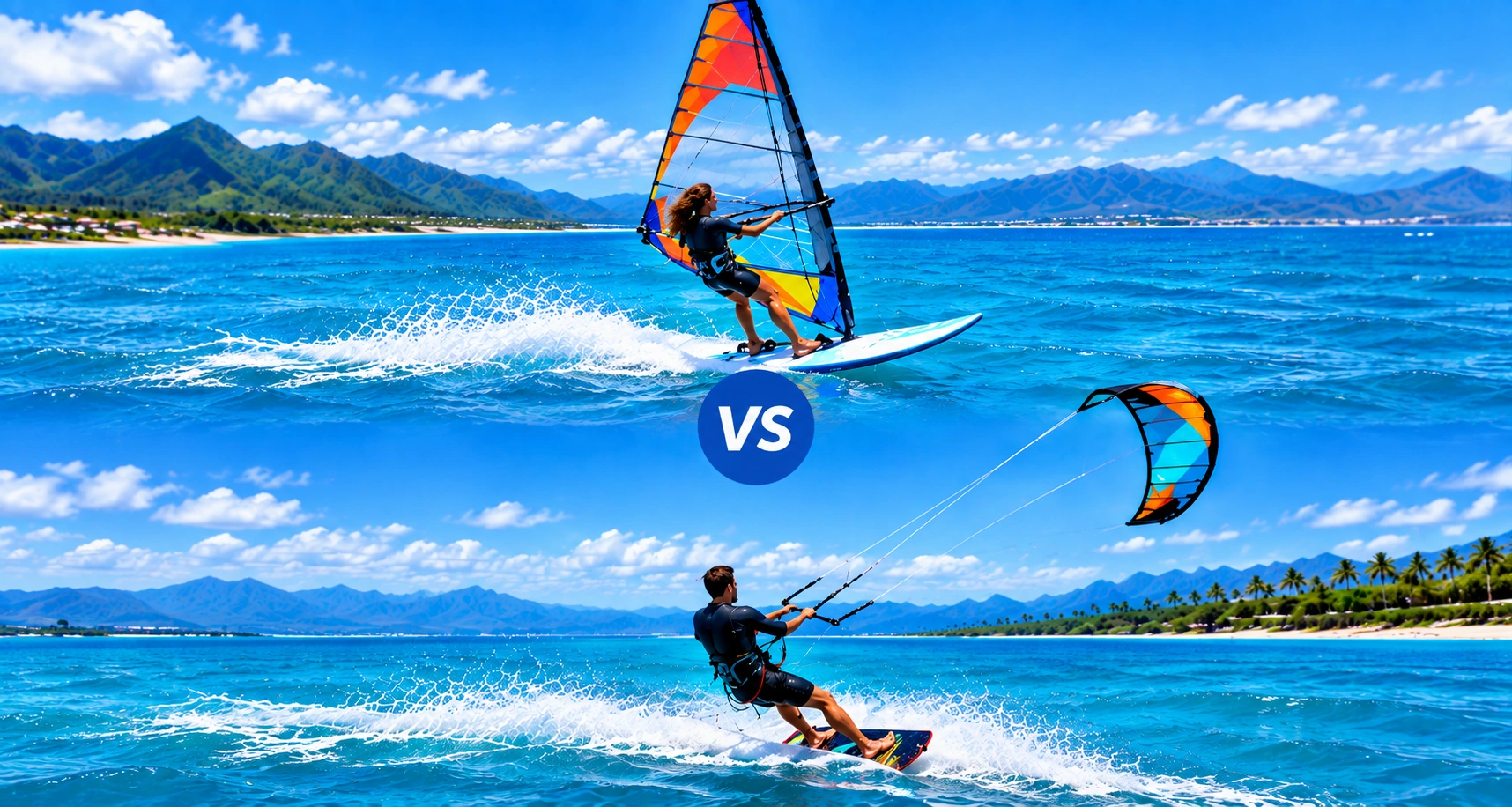
When it comes to learning windsurfing, the process is generally easier, while kitesurfing tends to be more complicated. However, after getting the hang of kiting, kitesurfing can be more rewarding. Windsurfing is preferred by those who want to be in touch with the immense power of wind through direct control and have an easier time breaking in as a kiting novice. Kitesurfing may be a better match if you want to prioritize travel light, perform a lot of jumps, and see the strong winds on the water once you’re off the shore.
Imagine two riders leaving the same beach on the same gusty afternoon. One clips into a harness, uphauls a sail, leans back into the wind, and cuts across the chop with the rig humming in her hands. The other launches a kite the size of a small parachute, lets it travel overhead, and she gets yanked onto a plane in seconds, boots already skimming the surface. The same water, the same breeze, two totally different feelings. That single beach is where the whole windsurfing vs kitesurfing debate lives, and, at the end of this guide, you will know exactly which rider you want to be.
I’ve spent enough seasons around Gulf Coast launch sites to watch hundreds of beginners agonize over this choice, usually while standing ankle-deep in warm water and squinting at the horizon. Both sports run on wind. Both need water. Both will humble you on day one and hook you by day five. But the reality of each, the gear you’ll put on, the muscles you’ll wake up sore, and the way the sport feels under your feet separate them into two very different lifestyles. Let’s settle the windsurfing vs kitesurfing question in the honest way with real numbers, real conditions, and a clear route to your first session.
The Core Difference: Sail in Your Hands vs Kite Overhead
We start with the mechanics first, because everything else starts from there.
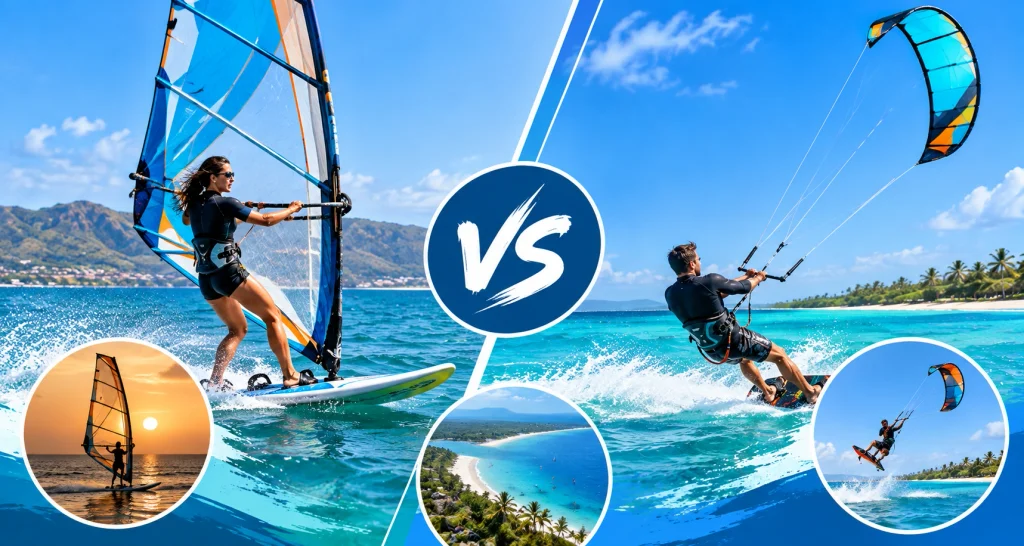
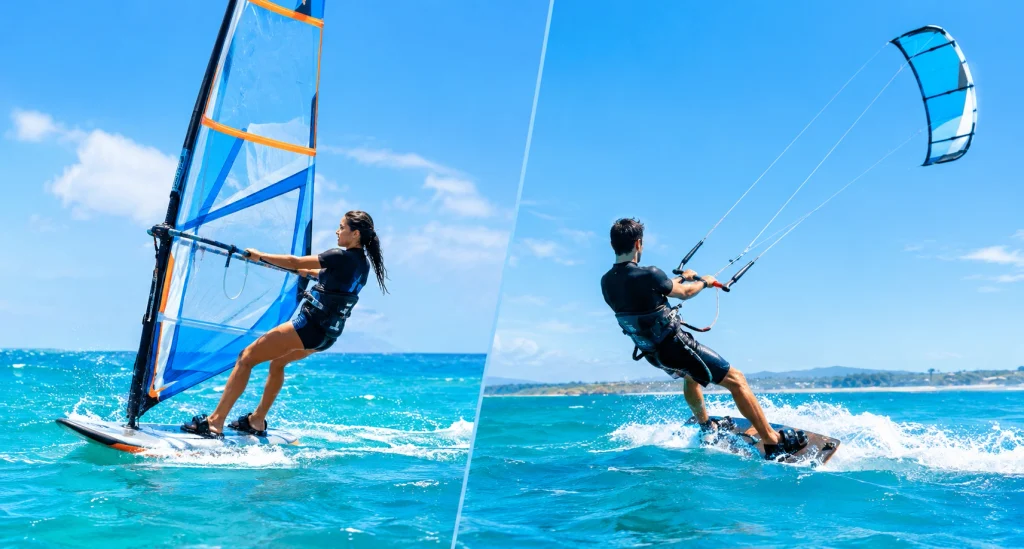
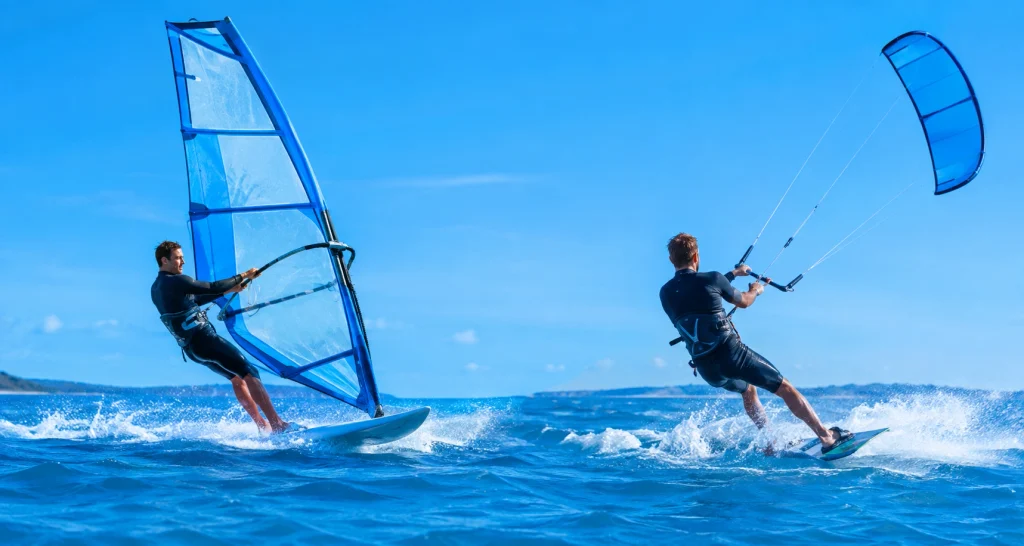
Windsurfing vs kitesurfing bolts a sail over the board in a flexible joint. You grip a boom, that horizontal bar running through the sail, and steer by shifting the rig and body weight. Power flows through your arms and hips in real time so you feel every gust and lull the instant it hits. When you fall, the sail drops into the water, and the power dies with it. That direct connection is why so many first-timers stand up and creep along within their first hour.
Kitesurfing hands the power source to the sky. A large inflatable kite swims on 20- to 24-meter lines and pulls you along, while you ride a little twin-tip board that resembles a wakeboard. A bar guides the kite, a harness spreads the pull across your hips, and a depower system lets you dump force in a hurry. The feeling is flying, not sailing. You’re not fighting the rig with your arms; you’re managing a powerful engine floating high above your head.
That one structural gap, sail bolted to the board versus kite flying on lines, shapes the learning curve, the risk profile, the packing list, and the muscles you’ll build. Keep it in mind as we go, because most of the windsurfing vs kitesurfing trade-offs trace right back to it.
The Learning Curve: Fast Start vs Fast Progress
This is at the heart of the windsurfing vs kitesurfing decision and where your personality matters more than your fitness.
Windsurfing rewards patience with an easy entry. In light wind on a big, stable beginner windsurfing board, most people are standing, catching a breeze, and steering within the first lesson. That early win feels fantastic. The catch comes later. Planing, the process of lifting the board and sliding over the surface, takes about five to seven days of steady practice, and the intermediate grind starts; harness work and carving gybes take months. Windsurfing gives you a nice handshake and a long climb in front of you.
Kitesurfing flips that curve. You will learn to fly the kite in the first two or three days on the beach and in waist-deep water before a board even touches your feet. Those early hours are clumsy and slow. But once kite control is established, things accelerate so quickly that most students in a five-day camp ride independently by day three or four, and jumping, a real thrill, is a lot quicker than it would be on a sail. It will take eight to fifteen hours of instruction to reach that independent riding point.
So which is harder? In either way, kitesurfing is harder for impatient people who hate the beach drill phase. Windsurfing vs kitesurfing is harder for those who skip lessons and want to plan on willpower. Choose the sport that suits your temperament, not the one with the scarier reputation.
One practical note for families: kids can start windsurfing at around age eight with scaled-down gear, and they get that “I’m sailing!” grin almost instantly. Kitesurfing calls for more size and maturity; most instructors want riders to weigh at least 40 kg so a gust can’t overwhelm them. If you’re planning a trip with children, that difference is often the only factor that decides the windsurfing vs kitesurfing choice, and it’s worth weighing alongside our guide to the best family beach vacations in the USA when you’re mapping out where to go.
Windsurfing Equipment: What You Actually Carry
Let’s talk gear, because the two kits feel worlds apart the moment you try to load a car.
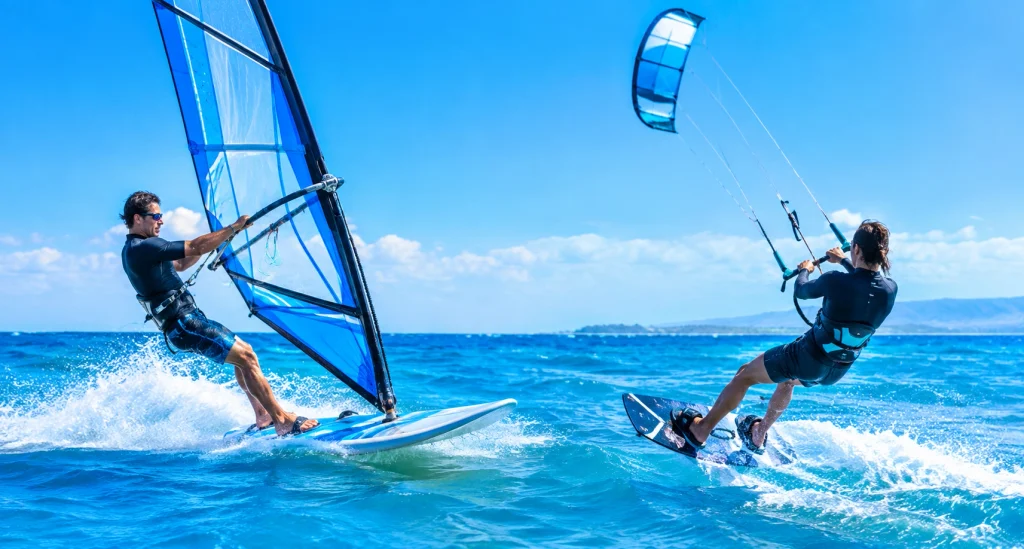
The full set of windsurfing equipment includes a board, a mast, a boom, a sail, and that universal joint that holds them together. The windsurfing board for a beginner is long and wide and packed with volume, and that is what keeps you afloat and forgiving when you find your balance. As you get better, you’ll want a smaller, faster windsurfing board for planing and waves and a small quiver of sails for different wind strengths. This is the part that fills a garage.
The honest downside of windsurfing equipment is bulk. A board bag of one or two boards with three sails can weigh almost 30 kilograms, and dragging that through an airport gets old really fast. A single windsurfing board already occupies more space than an entire kite kit, and storage and transport are part of the lifestyle. Dedicated sailors build a quiver of three or four sails to cover everything from a light summer breeze to a screaming winter blow, and that quiver is where windsurfing vs kitesurfing quietly becomes expensive over the years.
The upside of all that windsurfing vs kitesurfing equipment is range and durability. Sailcloth is tough and can last for years. One versatile board and two or three sails can take you from an eight-knot cruise on flat water to a 35-knot blast on chop. You feel the sport directly on your hands, and that’s why some people never want to give it up once the habit settles in.
Kitesurfing Guide to Gear: Small Bag, Delicate Kites
Now flip the script. This section serves as a quick kitesurfing guide to the parts you’ll be dealing with so you know what the shop is talking about.
A kite setup packs down small. The entire rig, an inflatable kite of around 7 to 17 square meters, a control bar with four lines, a compact twin-tip board, a harness, and a pump, all fit into a single bag that weighs around 15 to 20 kg. That’s the headline win of any kitesurfing guide: you can check all of that as one piece of sports luggage and be riding a new coastline the same afternoon.
The trade-off is evident in fragility and safety requirements. Kite canopies have thin, light material that tears faster and wears out sooner than sailcloth, and many riders replace kites every couple of years. And because the kite is still powered even when you fall, kitesurfing needs to be more rigorous than windsurfing. A good kitesurfing guide or instructor will demonstrate the depower system, quick-release, and self-rescue for you long before you’re allowed near deep water. That’s not gatekeeping; it’s the difference between a fun session and getting dragged down the beach.
When you’re assessing kitesurfing equipment for beginners, don’t buy first and learn later. The right kite size depends on your weight and the local wind, and guessing wrong is the reason people get overpowered and scared off from the sport. Beginners will start learning proper kitesurfing equipment and learning to ride the correctly sized kites while your instincts develop. Once you know your home wind range, you can hire a starter quiver of two kites and a board and harness for most days. Buying kitesurfing equipment for beginners before your first lesson almost always means buying the wrong thing twice.
Physical Demands: Where You’ll Feel It
On the fitness side of the windsurfing vs kitesurfing question, both sports deliver a full-body workout, but they load different muscles.
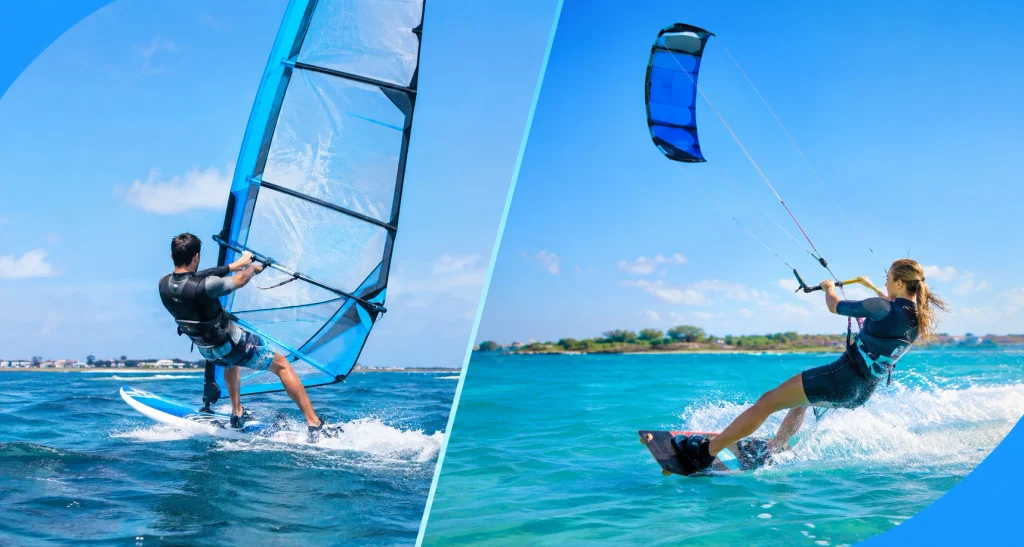
Windsurfing relies on upper-body and core strength. You’re lifting the sail up, holding it against the wind, and cranking the rig with turns so your back, shoulders, and forearms are bearing the load. Beginners burn arm strength in the uphauling phase, but harness technique takes over and spreads the load across the course of the day. It was the most physically demanding sport in the early days, and it rewarded anybody who already lifted, paddled, or sailed.
Kitesurfing shifts the work to your core and legs. The harness draws most of the pull of the kite to your hips, so you don’t grip and grind with your arms all day. You’re not just jumping in and out of space; you’re walking and jumping through them. Riders who lean less on their upper body strength tend to prefer the harness approach, and the big jump’s explosive pop requires a sound, fast-paced combination of legs and coordination.
If your shoulders are the strong link in your chain, windsurfing will feel natural. If your legs and core are your engine, kitesurfing may suit you better. Either way, expect to sleep well after a long session.
Safety: Two Different Risk Profiles
Where safety at work between windsurfing vs kitesurfing, it’s not a dangerous sport for you to participate in if you have the right training.
Windsurfing risks are firmly within you and the rig. Falls into the water, a boom strike, and just fatigue are all part and parcel. The sail depowers when you drop it, and the only equipment you connect to is your hands, so far from trouble, it’s a simple break from the rig. Windsurfing, statistically, suffers fewer serious injuries per hour on the water.
Kitesurfing has higher-than-average risks that good instruction can manage. A powered kite can lift a rider into the air or drag them across the beach when control fails, and you stay connected to that kite through the harness even during a wipeout. Lines can tangle, gusts can surprise you, and launching or landing near hard objects invites trouble. The depower and quick-release systems are built for these moments, and so a good kitesurfing guide treats safety drills as non-negotiable rather than optional.
The takeaway is not that one sport is safe and the other reckless. Both reward respect for conditions and punish shortcuts. Kitesurfing simply requires more front-loaded safety discipline, while windsurfing vs kitesurfing lets you learn the hazards at a gentler pace.
Wind and Conditions: What the Forecast Needs to Say
Your local weather might make the windsurfing vs kitesurfing decision for you before personality even enters the picture.
Most modern kites pull in surprisingly light air. You can ride a big kite in 10 to 12 knots, which opens up more marginal days than windsurfing offers at the bottom end. Windsurfing typically wants 12 to 15 knots or more to plane, though a big board lets you cruise happily in an eight-knot breeze without planing at all.
And windsurfing is more versatile in gusty conditions than kitesurfing. Because you have hands on the rig all the time, you handle onshore wind and the occasional change in wind and hold up launch spots better than a kite rider who has 24 meters of line to contend with. Windsurfing also has more possibilities to be usable once you have a few sails, from a lazy summer glide to a 35-knot storm session on a small waveboard. Kitesurfing works on open water with steady wind and room to launch, which is what a lot of coastal travel spots provide.
Check a marine forecast for your home water and any destination you’re eyeing. A steady 15-to-20-knot side-shore wind over open water flatters both sports. Gusty, cramped, or light-and-shifty conditions tilt the answer toward windsurfing vs kitesurfing.
The Cost Breakdown: New, Used, and Long-Term
Money talks, so we can show the numbers side by side. Treat these as ballpark figures, since prices swing with brand, model year, and how hard you shop.
| Cost Factor | Windsurfing | Kitesurfing |
|---|---|---|
| New Beginner Setup | ~$1,500–2,500 (board, mast, boom, sail) | ~$1,800–3,000 (kite, bar, board, harness) |
| Used Gear | Roughly half the new price | Roughly half the new price |
| Ongoing Quiver | 3–4 sails for full wind range | 2–3 kites for full wind range |
| Discovery Lesson | ~$75–150 | ~$75–150 |
| Beginner Course | ~$200–400 | Often $300–800 for full progression |
| Gear Lifespan | Sails last years; boards are durable | Kites are often replaced every ~2–3 years |
| Travel | Bulky; extra airline fees common | Fits one checkable bag |
The pattern is clear. The entry costs are in the same neighborhood, and used gear halves the sting for either sport. Windsurfing quivers creep up as you add sails, while kite canopies need to be replaced more often. Kitesurfing wins decisively on travel because a full windsurfing vs kitesurfing equipment haul means a board bag, a mast bag, and a sail bag, while a kiter strolls through the terminal with one bag under an arm. If you fly to your sessions, factor that in heavily — it’s the same reason budget-minded riders comparison-shop other Gulf Coast watersports, like how much jet skiing costs in the USA, before committing to a full kit.
One smart move before you spend a cent: book a discovery lesson in each sport. A single afternoon on the water tells you more about the windsurfing vs kitesurfing fit than any spec sheet, and it’s the cheapest research you’ll ever do.
Where to Try It: Florida’s Gulf Coast
Reading about wind sports only goes so far. At some point you have to stand on a board and get pushed around by the breeze, and Florida’s Gulf Coast is one of the friendliest places in the country to do exactly that. Warm water, shallow flats, and steady sea breezes make it forgiving for first-timers in both sports.
Start with St. Pete Beach, where North Beach Windsurfing has been offering lessons and rentals for more than two decades. The setup is close to ideal for learning: Gulf breezes mixing with shallow bay water and reliable winds in the 10-to-20-knot range that beginners can handle well. Instructors at North Beach Windsurfing teach everything from a first uphaul to wing foiling, and with flat waist-deep launch points nearby, you can make water starts and turns without diving into deep water on day one.
Riders who visit Tampa and Sarasota again and again point to North Beach Windsurfing as the source of continued improvement, which says a lot about a small shop that knows its home water. Renting from North Beach Windsurfing also spares you from hauling bulky windsurfing equipment across the country for a vacation session, and if you want to mix in another adrenaline hit on a rest day, Clearwater Beach parasailing is a short drive up the coast.
Northwest along the coast, and you will find windsurfing in Panama City Beach anchored by St. Andrews State Park. The park is on a peninsula with a calm lagoon on one side and an open Gulf on the other, so you can pick your conditions to match your skill on any given day. That geography is what makes windsurfing in Panama City Beach so beginner-friendly: nervous first-timers work the sheltered lagoon while stronger riders chase the open-water chop, all within the same park. Forecast services track wind, waves, and tides for St.
Andrews specifically, so planning a session around windsurfing in Panama City Beach takes only a quick look at a marine app the night before. Just remember that park hours, ferry service, and beach access can shift with weather and season, so confirm current details on the official St. Andrews State Park page before you drive out for windsurfing vs kitesurfing in Panama City Beach.
Both spots suit kiting too, though kiters need to respect launch zones and crowds more carefully than sailors do. If you’re torn on the whole windsurfing vs kitesurfing question, a Gulf Coast trip lets you sample both in a single week and let the water make the argument for you.
How to Choose: A Simple Decision Framework
Strip away the noise, and the choice comes down to a handful of honest questions.
Ask yourself how much you travel. If most sessions mean a flight, kitesurfing’s single-bag kit is a gift and windsurfing vs kitesurfing three-bag sprawl is a tax. If you drive to a home spot and store gear in a garage, that factor disappears.
Ask what your body brings to the party. Strong shoulders and a sailing or paddling background point toward windsurfing vs kitesurfing . A core-and-legs athlete with wakeboarding instincts often clicks faster with a kite.
Ask how patient you are. If you crave a win on day one, windsurfing vs kitesurfing delivers. If you’ll happily grind through a few beach-drill sessions for a faster ride to jumping, kitesurfing pays that patience back.
Ask what your local wind does. Light, gusty, or cramped water favors windsurfing vs kitesurfing direct control. Steady, open, moderate wind flatters kiting.
Ask what thrill you’re chasing. Windsurfing offers a deep, technical progression from cruising to wave riding to speed sailing. Kitesurfing offers big air and a flying sensation that nothing else on the water matches.
There’s no universal winner in the windsurfing vs kitesurfing vs kitesurfing matchup. There’s only the sport that fits your travel, body, temperament, wind, and idea of fun. Answer those five questions, and the right choice usually names itself.
The Bottom Line
The windsurfing vs kitesurfing debate has no trophy winner, whatever you’re told by everyone else selling their own favorite. Windsurfing gives you a gentle introduction, a direct feeling in your hands, quick adaptability during wild conditions, and a long, rewarding climb to mastery. Kitesurfing asks for patience and safety discipline first and then pays you back with a featherlight travel kit, a flying sensation, and big air much quicker than you’d think.
So stop reading spec sheets and just feel it. Give each sport a discovery lesson, ideally somewhere warm and shallow like the Florida Gulf Coast, and let your first hour on the water settle the argument that a thousand articles never quite can. From the hum of a sail to the kite’s tug, you’ll walk off the beach salt-crusted, grinning, and already planning for the next session. That is the real answer to windsurfing vs kitesurfing: the winner is whichever one you’ll do again and again.
Frequently Asked Questions
1. Is windsurfing or kitesurfing easier to learn?
Ans: Windsurfing is easier in the first few hours, since most beginners stand and sail slowly on day one. Kitesurfing has a steeper start because you master kite control on land first, but it offers a faster path to advanced riding once you’re past the beginner phase. Your patience matters more than your fitness here.
2. Which sport is cheaper to get into?
Ans: Entry costs run close. A new beginner windsurfing vs kitesurfing setup lands around $1,500 to $2,500, while a new kitesurfing equipment package for beginners runs roughly $1,800 to $3,000. Used gear cuts either figure by about half. Long-term, windsurfers spend on extra sails while kiters replace canopies more often, so lifetime costs end up comparable.
3. Can I teach myself, or do I need lessons?
Ans: Take lessons for both, and treat them as mandatory for kitesurfing. A powered kite can loft or drag you if you mishandle it, so proper safety training on the depower and quick-release systems is essential. Windsurfing is more forgiving to self-taught beginners, but a couple of lessons still shortcut months of frustration.
4. What wind conditions do I need?
Ans: Kites ride in lighter air, from about 10 to 12 knots upward, while windsurfing vs kitesurfing usually needs 12 to 15 knots to plane, though a big board cruises in an eight-knot breeze. Windsurfing copes better with gusty, onshore, or cramped conditions because your hands stay on the rig the whole time.
5. Where can I try windsurfing in Florida?
Ans: St. Pete Beach and Panama City Beach are two of the best beginner-friendly options on the Gulf Coast. St. Pete Beach offers lessons, rentals, and shallow practice water, and windsurfing in Panama City Beach at St. Andrews State Park lets you enjoy a sheltered lagoon and open Gulf side by side.