

Picture the concourse at London King’s Cross on a Friday evening. The departure board flickers, a Cornish pasty is going cold in your bag, and you have ninety seconds to buy a ticket to Edinburgh before the gate shuts. You open your phone. Two apps are both on the screen, and the fare they quote for the exact same train is almost ten pounds apart. That gap, repeated through a year of journeys, is the whole reason the Trainpal vs Trainline debate comes up in the first place.
For years Trainline was the default. It was established in 1997; it sponsors half of the railway posters you have ever looked at, and its name has become shorthand for “buy a train ticket.” Then a scrappier app came along promising zero booking fees and automatic split ticketing, and suddenly the most-established name in British rail had a real fight on its hands. So in the Trainpal vs Trainline matchup, which one actually leaves more money in your pocket? We booked, compared, refunded, and grumbled our way through both so you don’t have to.
The 30-second verdict
If you want the short version before your train arrives: TrainPal usually comes out cheaper on the total price, mostly because it has no booking fee and applies split ticketing without you lifting a finger. Trainline wins on polish, coach tickets, and one very specific perk if you bank with Monzo. Most seasoned travellers keep both installed and check prices in each before tapping “pay.”
That’s the headline. The detail is where the real money hides, so let’s get into it.
TrainPal vs Trainline at a glance
| Feature | TrainPal | Trainline |
|---|---|---|
| UK Booking Fee | None (online/app) | 59p–£2.79, variable |
| Split Ticketing | Automatic (since 2018) | SplitSave (since 2020) |
| Split Commission | Unspecified “Split service fee”, not always charged | No separate fee |
| Digital Railcards | Yes (activate within 30 days) | Yes (no activation step) |
| Cancellation Admin Fee | £9.99 flat | Tiered, based on ticket value |
| Loyalty Rewards | TrainPal Card + PalPoints | None |
| Coach Tickets | Yes | Yes |
| European Coverage | 1,000+ partners, 45+ countries | 270+ operators, 45 countries |
| Owner | Trip.com Group (Nasdaq) | Trainline plc (LSE, FTSE 250) |
| Trustpilot | ~4.4 / 5 (10,500+ reviews) | Mixed |
| Best For | Lowest total price | Polish, coach, Monzo perk |
What each app actually is
Both apps do the same basic job: search every UK train operator at once, compare fares and sell you an e-ticket that lands in your Apple or Google Wallet. Both cover Europe. Both sell digital railcards. On a shop-window level, they’re twins.
Trainline is the giant. It’s a public company on the London Stock Exchange; it works with more than 270 rail and coach operators across 45 countries, and it sells coach tickets alongside trains. TrainPal is younger and leaner. It belongs to Trip.com Group, the Nasdaq-listed travel giant that also owns Skyscanner and Ctrip, and it built its reputation in Britain on a single promise: no booking fees, ever, on UK tickets bought online.
The Trainpal vs Trainline question really comes down to how those two philosophies play out at checkout.
Price: Who’s Actually Cheaper?
Here is the part everyone skips to. The Trainpal vs Trainline price gap is about fees, not fares. The tickets themselves are the same everywhere you buy them. A single from Reading to Manchester is a regulated fare set by the operator, and that price is identical on every app and at the station window. What changes the number you actually pay is three things: booking fees, split-ticketing cleverness, and any extra commission an app skims off your savings.
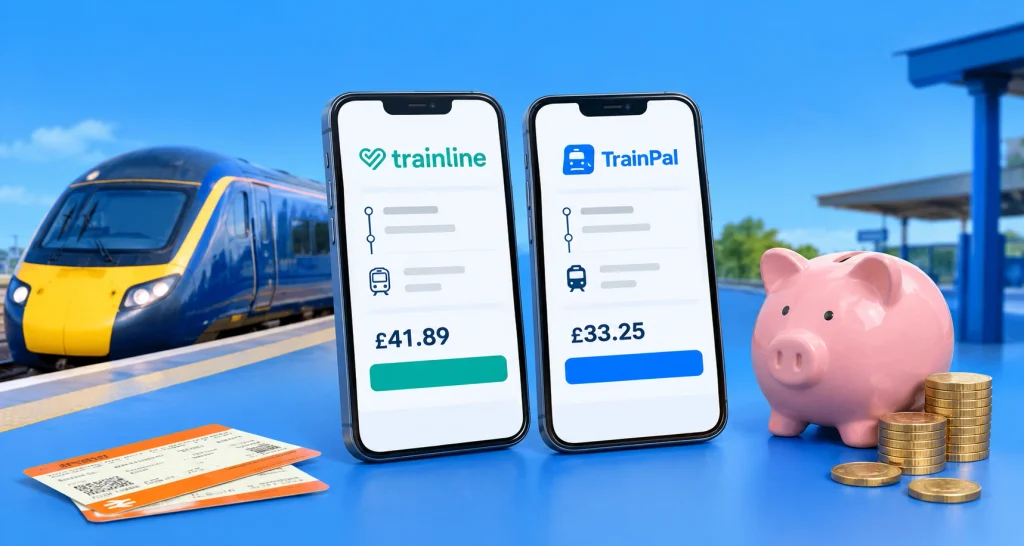
An independent price test run in January 2026 across 22 UK routes shows the pattern. On a lot of trips the apps were within pennies of each other. On others the gap yawned open. Reading to Stoke-on-Trent came out to £41.89 on Trainline and £33.25 on TrainPal. Plymouth to Oxford was £71.49 versus £52.20. London King’s Cross to Edinburgh Waverley was £89.29 on Trainline and £79.50 on TrainPal. Brighton to London Victoria was tied at £24.40 on both.
| Route (single adult, no railcard) | Trainline | TrainPal | Cheaper |
|---|---|---|---|
| Reading → Stoke-on-Trent | £41.89 | £33.25 | TrainPal (−£8.64) |
| Plymouth → Oxford | £71.49 | £52.20 | TrainPal (−£19.29) |
| London King’s Cross → Edinburgh | £89.29 | £79.50 | TrainPal (−£9.79) |
| York → Aberdeen | £79.09 | £77.00 | TrainPal (−£2.09) |
| Liverpool Lime St → Southampton | £95.39 | £98.00 | Trainline (−£2.61) |
| Brighton → London Victoria | £24.40 | £24.40 | Tie |
The takeaway isn’t that any one app is half-priced. It’s that TrainPal gets ahead often enough, and by enough, to matter over a year of commuting. When the two apps disagree, Trainline is more often the pricier one, dragged up by its booking fee on otherwise competitive fares.
Money-saver: The individual ticket prices are regulated and identical everywhere. The only levers that move your total are booking fees, the split-ticketing algorithm, and any saving commission. That’s why the same train can cost £10 more in one app than the other.
Booking Fees: The Quiet Difference That Adds Up
TrainPal charges no booking fee on UK train tickets bought online. Nothing. The price you see is the price you pay.
Trainline charges a variable booking fee, and “variable” really does work in that sentence. The amount depends on the journey, the ticket price at the time of booking, and whether you use the app or the website. For UK journeys booked inside the UK, the fee is typically between 59p and £2.79. You can usually avoid it by booking a same-day ticket in the app. The increase is much bigger for a European journey; one traveller reported a £17 fee on a Lille-to-Nice trip with no fee at all on the French operator’s own site.
None of these fees will bankrupt you. But 59p to £2.79 a pop, twice a week, quietly siphons £30 to £150 out of your account over a year. Multiply that across a household, and the Trainpal vs Trainline cost gap stops looking trivial.
| Booking scenario | TrainPal | Trainline |
|---|---|---|
| UK ticket, booked online | £0 | 59p–£2.79 (varies) |
| UK same-day ticket in app | £0 | Often £0 |
| European journey | £0 | Variable, can be £10+ |
| Fee refunded if you cancel? | N/A | Usually not |
Split Ticketing: Same Trick, Different Algorithms
Split ticketing sounds like a loophole. It isn’t. You buy two or more cheaper tickets that cover different legs of one journey instead of a single expensive through-fare, stay in the same seat the whole way, and pocket the difference. It’s written into section 14 of the National Rail Conditions of Travel, so no inspector can fault you for it.
Both apps do this automatically. TrainPal started splitting tickets in 2018 and claims savings up to 90% on some routes, with a more realistic average around 30%. Trainline calls its version SplitSave, launched it in 2020, and flags eligible journeys with a little icon in your results.
The catch is that the two apps run different algorithms, so they will often reveal different splits and different totals for the same train. Trainline doesn’t charge a separate fee on SplitSave savings. TrainPal mentions a “Split service fee” but doesn’t always publish it and doesn’t always apply it, depending on whatever promotion is running. In reality, these commissions are small next to the savings itself, which is why checking both apps beats loyalty to either one.
Railcards: Activation Traps and a Monzo Shortcut
A railcard cuts about a third off most fares and costs £35 for one year or £80 for three, straight from the official Railcard site. Railcards are one area where the Trainpal vs Trainline split matters more than the price. Both apps sell the digital versions, and the range is generally the same: 16-17 Saver, 16-25, 26-30, Senior, Family & Friends, 2 Together, and Network.
| Railcard detail | TrainPal | Trainline |
|---|---|---|
| Price (1 year / 3 years) | £35 / £80 | £35 / £80 |
| Activation required? | Yes, buy a ticket within 30 days | No |
| Free via Monzo Perks/Max? | No | Yes (redeem on Trainline site) |
| Discount | ~1/3 off most fares | ~1/3 off most fares |
One difference bites new users. Buy a digital railcard from TrainPal, and you have to activate it by purchasing a ticket within 30 days. A few one-star reviews come from people who bought a Senior or Network railcard, couldn’t figure out the activation step, and couldn’t reach support fast enough to fix it. A Trainline Railcard, on the other hand, has no such activation hoops. It’s in your account and working the moment it’s issued.
If you bank with Monzo, there’s a shortcut to get any Trainline Railcard at no extra cost. Monzo’s Perks plan (£7 a month) and Max plan (£17 a month) both come with a free annual digital railcard. You get a code in the Monzo app, redeem it on the Trainline website, and then the railcard sits in your Trainline account ready to use anywhere. If you’re already paying for Perks or Max, that’s a £35 Trainline Railcard for nothing. If you’d sign up for the railcard alone, the maths only works if you also want the Greggs, Uber One and Vue extras that come bundled in.
Refunds and Delays: Read This Before You Cancel
Refunds are where the Trainpal vs Trainline contest gets personal, because this is where an app earns its reputation, good or bad.
The Trainline Refund rules are National Rail-based. Advance tickets are not refundable but can be amended for a fee. Flexible tickets (anytime, off-peak, etc.) can be refunded within their validity window, minus a tiered admin fee based on the ticket value. If your train is cancelled, you’ll get a full refund with no fee. One thing to note: Trainline changed its refund rules for certain National Rail tickets from 1 April 2026, so the exact Trainline Refund terms may differ from the ones you remember. Check the current terms before you cancel anything pricey.
TrainPal also handles refunds and Delay Repay claims in-app, and its automatic delay alerts are genuinely useful. The sting is a flat £9.99 admin fee on cancellations, which can swallow a big chunk of a cheap ticket’s value. Both apps push Delay Repay claims through their apps and ping you when you’re owed compensation, so on delays there’s little between them.
If your journey is straightforward, you get a clean refund on both apps. The horror stories, on both sides, centre on edge cases: a medical emergency, an erroneous ticket, a claim that needs a human to look at it. Support quality is what decides how those play out.
| Refund / delay | TrainPal | Trainline |
|---|---|---|
| Advance tickets | Non-refundable (amendable) | Non-refundable (amendable) |
| Flexible tickets | Refundable in validity window | Refundable, tiered fee by value |
| Cancellation admin fee | £9.99 flat | Tiered, based on ticket value |
| Cancelled-train refund | Full, free | Full, free |
| Delay Repay | In-app + auto alerts | In-app + alerts |
| Support | Email/chat, 24–48h, no phone | Email / chat / help centre |
Before you cancel: Trainline changed its refund rules for certain National Rail tickets from 1 April 2026. Check the current terms in-app before refunding anything expensive.
Is Trainline Legit? A Fair Question With a Boring Answer
People type “Is Trainline Legit” into Google every day, usually after a booking fee was unexpected or a refund came back smaller than expected. So, is Trainline legit? Yes, unambiguously. Trainline is an authorised provider of tickets for National Rail and is a public company trading on the London Stock Exchange; it runs on the same official rail ticketing system the operators themselves use. Your ticket is real and valid for travel.
Ask Is Trainline Legit, and the paperwork settles it fast. The complaints about Trainline aren’t about legitimacy; they’re about value. Booking fees, banner ads shoved into search results, and a 2025 AI assistant that gave out wrong information all dented goodwill. None of that makes the company a scam. It’s a business that would rather you didn’t notice the fee. Answering “Is Trainline Legit” with a flat yes is easy; deciding if it’s the cheapest option is the harder call.
Is TrainPal Legit? Yes, Despite the Temu-Style Games
The other half of the TrainPal vs Trainline trust question lands on the younger app, which breeds even more suspicion, and “Is TrainPal Legit” is one of the most-searched things about it. Fair enough. It’s Chinese-owned, the app throws spinning-wheel discount games at you, and the vouchers can be fiddly. None of that answers the actual question.
So, is TrainPal legit? Yes. TrainPal is a National Rail Approved Retailer, meeting the Rail Delivery Group’s technical and commercial standards, the same bar Trainline clears. It doesn’t print its own tickets; every fare runs through the official National Rail back-end. Its parent, Trip.com Group, is a Nasdaq-listed company that serves hundreds of millions of travellers a year. Asking Is TrainPal Legit is really asking whether a global public company is running a scam on British commuters, and the answer is no. Payments are PCI-DSS compliant, your data is UK GDPR compliant, and TrainPal falls under the Rail Ombudsman if a dispute escalates.
Almost every complaint about TrainPal traces back to the railcard activation step or a refund dispute, not to fake tickets.
TrainPal Reviews: What Real Users Actually Say
The TrainPal vs Trainline verdict shouldn’t rest on marketing, so look at TrainPal Reviews, and you get a genuinely split picture, which is more useful than a flat score. TrainPal averages 4.4 out of 5 on its Trustpilot profile, from more than 10,500 ratings. It’s a good number, and the praise is consistent: cheaper fares than rival services, no booking fee, a clean booking flow, and live journey updates that people love when a train goes down around them.
The negative TrainPal reviews overlap with each other. Support is email and in-app chat only, no phone number, and replies can take 24 to 48 hours — when you’re stranded, that feels like forever. Refund disputes turn ugly when someone needs a human to weigh the evidence. The railcard activation requirement trips up first-time users, and the voucher games are harmless enough, but they make the app feel like a shopping arcade rather than a rail service.
- What reviewers love: cheaper fares, no booking fee, clean booking flow, live journey alerts.
- What frustrates them: slow email-only support, messy refund disputes, the 30-day railcard activation, and voucher games that feel like a shopping arcade.
Read enough TrainPal Reviews and a rule emerges: the app works great when everything goes to plan, and not so well when it doesn’t. Weigh the reviews as a whole, and the pattern holds. Book simple journeys and you’ll likely join the happy majority. Rely on quick, human help for a complicated problem, and you may be disappointed.
Trains to London: Which App Wins the Commute?
London is where the Trainpal vs Trainline comparison earns its keep, because far more UK rail trips are made into the capital than anywhere else. Booking Trains to London is the single most common thing either app does. King’s Cross, Euston, Paddington, Victoria, St Pancras, Liverpool Street and Waterloo are each fed by dozens of routes, each priced differently. If you book trains to London even a couple of times a month, the app you choose shapes your annual spending more than almost any other travel decision.
For trains to London on longer intercity routes, split ticketing does its heaviest lifting. A journey like Manchester or Leeds down to Euston often splits at an intermediate city for a real saving, and TrainPal’s fee-free structure means the discount reaches your pocket intact. TrainPal came in around ten pounds cheaper on the King’s Cross to Edinburgh test above, and that pattern repeats on many long hauls into the capital.
For short hops, the gap narrows. Brighton to London Victoria tied at £24.40 across both apps, because there’s little to split and the base fare is fixed. Commuters buying trains to London from the home counties will see almost identical prices, so the tiebreaker becomes the interface, the ads, and whether that booking fee sneaks in. The simplest routine for any train to London booking: search both, take the cheaper total, and don’t get sentimental about it.
TrainPal UK Extras: The Loyalty Layer
Apart from fares, TrainPal UK has a rewards system that Trainline simply doesn’t offer. For TrainPal UK travellers who ride frequently, there’s the TrainPal Card (sometimes called TrainPal+): £3 a month for 3% off up to 10 bookings a month, stacking on top of any railcard or promo discount. Commute regularly, and it pays for itself; travel twice a year and it won’t.
On top of that is PalPoints, earned on every booking and redeemable on future trips at roughly 100 points per £1 of discount. It’s a nice bonus, and it won’t drive anyone to switch, but the points do expire if you ignore them. Trainline has no equivalent subscription or points scheme, so on loyalty rewards alone, the TrainPal UK ecosystem stands on its own.
A note for TrainPal UK users heading abroad: TrainPal has more than 1,000 transport partners across 45-plus countries, which is comparable to Trainline’s European reach. If you’re planning a longer continental trip on top of the UK leg, it’s worth comparing how each app’s rail partners stack up against a dedicated option like a Eurail Pass for multi-country travel. For most British travellers, the continental coverage on either app is close enough that it won’t decide the TrainPal vs Trainline choice on its own. Where TrainPal loses ground is coach travel, which both apps sell, and the overall polish of the experience, where Trainline’s years of investment still show.
So Which Should You Use?
Trainpal vs Trainline: the honest answer to the TrainPal vs Trainline question is to install both and let the prices decide each trip.
Choose TrainPal as your default if your priority is the lowest total price, you book mostly UK journeys, and you don’t mind email-only support and the odd discount game. The zero booking fee, automatic splits, and loyalty perks make it the value pick for regular travellers.
Lean on Trainline if you want a slicker app, you book coach tickets, you travel in Europe, or you’re a Monzo Perks or Max customer with a free Trainline Railcard already sitting in your account. Its refund process is dependable, and its scale means fewer surprises on unusual routes.
For most people, the smart move in the Trainpal vs Trainline debate isn’t picking a winner. It’s the fifteen seconds it takes to check both before you pay. Do that on every booking, and you’ll capture the best of each, which is exactly what the savviest commuters already do.
The Bottom Line
The TrainPal vs Trainline rivalry has been good for anyone who buys train tickets. Trainline was comfortable charging booking fees when there were no serious competitors; TrainPal arrived, scrapped the fees, automated the splits, and forced the whole market to sharpen up. Both are legitimate, both sell the same regulated tickets, and both will get you where you’re going.
The difference is in the total at checkout and the quality of help when something breaks. TrainPal usually wins the first; Trainline often wins the second. Keep both on your phone, check them side by side, and let the cheaper fare take you to King’s Cross. Your future self, pasty in hand and £80 better off by year’s end, will thank you.
FAQs
1. Can I use a railcard bought on TrainPal with Trainline?
Ans: Yes. A digital railcard bought through TrainPal is a valid National Rail railcard. You can show it to an inspector and use it against tickets bought anywhere, including on Trainline. The same works in reverse for a Trainline Railcard. TrainPal’s railcards must be activated by purchasing a ticket within 30 days.
2. What is the Trainline refund fee?
Ans: With refundable UK tickets, Trainline has a tiered admin charge based on the ticket’s value, and its booking fee is not refunded. Advance tickets can’t be refunded but can be amended. Cancelled train refunds are free, with no Trainline Refund fee at all. Note: Trainline refund rules changed for some National Rail tickets from 1 April 2026, so check the current terms before cancelling.
3. Is TrainPal safe to give my card details to?
Ans: Yes. TrainPal receives payments through PCI-DSS-compliant systems, doesn’t store raw card numbers, and is under UK GDPR. It accepts Visa, Mastercard, Amex, Apple Pay, and Google Pay. On the broader “Is TrainPal Legit” question, it’s a National Rail Approved Retailer owned by a Nasdaq-listed company, so your tickets and your data are secure.
4. Which is a better booking app for London trains?
Ans: Both cover every route into the capital. It is for long intercity Trains to London where split ticketing saves the most, and TrainPal’s fee-free pricing wins the day there. For shorter commuter hops the price is the same on both apps, so it comes down to which interface you prefer.
5. Do both apps offer Delay Repay?
Ans: Yes. Both TrainPal and Trainline let you submit Delay Repay claims in-app and send alerts when your train is delayed or cancelled. TrainPal’s automatic delay notifications are a particular strength when a journey unravels mid-trip.