
Bungee Jumping New Zealand: I want to be honest with you before we go any further: I am not an adrenaline junkie. I don’t ride motorcycles. I get anxious on ladders above the top of the third rung. A wild Saturday is generally a long hike and a bigger dinner.
So when I tell you I’ve spent nine days bungee jumping New Zealand, throwing myself off a bridge, a canyon, and a skyscraper, I’m not telling you this is the story of a fearless person doing fearless things. This is the story of an ordinary, mildly anxious traveler who went looking for bungee jumping new zealand because the country practically dares you to, and came home with a completely different relationship with fear.
If you’re planning your own trip, you’ve probably already found the spec sheets: the heights, the speeds, the prices. I’ll give you all of that too, because you need it to plan properly, and if you’re weighing options beyond New Zealand, I’ve also covered bungee jumping in Oregon for comparison.
But I also want to tell you what it really feels like to stand at each of these edges, because numbers don’t capture the part that matters most: the fifteen seconds before you go.
Why I Started in Queenstown, Not Auckland
I flew to Auckland, which is where most itineraries start, but I made a conscious decision to skip straight to the Sky Tower and head south to Queenstown first.
The logic was simple: if Bungee Jumping New Zealand was invented anywhere, it was invented here in New Zealand, and I wanted my first jump to mean something rather than just a novelty ticked off a list.
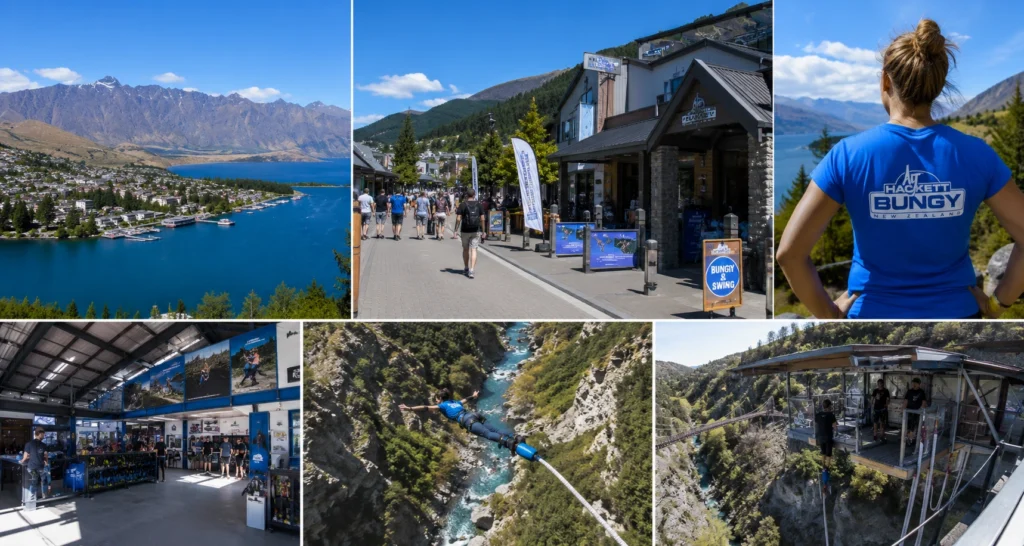
Queenstown does not disappoint as a staging ground for this sort of trip. It’s a small alpine town around a lake surrounded by mountains that look slightly unreal, as if a movie set someone forgot to make is less dramatic.
Every second shopfront on the main street seems to sell either meat pies or adventure bookings, sometimes both, and within an hour of landing, I had already walked past three separate groups of people wearing branded AJ Hackett T-shirts, grinning in that specific way people grin after they’ve just done something their brain told them not to do.
I went to a hostel near the lakefront, dropped off my bag, and walked straight to the Station Building in the corner of Shotover and Camp Streets, the unofficial headquarters of pretty much every bungee operator in the region. That’s where I discovered the first thing that surprised me about Bungee Jumping New Zealand: it’s not one thing. It’s an entire menu, from a 43-metre bridge jump that’s been running since the 1980s to a 134-metre canyon drop that still gives me a little stomach flip just thinking about it. I decided, somewhat impulsively, to do both, plus one more in Auckland before I got home. What was each one like?
Day One: Kawarau Bridge Bungy, New Zealand’s Original Bridge Bungee Jump
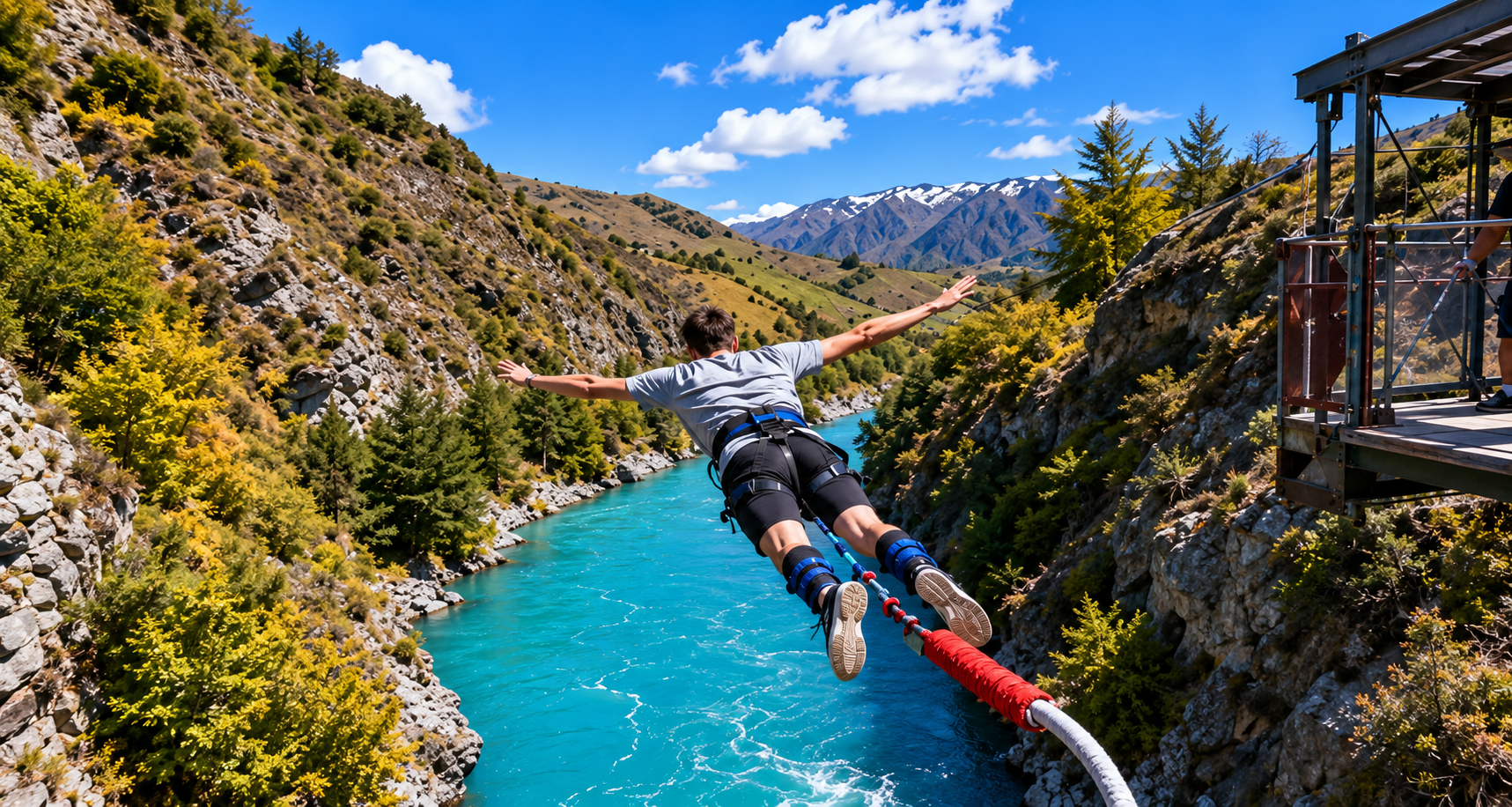
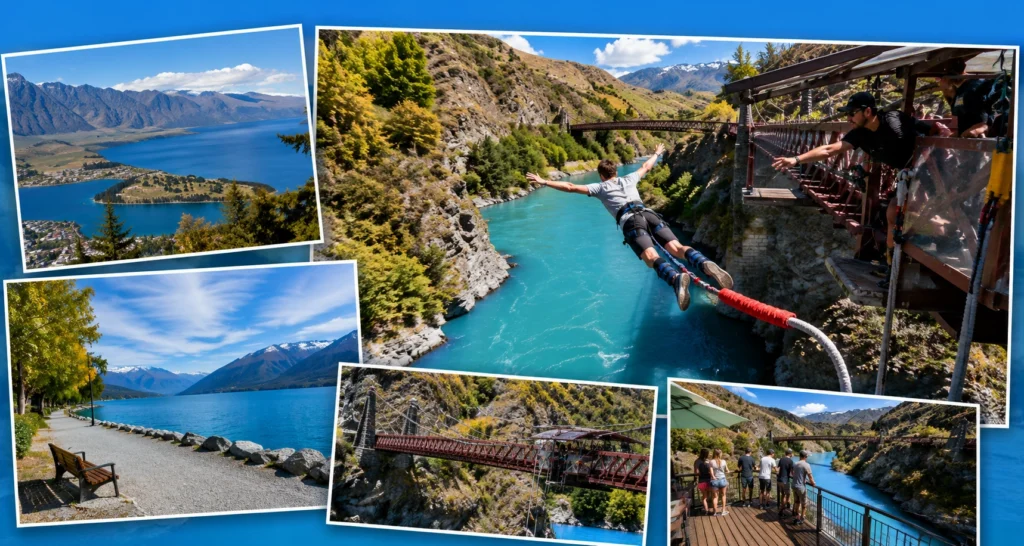
There’s a kind of pressure that comes with doing something historic. The Kawarau Bridge Bungy, about twenty minutes outside central Queenstown, is the site of the world’s first commercial bungy jump, opened in November 1988 by AJ Hackett himself. Before that jump, the sport was just a few experiments and Vanuatu land diving rituals. Adventure tourism as an industry essentially began here, with a 140-year-old suspension bridge over the Kawarau River.
I sat next to a retired schoolteacher from Ontario who was doing this as a sixtieth birthday gift to herself, and a French backpacker who’d apparently already done four other Bungee Jumping New Zealand and around the world and thought this one was “the pilgrimage.” All of us on that bus had a slightly different reason for going, but the destination gave us all one thing in common.
Check-in involves getting weighed, and I mean properly weighed, with the number written in thick marker on the back of your hand for the crew to reference before you jump. There’s no vanity in bungy jumping; the crew needs your exact weight to calibrate the cord, and they will absolutely write it somewhere you can’t hide it. I found that oddly comforting rather than embarrassing. It’s the sort of unglamorous, procedural detail that tells you the operation cares more about physics than appearances.
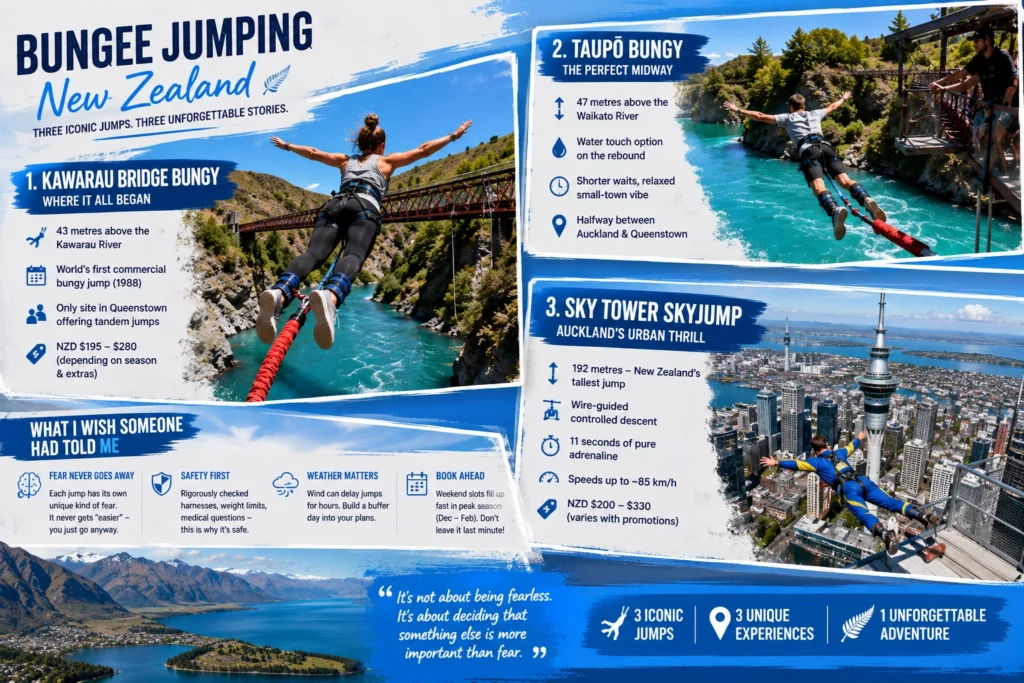
The Kawarau Bridge Bungy is 43 metres above the river, low by New Zealand standards, but high enough to make your legs disagree with your decision the instant you get in and start to walk towards the platform edge. Pricing ranges from NZD $195 to $280 depending on the season and whether you add photos or video, and it’s the only site in Queenstown to be able to jump tandem, which is why many couples and best friends opt for it as their first (and sometimes only) jump.
What nobody really prepared me for is that the walk to the edge is worse than the jump itself. You’re locked up at the ankles and you’re shuffling along on these little undignified hops, and each one of those hops takes ten seconds. The crew is really light, really funny, playing music and just treating the whole thing like a party you’ve been invited to rather than a controlled fall toward a river. One of the guides told me that fear doesn’t go away; you just move anyway. That stayed with me longer than I expected.
When I actually leaned forward off the platform, because that’s how it works, you fall forward, not up, there was a half-second of complete silence where my brain seemed to just… stop processing. Then the river rushed up, the cord caught, and I was hanging upside down over turquoise water with my heart going somewhere it had never been before. You have the choice to dip your fingers, or even your whole head, into the Kawarau River on the rebound. I went for the water touch. Cold, sudden, and somehow the exact right ending to the whole thing.
Afterward, there’s coffee, a T-shirt that says “Kawarau Bridge Bungy” on it, and a video package you will absolutely buy even though you swore you wouldn’t, because you are genuinely unable to recall what your own face looked like mid-fall.
Day Two: The Rest Day Nobody Warns You That You’ll Need
I hadn’t envisioned a rest day, but my body more or less required one. Adrenaline is exhausting in a way that sneaks up on you. I woke up the morning after Kawarau Bridge feeling like I’d run a half marathon, even though all I’d technically done was fall off a bridge and get back on a bus. So instead of booking anything, I let Queenstown do what Queenstown does best: I wandered.
I walked the lakefront path along Lake Wakatipu with a coffee and watched the Southern Alps do their slightly showing-off thing across the water. I ended up at the Kawarau Bungy Centre viewing deck that afternoon, not to jump again, but just to watch. Something is interesting about standing on solid ground, coffee in hand, and seeing other people’s fifteen seconds of terror, not your own.
I spoke to a jump crew member on a break who said that the hardest part of his job was not reassuring nervous jumpers; it was persuading repeat customers that the fear was supposed to still be there. It never goes away, no matter how many times you do it, he said. That changed everything for me. I’d been quietly thinking day two of my own trip would be easier than day one, and having that from someone who does this professionally, all the time, made me stop expecting that.
I also took the chance to read the fine print on the Nevis Bungy before I had to go and do it (134 metres is a very different thing from 43), and I would rather have my eyes open than my adrenaline be the deciding factor. I confirmed my booking, checked the weight and health requirements one more time, and ate an enormous plate of hot chips at a pub near the lake, surrounded by other travellers comparing notes on which jump had rattled them the most. It turned out to be a good, low-key day, not glamorous but just what I needed before I had to go on to the highest bungy in New Zealand the next morning.
Day Three: The Nevis Bungy, New Zealand’ Highest Bungee Jump
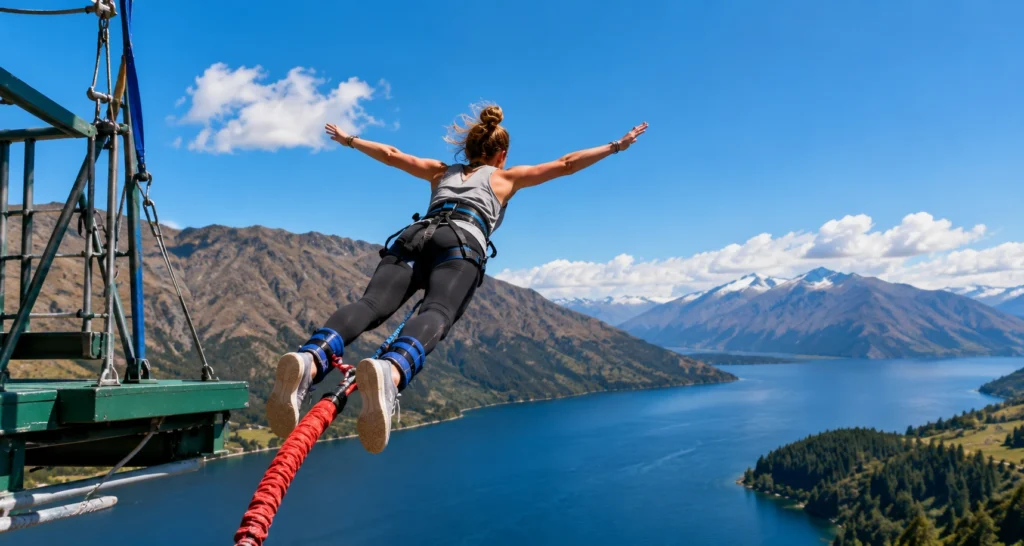
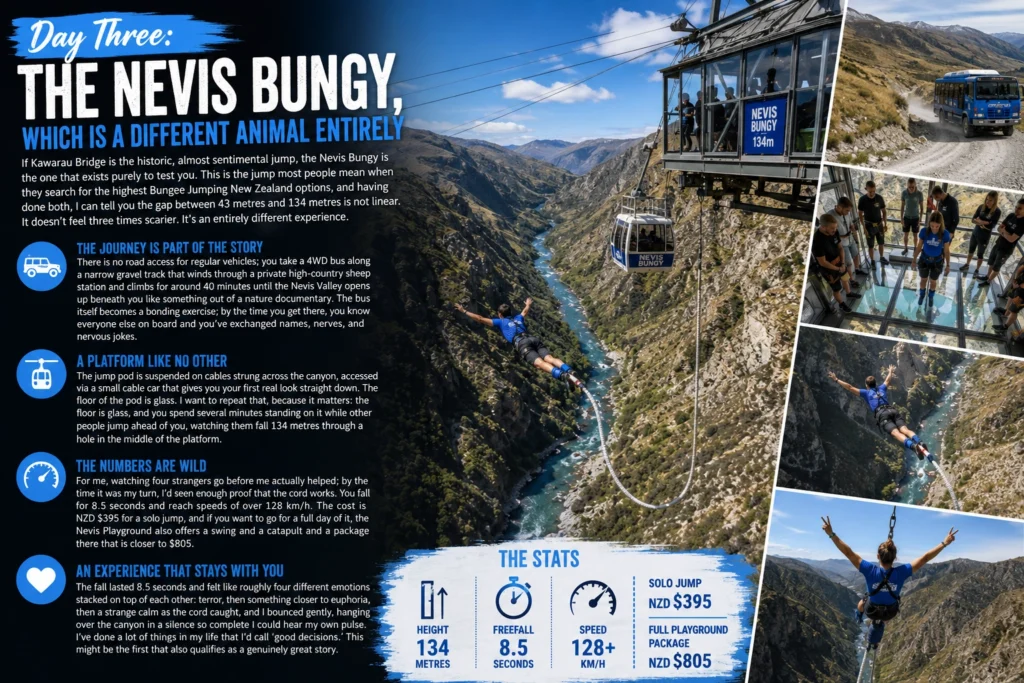
If Kawarau Bridge is the historic, almost sentimental jump, the Nevis Bungy is the one that exists purely to test you. This is the jump most people mean when they search for the highest bungy jump in New Zealand, and having done both, I can tell you the gap between 43 metres and 134 metres is not linear. It doesn’t feel three times scarier. It’s an entirely different experience.
Getting there is part of the story. There is no road access for regular vehicles; you take a 4WD bus along a narrow gravel track that winds through a private high-country sheep station and climbs for around 40 minutes until the Nevis Valley opens up beneath you like something out of a nature documentary. The bus itself becomes a bonding exercise; by the time you get there, you know everyone else on board and you’ve exchanged names, nerves, and nervous jokes.
The jump pod is suspended on cables strung across the canyon, accessed via a small cable car that gives you your first real look straight down. The floor of the pod is glass. I want to repeat that, because it matters: the floor is glass, and you spend several minutes standing on it while other people jump ahead of you, watching them fall 134 metres through a hole in the middle of the platform. This is either the best or the worst pre-jump warm-up imaginable, depending on your temperament.
For me, watching four strangers go before me actually helped; by the time it was my turn, I’d seen enough proof that the cord works. The numbers here are wild: you fall for 8.5 seconds and reach speeds of over 128 km/h. The cost is NZD $395 for a solo jump, and if you want a full day of it, the Nevis Playground also offers a swing and a catapult, with a combined package closer to $805.
I didn’t have the courage or the wallet that day to do the full trilogy, but I heard that several jumpers I met were doing all three back to back, which really sounds like its own kind of insanity, which I respect from a safe distance.
At the actual edge of the Nevis platform, it’s different from Kawarau in a way you can’t really picture until you’ve been in it. At 43 metres, the river below is still a river. At 134 metres, the canyon floor appears abstract, more like a picture of a place where you could live than a place where you would. Your brain struggles to comprehend the scale, which makes the fear feel less specific and more existential. I didn’t think about the fall in that final second. I thought about nothing at all, which I have since decided is the whole point.
The fall lasted 8.5 seconds and felt like roughly four different emotions stacked on top of each other: terror, then something closer to euphoria, then a strange calm as the cord caught, and I bounced gently, hanging over the canyon in a silence so complete I could hear my own pulse. I’ve done a lot of things in my life that I’d call good decisions. This might be the first that also qualifies as a genuinely great story.
A Quieter Alternative: Taupō, for anyone who wishes to get the experience without the extremes
Not everyone wants New Zealand’s tallest, wildest bungy, and that’s perfectly reasonable. From a different trip, my friend picked the Taupō Bungy because it’s around halfway between Auckland and Queenstown, both in terms of distance and intensity. You jump 47 metres above the turquoise Waikato River and dip into the water on the rebound at the same time, so it has almost all the emotional rewards of Kawarau Bridge but feels more like a small-town experience, often with shorter wait times. If you don’t make it as far south as Queenstown, it’s still a solid way to say you’ve done bungee jumping New Zealand.
If you want to round out the adrenaline without adding another bungee jumping new zealand, Queenstown and the wider South Island make it easy. Rotorua’s white-water rafting scratches a similar itch without the height, and the Routeburn Track is a good way to slow back down afterward.
Auckland’s Sky Tower Bungee Jumping New Zealand: SkyJump Prices and What It’s Really Like
When I arrived in Auckland for my flight home, I assumed I’d have “one more bungee jumping new zealand” before heading to the airport. I was wrong, and it’s worth explaining why, because I nearly booked this without understanding what I was actually about to do.
Sky Tower Bungee Jumping New Zealand is the term most people search for when they mean Auckland’s version of this activity, but technically it isn’t a bungy at all. SkyJump is a wire-guided controlled descent. You’re lowered by a cable that controls your speed the whole way down, and instead of the elastic bounce of Kawarau or Nevis, it’s one long, continuous 192-metre fall with a smooth landing and no rebound. I only caught this difference reading the fine print at check-in, and I really liked it. It’s still quite an extraordinary experience, just a different mechanism from the two bungee jumping new zealand I’d already done.
At 192 metres, it’s actually the tallest bungee jumping new zealand, even higher than the Nevis. You can reach speeds of around 85 km/h during an 11-second descent, launching from a platform near the top of the country’s tallest building, right in the middle of Auckland’s central business district. Sky Tower Bungee Jumping New Zealand prices vary more than the South Island bungee jumping new zealand because of promotions; I found listings from around NZD $200 during a sale up to a regular price of $330, so it’s worth checking current pricing before you commit, since operators often run discounts.
The experience itself is so different from the canyon bungee jumping new zealand, and not just because of the mechanics. There isn’t a bus ride through farmland, no cable car over a gorge. You take an elevator. You’re in a full-body flying suit fifty-three floors above traffic, city buses, and pedestrians who have no idea you’re about to drop toward them. It’s an odd, almost surreal contrast: wilderness-grade adrenaline delivered in an entirely urban environment.
I stepped off the platform and for eleven full seconds, Auckland was a blur of glass and pavement rushing upward, and I fell toward SkyCity Plaza, landing with a controlled, soft thud that was almost anticlimactic after the Nevis freefall. Almost. My hands were shaking twenty minutes later.
What I Wish Someone Had Told Me Beforehand
There are a few things that surprised me across all three bungee jumping new zealand, and I think they’re worth passing along directly because they’re the kind of practical detail that doesn’t show up in most marketing copy.
Fear doesn’t fade with repetition
I thought jump two would be easier than jump one, and jump three easier still. It wasn’t. Each site has its own particular flavor of terror: Kawarau’s is commitment, Nevis’ is scale, and Sky Tower’s is the strange vertigo of being surrounded by a city rather than nature. Don’t go in expecting to build immunity. You won’t.
The safety process is stricter than the marketing photos suggest
All the operators I worked with, under the AJ Hackett Bungy banner that runs most commercial sites around Queenstown, Taupō, and Auckland, checked harnesses before every bungee jumping new zealand, asked medical questions where relevant, and enforced weight limits for everyone.
The minimum age at most sites is 10 years old, with parental consent required for younger teens, and body-weight limits range from about 35kg up to somewhere between 127kg and 235kg, depending on the bungee jumping new zealand and whether you’re jumping tandem. Pregnant travelers and people with certain heart, spine, or neurological conditions aren’t allowed to jump, and staff ask directly rather than assume. None of this felt bureaucratic; it felt like the reason the sport has survived four decades with the safety record it has.
Weather can rearrange your schedule
My Nevis jump was delayed for two hours because of the wind, and I met other travelers whose Sky Tower slot was postponed for the same reason. If you have a specific jump on your bucket list, build in a buffer day rather than booking it for your last morning before a flight.
Book ahead, especially in peak season
Weekend slots at the most popular Queenstown sites fill up quickly during the December-to-February peak season. I booked Kawarau Bridge only a day ahead and got lucky with a cancellation; I’d reserved the Nevis almost a week out and was glad I did.
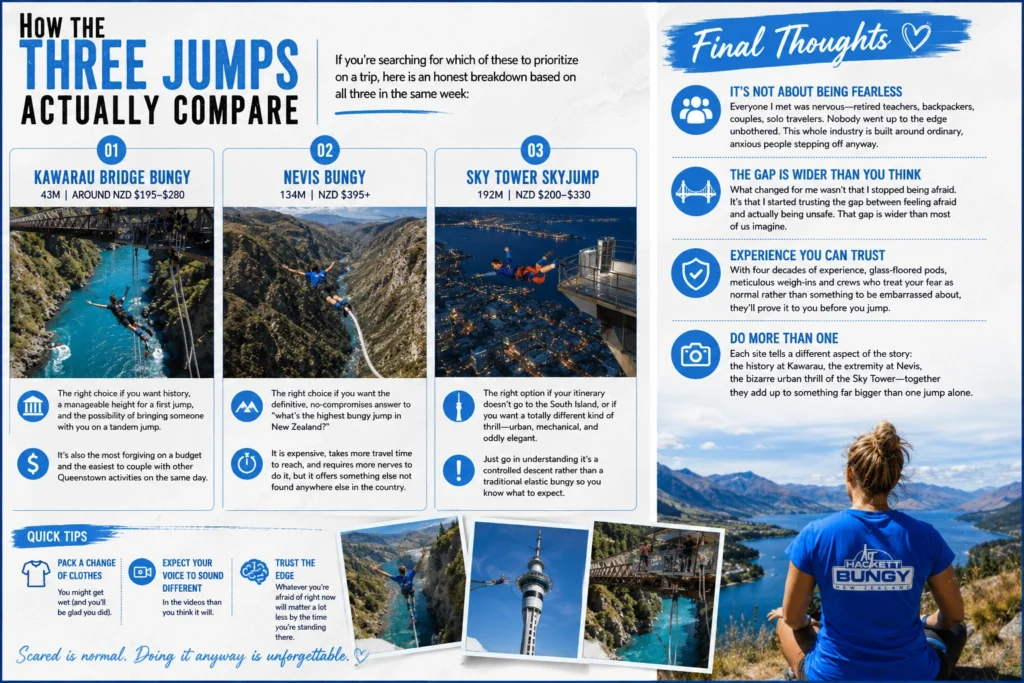
How the Three Jumps Actually Compare
If you’re trying to decide which of these to prioritize on a trip, here’s an honest breakdown based on doing all three in the same week:
Kawarau Bridge Bungy — best for first-timers (43m, NZD $195–$280)
This is the right choice if you want history, a manageable height for a first bungee jumping new zealand, and the option to bring someone along on a tandem jump. It’s also the most forgiving on a budget and the easiest to pair with other Queenstown activities on the same day.
Nevis Bungy — New Zealand’s highest bungee jump (134m, NZD $395+)
This is the right choice if you want the definitive, no-compromise answer to “what’s the highest bungy jump in New Zealand?” It’s expensive, takes more travel time to reach, and asks more of your nerves, but it offers something not found anywhere else in the country.
Sky Tower SkyJump — best if Auckland is as far as you’re going (192m, NZD $200–$330)
This is the right option if your itinerary doesn’t reach the South Island, or if you want a completely different kind of thrill: urban, mechanical, and oddly elegant compared to the raw canyon bungee jumping new zealand. Just go in understanding it’s a controlled descent rather than a traditional elastic bungy, so you know what to expect.
Final Thoughts
I’d argue a lot of people who are considering bungee jumping New Zealand are stuck on the wrong question. They’re wondering whether they’re “the type of person” who does this kind of thing, as if fearlessness should be a prerequisite. And every single person I knew on those shuttle buses, the retired teacher, the French backpacker, the couple celebrating an anniversary, the solo traveler two years into a career break, was nervous. Genuinely, visibly nervous. Nobody walked up to the edge unbothered. The whole industry has been built, successfully, around ordinary anxious people finding a way to step off anyway.
What changed for me, somewhere between the Kawarau Bridge and the Nevis Canyon, wasn’t that I stopped being afraid. It’s that I started trusting the gap between feeling afraid and actually being unsafe. That gap is wider than most of us imagine, and New Zealand’s bungy operators, with four decades of experience, glass-floored pods, meticulous weigh-ins, and crews who treat your fear as normal rather than something to be embarrassed about, try to prove that to you before you jump.
If you’re planning a trip around this, my honest advice is to do more than one. Each site tells a different part of the story: the history at Kawarau, the extremity at Nevis, the bizarre urban thrill of the Sky Tower, and together they add up to something bigger than any single bungee jumping New Zealand could give you alone. If you’d rather end the trip on solid ground, a hot air balloon ride gives you a similarly huge view with none of the falling.
Pack a change of clothes for the water touch, expect your voice to sound different in the videos than you think it will, and trust that whatever you’re afraid of right now will matter a lot less by the time you’re standing at the edge, looking down, and deciding to lean forward anyway.