

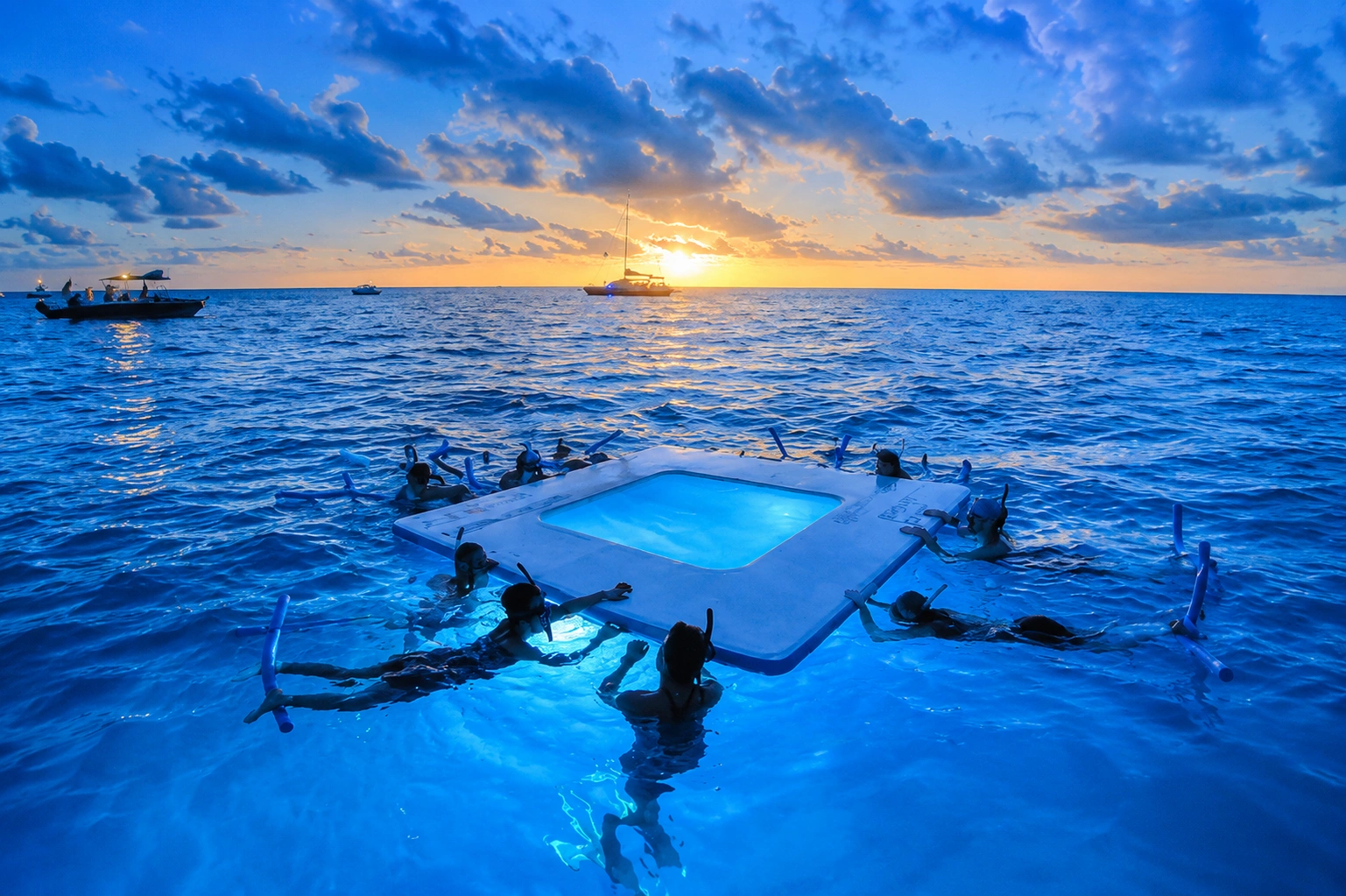
Floating in warm, dark water off the Kona coast, you watch a shape the size of a small car glide up from the black and roll straight beneath your feet, mouth wide, wingtips almost brushing your fins. That single moment is why the Manta Ray Night Snorkel sits near the top of so many Hawaii bucket lists. It is not a staged show. These are wild reef mantas feeding on plankton drawn to a ring of lights, and the encounter is close, quiet, and genuinely humbling.
The Big Island of Hawaii is one of the only places on Earth where you can count on seeing giant manta rays up close after dark, night after night, all year round. The reef mantas here are year-round residents rather than seasonal visitors, and the top viewing sites report sightings on roughly 80 to 90 percent of Manta Ray Night Snorkel. That reliability, paired with calm, accessible water, is what turned a handful of dive lights in 1999 into a world-famous wildlife encounter.
This guide is built to answer every question you have before you book. You will learn exactly what the experience involves, why Kona works so well, where the best sites are, when to go, how snorkeling compares with diving, what a fair 2026 price looks like, and how to swim responsibly so these animals stay healthy. It is beginner-friendly and family-friendly, and safety runs through every section, because a good Manta Ray Night Snorkel on the water starts with knowing what you are signing up for.
What is a manta ray night snorkel?
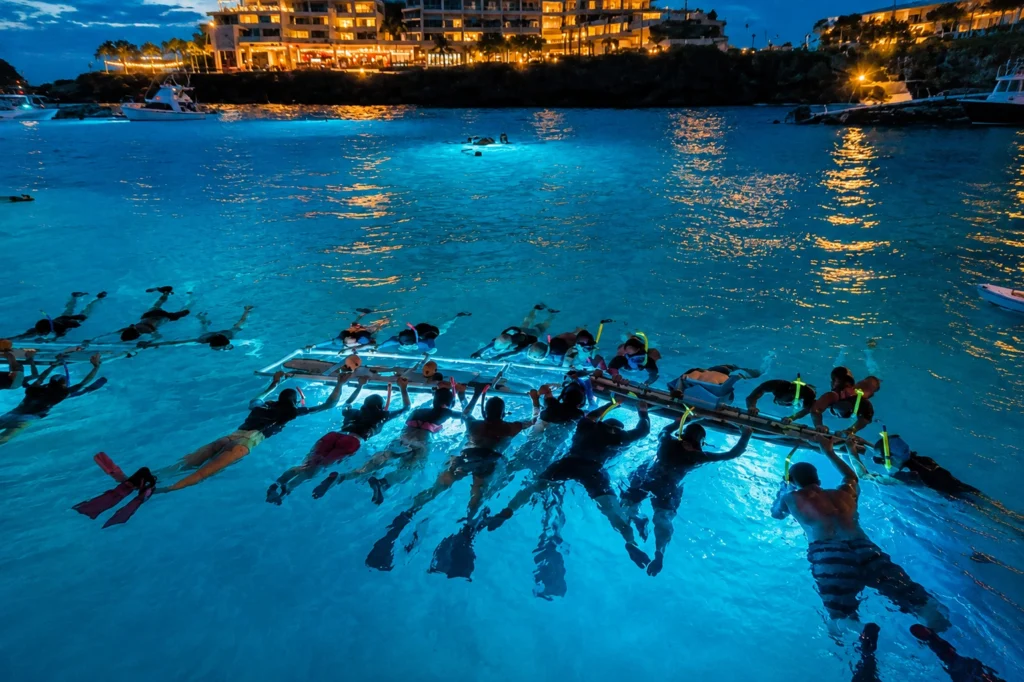
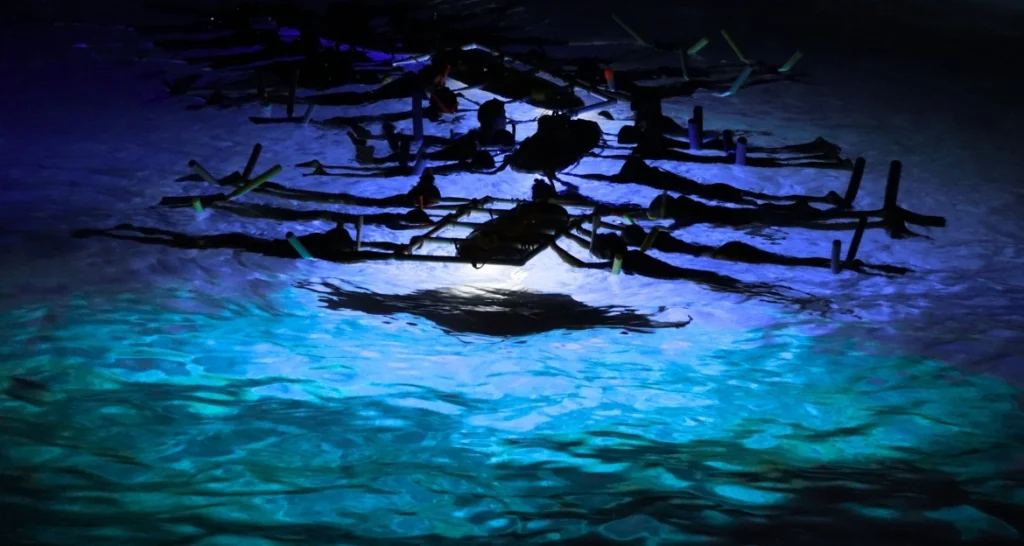
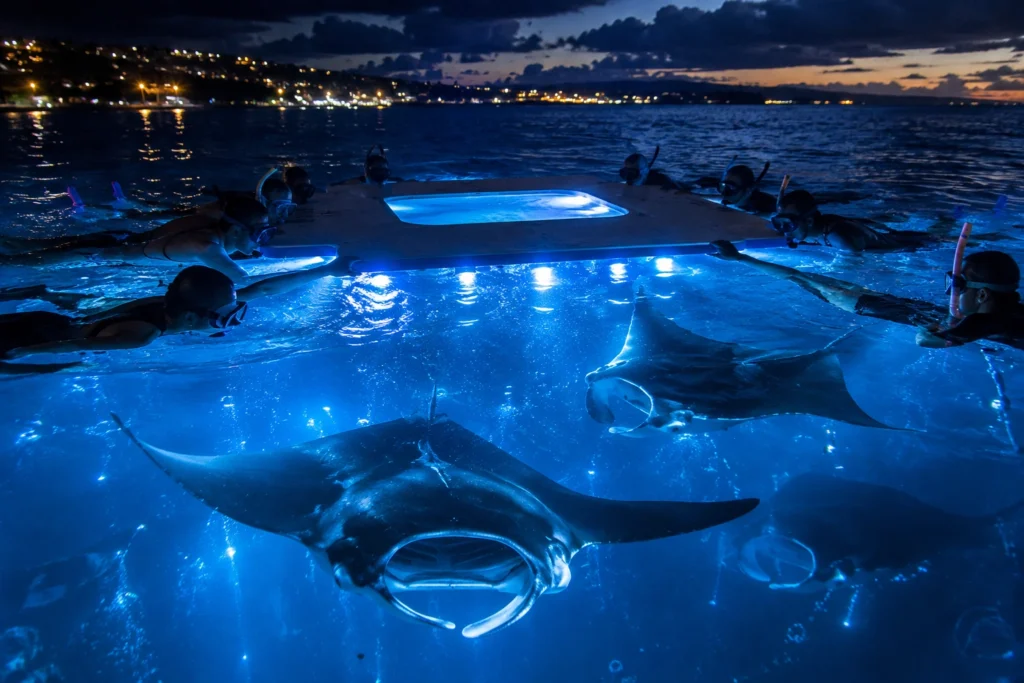
A Manta Ray Night Snorkel is an after-dark ocean tour where you float at the surface, usually holding a lighted flotation board, while giant manta rays feed on plankton just below you. A boat takes you a short way offshore to a known feeding site. Guides lower bright lights, the lights gather clouds of plankton, and the plankton draws in mantas that swoop, bank, and barrel-roll through the glow to feed. You are a still observer looking down, not a swimmer chasing anything.
What makes it unique
Most wildlife tours ask you to spot animals at a distance. This one flips that. The mantas come to the light, and because the light sits right under the Manta Ray Night Snorkel, the animals feed within arm’s reach without ever being fed or touched by people. You hold position on a float, keep your body still, and let a 12-to-16-foot animal choose its own path through the water column. Few encounters put you this close to a large wild creature so calmly.
Why do manta rays come close?
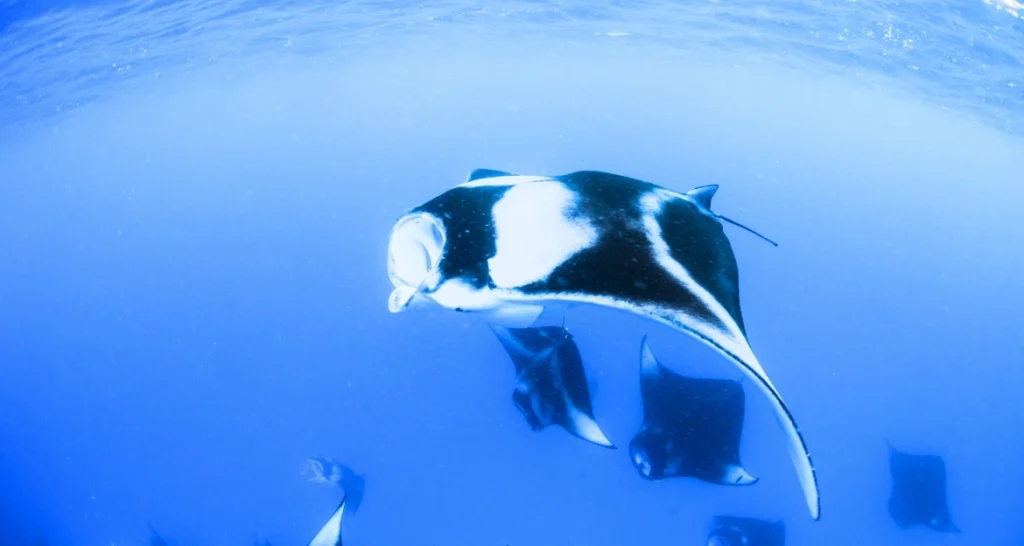
Reef mantas are filter feeders. They swim with their mouths open, funneling seawater over their gills and straining out zooplankton. Artificial lights concentrate that plankton into a dense, easy meal, so the mantas linger and loop back through the beam. They have no interest in people. Any contact is incidental to their feeding, which is one reason the encounter feels so unbothered on both sides.
Why Kona is world-famous
The Kona coast combines three things that rarely line up elsewhere: a resident manta population, sheltered water on the island’s dry leeward side, and a couple of shallow, sandy feeding sites that guides can reach in minutes. Add more than two decades of local operators refining how the tours run, and you get a Manta Ray Night Snorkel that is both dependable and well managed. It is the reason this stretch of coast is regularly ranked among the best marine wildlife experiences in the world.
Why Kona is the best place in the world for this experience
Plenty of destinations have Manta Ray Night Snorkel. Very few can promise a close encounter with almost every Manta Ray Night Snorkel, from the surface, within a short boat ride of your hotel. Kona can, and the reasons are part biology and part geography.
A short history of the Kona manta encounter
The nightly gathering started, in part, by accident. Resort lights along the shore spilled into the water, plankton bloomed in the glow, and mantas learned there was an easy meal waiting after dark. When one hotel’s lights went dark in 1999, and the mantas moved off, a local diver went looking for them, dropped lights into a sandy chute at Garden Eel Cove one calm August Manta Ray Night Snorkel, and had six mantas arrive almost immediately. That improvised “campfire” of lights on the sand became the template every operator still uses today.
| Year | Milestone |
|---|---|
| 1970s–80s | Mantas begin feeding under resort lights along the Keauhou shoreline. |
| 1990s | “Manta Village” becomes the established Manta Ray Night Snorkel-viewing site off Keauhou Bay. |
| 1999 | Lights placed at Garden Eel Cove open a second reliable site, “Manta Heaven.” |
| 2000s–2010s | Operators adopt lighted floats, mooring balls, and passive-viewing etiquette. |
| 2020s | Manta-SAFE style standards and ID cataloguing (290+ rays) shape modern tours. |
Plankton and underwater lights
The whole spectacle runs on plankton. Bright lights, whether fixed on the seabed or hanging from a Manta Ray Night Snorkel float, concentrate zooplankton into a glowing column. Mantas feed most efficiently where food is dense, so they orbit the light, banking and somersaulting to keep their mouths in the thick of it. No lights, no plankton column, no reliable show, which is why guides, not chance, make the encounter work.
The migration myth
A common assumption is that you have to catch a “manta season.” You don’t. Kona’s reef mantas are local residents that stay in the area year-round rather than migrating through. Individual animals are recognised and named from the unique spot patterns on their bellies, and the same rays turn up across many seasons. That resident population is exactly why a Manta Ray Night Snorkel here is a year-round activity instead of a seasonal gamble.
Why are sighting rates so high?
Because the food source is created on demand and the mantas live nearby, success rates are unusually high. The two main sites report mantas on roughly 80 to 90 percent of Manta Ray Night Snorkel, and the busiest evenings can bring dozens of animals to a single light. Reputable operators are transparent about this: it is a wild encounter, so no honest guide guarantees a sighting, but the odds are strongly in your favour.
| Metric | Kona manta encounter |
|---|---|
| Typical Manta Ray Night Snorkel sighting rate | ~80–90% at the main sites |
| Identified rays in the local population | 290+ catalogued individuals |
| Typical wingspan of reef mantas | ~10–16 ft (records up to ~18 ft) |
| Estimated visitors snorkeling with mantas / year | ~80,000 |
| Season for best encounters | Year-round; calmest April–October |
How does a manta ray night snorkel work?
The tour follows the same rhythm with almost every operator. Knowing the flow ahead of time takes the nerves out of it, especially if this is your first time in the ocean after dark.
| Step | What happens |
|---|---|
| 1. Book & check in | Reserve ahead (tours fill days out). Arrive at the harbor at your check-in time, not early. |
| 2. Briefing on the dock | Guides cover safety, etiquette, and gear before you leave, plus swim-ability requirements. |
| 3. Sunset cruise out | A 5–45-minute ride to the site, depending on the harbor and boat, often with a Kona sunset. |
| 4. Gear up | Mask, snorkel, fins, and a wetsuit top; you clip onto a lighted flotation board. |
| 5. Enter the water | You slip in and hold the float in a line, face down, staying calm and still. |
| 6. The show | Lights gather plankton; mantas rise into the beam and feed inches below you. |
| 7. Return | After 30–45 minutes, you climb back aboard for a warm layer and the ride home. |
Booking and departure
Book as soon as your dates are set; the best small-boat trips sell out early, particularly in peak months. You will make your own way to the departure harbor, most commonly Keauhou Bay for Manta Village or Honokohau Harbor for Garden Eel Cove. Follow the meeting instructions closely, because some operators use two departure points.
The briefing and getting in
Before anyone gets wet, guides run a safety briefing covering how to hold the float, how to breathe on a Manta Ray Night Snorkel, the no-touch rule, and what to do if you feel uneasy. Once at the mooring, you enter the water and take your place along the board. Everything is designed around floating and watching, not swimming laps, so it stays low-effort even for beginners.
Watching the mantas feed
This is the part people replay for years. As plankton thickens in the light, the first white belly turns up out of the dark, and the mantas begin their feeding loops, sometimes chaining barrel rolls directly beneath the floats. On a strong Manta Ray Night Snorkel, you can lose count. Then it is a short trip back to the harbor, usually with a hot drink and a dry layer waiting.
Best Big Island locations for a night snorkel with mantas
Nearly every Big Island Manta Ray Night Snorkel visits one of two sites off the Kona coast, with a third feeding area further north. Site choice matters less than first-timers expect, because good guides pick the site that is safest and most productive for that night’s conditions.
Manta Village (off Keauhou Bay)
The original and most consistent site, Manta Village, sits just offshore of Keauhou Bay, in front of the resort long known as the Sheraton and now the OUTRIGGER Kona Resort & Spa. Water is shallow (around 30–40 ft), often calm and sheltered, and the boat ride is short from Keauhou Bay. It has the highest historical sighting rate, which makes it the go-to for beginners and families.
Manta Heaven / Garden Eel Cove
About eight miles north, off Keahole Point near the Kona International Airport, lies Manta Heaven, called Garden Eel Cove by day. It is reached from Honokohau Harbor, sits in slightly deeper, more open water, and can handle stronger currents. Sightings run a little lower than in Manta Village but are still high, and busy Manta Ray Night Snorkel here can produce big numbers of animals.
The Kona Coast and northern sites
A third, less-used feeding area sits further north near Kawaihae Harbor. It sees far fewer boats, so it is quieter, though tours there are less frequent. Wherever you launch, remember that mooring balls, not anchors, are used to keep gear off the living reef.
| Location | Visibility / conditions | Crowd | Best for | Sighting rate |
|---|---|---|---|---|
| Manta Village (Keauhou Bay) | Shallow, calm, sheltered | Busier | First-timers & families | ~90%+ |
| Manta Heaven / Garden Eel Cove | Deeper, more open, some current | Moderate | Bigger manta numbers | ~80–90% |
| Northern Kona (Kawaihae area) | Variable, open water | Quietest | Fewer boats, more space | Lower / fewer tours |
Best time of year for a manta ray night snorkel
Because the mantas are residents, there is no month you must catch and no month you must avoid. That said, ocean conditions do shift through the year, and calmer water means an easier, more comfortable swim and a clearer view.
Season by season
April through October generally brings the calmest seas, warmest water, and the most settled conditions on the leeward Kona coast, which is why many guides point to this window for the smoothest trips. Winter (roughly November to March) still delivers excellent encounters and overlaps with humpback whale season, though larger swells occasionally move or cancel a tour. The plankton-and-light mechanism works the same all year.
Weather, swell, and the moon
Night-to-night ocean conditions matter more than the calendar. Big south or west swells can push operators to switch sites or reschedule for safety. A dark, moonless Manta Ray Night Snorkel can also help, since there is less ambient light competing with the boards, though operators run successfully through all moon phases. If your dates are tight, build in a backup evening in case the weather bumps your trip.
| Month range | Sea conditions | Water feel | Notes |
|---|---|---|---|
| Apr–Jun | Calm, settling | Warming | Reliable, comfortable swims |
| Jul–Oct | Calmest, minimal swell | Warmest | Peak comfort for beginners |
| Nov–Jan | More variable | Cooler | Whale season overlap; wetsuit welcome |
| Feb–Mar | Occasional larger swell | Cooler | Great encounters; watch for reschedules |
Manta ray night snorkeling vs manta ray scuba diving
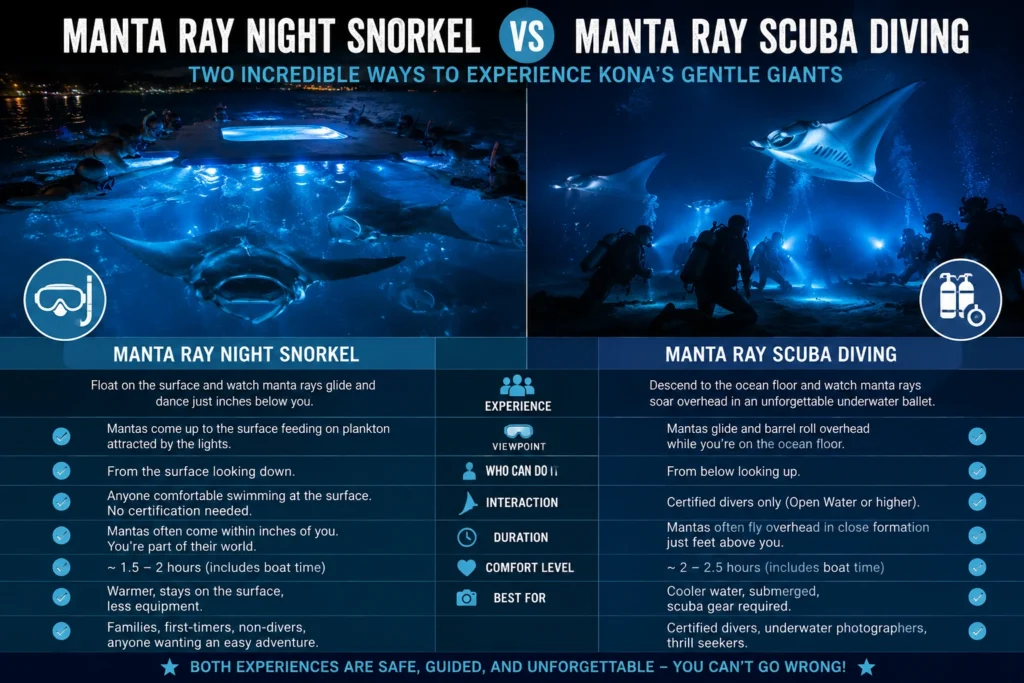
The same mantas, the same lights, two very different vantage points. Snorkeling keeps you at the surface looking down; Manta Ray Scuba Diving puts certified divers on the seabed looking up. Neither is “better” outright, so the right choice comes down to your experience, comfort, and who you are travelling with.
| Feature | Snorkel | Scuba dive |
|---|---|---|
| Your position | Surface, holding a lighted float | Seated on the sand at ~30–40 ft |
| Certification | None needed | Open-water certification required |
| Difficulty | Low; must swim & float | Moderate; dive skills needed |
| Kids / families | Yes (age & swim limits apply) | No (cert & age limits) |
| Vantage | Looking down at feeding mantas | Looking up as mantas pass overhead |
| Comfort | Warmer, easier exit | Cooler, longer bottom time |
| Typical price (2026) | ~$90–170 | ~$150–230+ |
| Best for | First-timers, most travellers | Certified divers wanting the campfire view |
Who should choose which
For the large majority of visitors, snorkeling is the sweet spot: no certification, minimal effort, a warm and easy experience, and a superb top-down view of the feeding loops. Choose Manta Ray Scuba Diving only if you are already certified and want the classic “underwater campfire” perspective from the sand, with the mantas silhouetted above you for 45 to 60 minutes. A common regret is booking the dive when the relaxed snorkel is what you actually wanted. If certified diving elsewhere is on your list too, our guide to the best scuba diving destinations for beginners is a good place to start planning.
Choosing the best Kona tour operator
With dozens of operators, the Best Manta Ray Night Snorkel Kona for you depends on group size, boat type, safety culture, and how the company treats the animals. When you line up different Kona snorkel trips side by side, price is only one piece of the value.
Small boats vs large boats
Fast rigid-hull inflatable boats (RHIBs) reach the sites quickly and carry fewer people, which usually means a calmer, more personal Manta Ray Night Snorkel. Large catamarans are steadier and more comfortable on the ride, but often load 20 to 50 guests, so the water can feel crowded. Some premium outfits cap trips at just six guests per boat.
Tour styles to compare
- Small-group & luxury: 6–12 guests, more space at the light board, higher price, more personal guiding.
- Family tours: patient guides, ride-along seats for non-swimmers, and gear sized for kids.
- Private charters: your own boat and schedule, ideal for photographers or special occasions.
- Budget & large-boat: lowest per-person cost, bigger groups, still a great sighting if the operator is reputable.
- Eco-certified: Manta-SAFE style operators that follow strict passive-viewing and reef-safe standards.
Green flags and red flags
Look for lifeguard- or safety-certified guides, small-to-moderate group sizes, clear cancellation and “re-ride” policies (a free repeat trip if no mantas show), mooring rather than anchoring, and explicit no-touch, reef-safe messaging. Be wary of operators that promise guaranteed sightings, cram in huge groups, or are vague about safety and swim requirements. When you weigh Big Island Snorkel Tours against each other, the responsible, well-reviewed operators consistently win on the details.
What you’ll experience during the tour
From the dock to the drive home, here is the full arc of the evening so nothing catches you off guard.
The ride out and the sunset
You gear up mentally on the cruise out, often with a classic Kona sunset over the water. Depending on your harbor, the ride is anywhere from a few minutes to around 45. Take motion-sickness medicine beforehand if you are prone to it, because the return leg is in the dark.
Into the water and the first sighting
You slip in, find your spot on the lighted board, and settle into stillness. The first minutes can feel surreal, warm black water, a glowing column of plankton, the muffled sound of your own breathing. Then a white shape resolves out of the dark, banks on a wingtip, and the encounter begins.
Barrel rolls and close passes
Feeding mantas often chain backward somersaults, called barrel rolls, to keep their mouths in the densest plankton. Because that plankton is right under the floats, the animals loop up close, sometimes so close you feel the push of water as a wing sweeps past. You stay put and let them work.
Expert tips for the water
- Breathe slowly and keep your body flat and relaxed; tension makes floating harder.
- Keep hands tucked at the float, never reaching toward an animal.
- Let your fins hang; kicking stirs sand and can startle mantas.
- Follow the guide’s positioning so the whole group gets clear views.
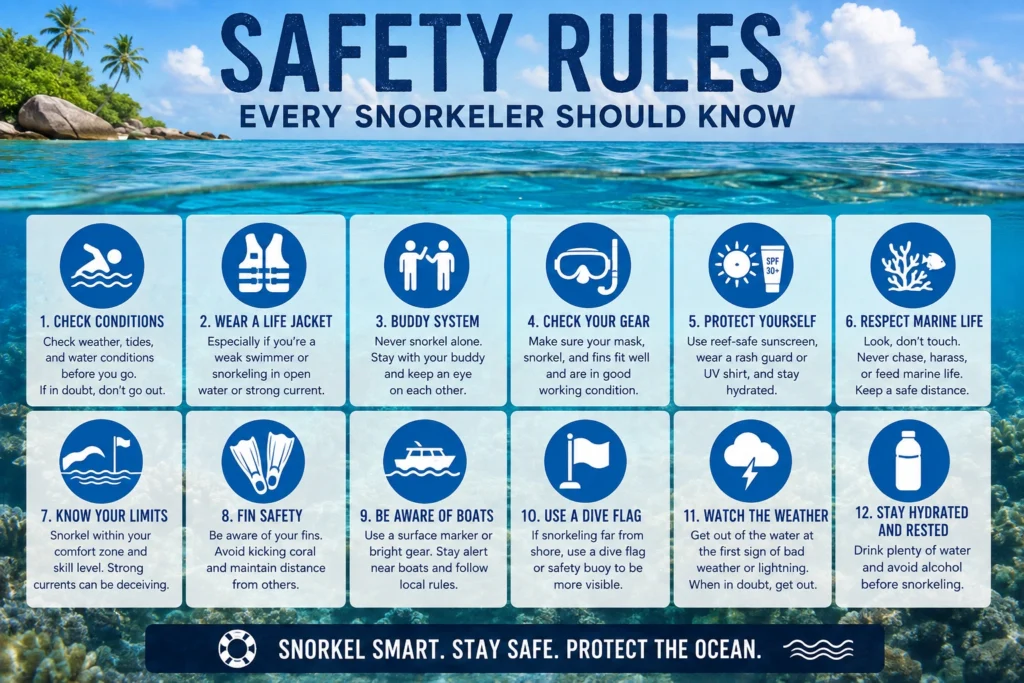
Safety rules every snorkeler should know
A Manta Ray Night Snorkel is a very structured, low-risk activity when you follow the guide, but it is still open ocean at night. These rules keep both you and the mantas safe.
The core rules
- Never touch the mantas. Their skin carries a protective mucus layer; touching it strips that defence and can lead to infection.
- Stay calm and still. Passive observation is safer for you and less disruptive for the animals.
- Use the flotation device. The lighted board keeps you buoyant so you can relax and just watch.
- Wear reef-safe sunscreen only, applied well before the tour, to protect the reef and the plankton chain.
- Listen to your guide. They position the group, read the conditions, and call the shots.
Are mantas dangerous?
No. Reef mantas have no stinger and no barb, unlike their stingray relatives, and they eat only plankton. They are curious at most and pose no threat to snorkelers. The real hazards are ordinary ocean ones: chop, chill, and fatigue, all managed by staying on the float and following instructions.
Medical and ability considerations
You must be able to swim and tread water and climb the boat ladder unassisted; most operators require genuine swimming ability, and some set a minimum age for unaccompanied guests. Tell the crew about motion sickness, pregnancy, heart or breathing conditions, or limited mobility before booking, and ask about a ride-along seat if you would rather stay aboard.
What to pack for the trip
Operators supply the mask, snorkel, fins, and usually a wetsuit top, so your job is to stay comfortable and warm and keep valuables dry.
| Item | Why do you need it |
|---|---|
| Swimsuit (worn under clothes) | Change before the dock; you’ll get in quickly |
| Towel + warm dry layer | The Manta Ray Night Snorkel ride back is cool once you’re wet |
| Reef-safe sunscreen | Protects reef and plankton; apply early, not at the site |
| Motion-sickness medication | Take before departure if you’re prone to it |
| Waterproof / dry bag | Keeps phone, keys, and dry clothes safe on board |
| GoPro or waterproof camera | Optional: a wrist mount frees your hands for the float |
| Water & a light snack | Eat lightly beforehand so you’re neither full nor hungry |
Marine conservation and responsible tourism
This encounter only exists because the community protects it. With tens of thousands of people in the water each year, how you behave on a single tour genuinely adds up.
Why is touching so harmful
A manta’s mucus coating works like part of its immune system. A single careless touch can wipe away that layer and open the animal to bacterial infection, which is why passive, hands-off viewing is non-negotiable. The same logic drives the no-chase, no-feed rules.
Research, ID, and protection
Local researchers photograph and catalogue individual mantas by their unique belly spots, tracking a population of more than 290 identified rays over many years. That long-term data underpins the site protections and etiquette every good operator follows.
How can you help
- Book a Manta-SAFE-style, eco-certified operator that moors instead of anchoring.
- Wear only reef-safe sunscreen and skip it entirely if you can cover up instead.
- Keep strictly to passive viewing, no touching, chasing, or crowding.
- Support ID and research programs, and spread the etiquette to first-timers in your group.
Pricing guide
For a 2026 Manta Ray Night Snorkel in Kona, budget roughly $90 to $170 per adult, with most standard tours landing between $90 and $130. Children often get around a 20 percent discount. Prices tend to rise in the December-to-April window that overlaps whale season and dip slightly in summer.
| Tour type | Typical 2026 price (adult) | What’s usually included |
|---|---|---|
| Budget / large boat | ~$90–110 | Big group, all snorkel gear, wetsuit top |
| Standard small-group | ~$110–135 | ≤12–18 guests, gear, lighted boards, guides |
| Premium / luxury (≤6) | ~$135–170 | Tiny group, personal guiding, extra comfort |
| Snorkel + dive charter | ~$200–230+ | Combined trips, more time on the water |
| Private charter | Quote on request | Your own boat, schedule and pace |
Cheaper is not automatically worse. When you compare Kona snorkel trips, factor in group size, harbor location, re-ride policy, and cancellation terms, since those change the real value far more than a $20 difference on the sticker price.
Photography tips
Low light and moving subjects make manta photography tricky, but a few habits get you keepers without disturbing the animals.
Gear and settings
- A GoPro or compact waterproof camera on a wrist strap is ideal; it keeps both hands near the float.
- Shoot video rather than stills; the motion is the magic, and grab frames later.
- Turn off any personal strobe or flash aimed at the mantas; rely on the tour’s boards for light.
Technique and etiquette
- Let the mantas come into frame; never move toward them for a shot.
- Hold the camera still and steady; the animals supply the movement.
- Minimise gear in the water column and keep your body position stable so you don’t block others.
Family & first-time visitor guide
A Manta Ray Night Snorkel can absolutely be a family outing, with a few honest checks first.
Can kids join?
Yes, on most tours, provided a child can swim confidently and is comfortable in open water, operators set minimum ages and require an adult. Nervous kids do better on small-group boats with patient guides and calm conditions at Manta Village.
Non-swimmers, seniors, and mobility
Non-swimmers can often buy a ride-along seat and enjoy the sunset and the show from the boat. Seniors and travellers with limited mobility should discuss boarding, ladder access, and the flotation setup with the operator in advance. If you would rather stay completely dry, a glass-bottom boat tour is another good way to see marine life up close without getting in the water.
Pregnancy and motion sickness
If you are pregnant or unsure about a medical condition, check with your doctor and the operator before booking. Anyone prone to seasickness should take medication before departure, since the return leg is after dark.
Common mistakes to avoid
- Touching or reaching for the mantas breaks the golden rule and risks their health.
- Kicking or swimming around; excess movement stirs sand and disrupts the group.
- Skipping the wetsuit top and getting cold cuts your time enjoying the water.
- Wearing ordinary sunscreen instead of reef-safe sunscreen harms the very ecosystem you came to see.
- Choosing an operator on price alone and ending up on an overcrowded boat.
- Waiting until the last minute to book, when the best small-group trips are already full.
Final thoughts
Few travel experiences deliver on their hype the way this one does. A Manta Ray Night Snorkel off Kona puts you, calm and floating, within a few feet of giant wild animals feeding in a column of light, and it does so reliably, safely, and without ever asking you to be an expert swimmer or a certified diver. That combination of wonder and accessibility is what keeps the Big Island at the very top of the manta-viewing world.
If you take three things from this guide, make them these: the mantas are here year-round, so any month can be magic; the site matters less than a good, responsible operator that moors, caps its group size, and enforces passive, no-touch viewing; and the health of this encounter depends on every visitor treating it as a privilege, not a petting zoo. Choose an eco-minded crew, wear reef-safe sunscreen, keep your hands to yourself, and you protect the experience for the travellers behind you.
Dates fill fast, especially in peak season, so book your Manta Ray Night Snorkel as soon as your Kona plans are set. Reserve early, pick a reputable operator, pack a warm layer and a waterproof camera, and get ready for the kind of Manta Ray Night Snorkel you will still be describing to people years from now.
FAQs
1. Is the Manta Ray Night Snorkel safe for beginners?
Ans: Yes. It is a highly structured activity built around floating on a lighted board rather than swimming, with a full safety briefing, guide supervision, and flotation support. You do need to swim and tread water confidently, but no prior snorkeling expertise is required.
2. Can children join a Big Island Manta Ray Night Snorkel?
Ans: Usually, yes, if the child can swim well and is comfortable in open water. Operators set minimum ages and require an accompanying adult. Non-swimming kids can often take a ride-along seat and watch from the boat.
3. What’s the best time of year for a Manta Ray Night Snorkel?
Ans: Any time. Kona’s mantas are year-round residents, so sightings stay high all year. April to October tends to bring the calmest, warmest, most comfortable conditions, while winter overlaps with whale season but can see occasional swell-related reschedules.
4. What’s the difference between snorkeling and Manta Ray Scuba Diving?
Ans: Snorkelers stay at the surface, holding a lighted float and looking down, with no certification needed. Manta Ray Scuba Diving puts certified divers on the seabed at about 30–40 feet, looking up as mantas pass overhead. Snorkeling suits most travellers and families; diving suits certified divers wanting the classic campfire view.
5. Are manta rays dangerous?
Ans: No. Reef mantas have no stingers or barb and feed only on plankton. They are gentle and curious at most, and they pose no threat to snorkelers who keep to passive, hands-off viewing.
6. Why do manta rays come near the lights?
Ans: The lights attract plankton, the manta’s main food. As plankton concentrates in the glow, the mantas loop and barrel-roll through the beam to feed, which is what brings them so close to snorkelers on the surface.
7. How much does the Best Manta Ray Night Snorkel Kona cost?
Ans: In 2026, expect roughly $90–170 per adult, with most standard tours between $90 and $130 and premium small-group trips at the higher end. Kids often get about 20% off, and combined snorkel-and-dive charters run higher.